










Gandhar adds 240,000 kl as Indian plants reach 82% utilisation
Key highlights
- Gandhar reported consolidated installed capacity of 838,637 kilolitres, following a management-stated 240,000-kilolitre increase from 598,000 kilolitres.
- Gandhar's Indian plants had 602,713 kilolitres of capacity and were operating at 82% utilisation on two shifts.
- Gandhar reported about 16% year-on-year standalone volume growth in H1 FY '27, while Process and Insulating Oil volume rose 23%.
- Gandhar's consolidated borrowings fell to about Rs 85 crore at September 30, 2026, from Rs 168 crore in March 2026.
powered by IRIS
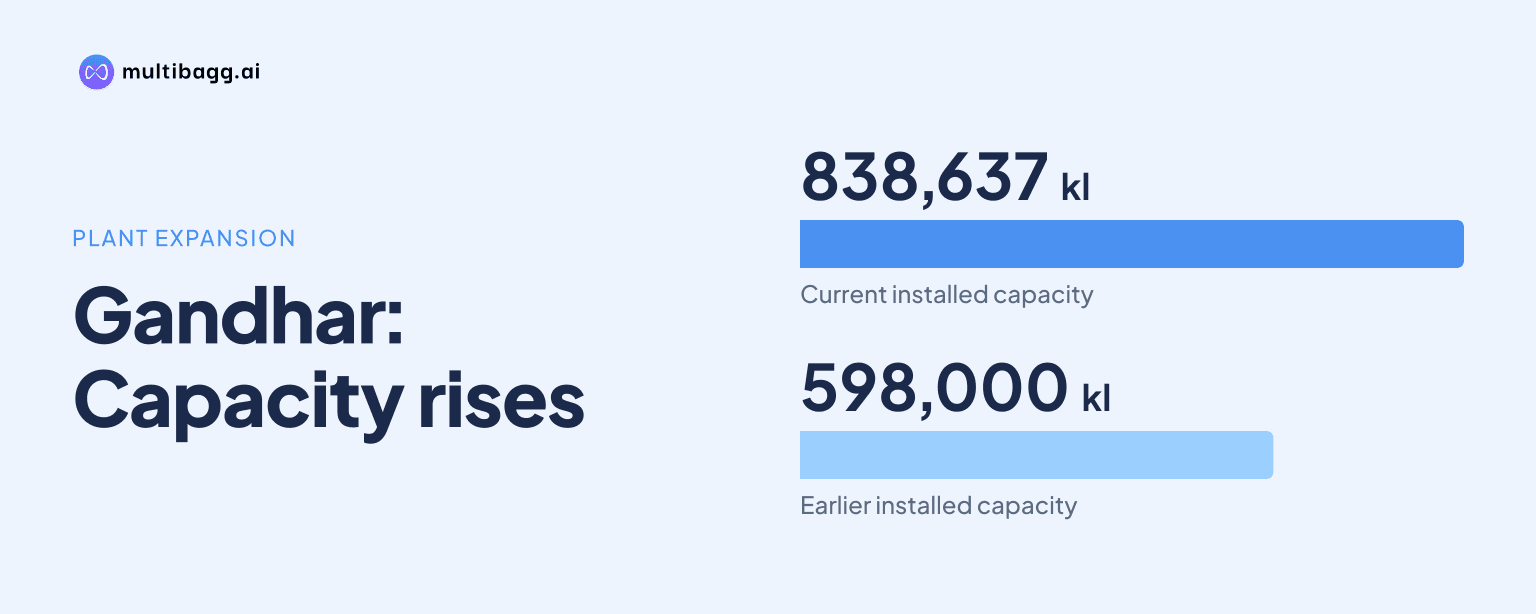
Gandhar Oil Refinery (India) Limited added a management-stated 240,000 kilolitres of installed capacity in the Q2 and H1 FY '27 call, taking consolidated capacity to 838,637 kilolitres, while management said Indian plants were operating at 82% utilisation on two shifts.
Know Gandhar Oil Refinery (India) inside out
Results, valuation, peers and who's buying, in one view.
How did Gandhar add 240,000 kl of capacity?
Gandhar said the capacity increase came from both debottlenecking and new investments at its Indian plants. Chief Financial Officer Indrajit Bhattacharyya said capital work in progress, or CWIP, had been capitalised over the past 1.5 to 2 years, lifting installed capacity at the Indian plants to 602,713 kilolitres.
The investments were funded through initial public offering proceeds and internal accruals, according to Joint Managing Director Aslesh Parekh. Management described the increase as mostly capacity enhancement, rather than solely a process improvement, and said the 240,000-kilolitre addition was measured against earlier consolidated capacity of 598,000 kilolitres.
Texol's installed capacity remained unchanged at 235,924 kilolitres, meaning the reported increase came from India rather than the United Arab Emirates subsidiary. Management rounded the current consolidated total to 838,000 kilolitres in its answer to an analyst, while its opening remarks provided the precise total of 838,637 kilolitres.
What is Gandhar's current plant utilisation?
Gandhar said standalone utilisation was 82%, while consolidated utilisation was about 61%. The standalone measure relates to the Indian operations, which have 602,713 kilolitres of capacity, whereas the consolidated measure also includes Texol's 235,924 kilolitres.
The Indian plants were operating on two shifts when management gave the utilisation figure. An analyst said the facilities could run at 130% on three shifts, but management did not confirm that operating level, set a FY '27 utilisation target, or quantify the additional sales volume that a third shift could generate.
The 82% utilisation disclosure followed a July disruption at Silvassa Unit 2, where heavy rainfall and flood-like conditions required cleaning and special repair work. Operations resumed in early August, and Gandhar recorded a Rs 21 crore exceptional item for stock loss, stock contamination and costs incurred to restore the factory.
Is added capacity supporting Gandhar's Indian volumes?
Gandhar reported about 16% year-on-year standalone volume growth in H1 FY '27, while domestic standalone sales increased about 15%. The capacity addition therefore coincided with higher Indian volumes, although management did not allocate a specific portion of that growth to the newly capitalised assets.
The result differed at Texol, where management said raw-material availability and sales were affected by the Gulf crisis and disruption around the Strait of Hormuz. Gandhar said it was mitigating the situation through domestic purchases and road-based surface transport, while management expected lost volumes and business to return if the Strait reopened.
Product trends also varied in H1 FY '27. Process and Insulating Oil volume increased 23% year on year on demand from transformer, power and rubber-industry customers, while lubricant volume was broadly flat year on year but rose about 9% sequentially. Personal Care, Healthcare, Performance Oil volume was broadly in line with the prior-year first half, although Q2 volume declined slightly as certain personal-care customers faced competition from newer and smaller brands.
Got a follow-up? Ask IRIS
What does capacity expansion mean for Gandhar's growth plan?
Gandhar has operating room to increase Indian output without announcing another specific capacity target. Management identified capacity expansion, deeper presence across segments, entry into new geographies and movement up the value chain as priorities, and said growth capital expenditure would be funded largely through internal accruals.
The larger capacity base was reported alongside higher sales. Consolidated Q2 FY '27 revenue reached Rs 1,847 crore, compared with Rs 1,068 crore in Q2 FY '26, while H1 FY '27 revenue was Rs 3,579 crore, up 82% year on year. Management said average realisation was about Rs 1.35 lakh per kilolitre, compared with close to Rs 80,000 per kilolitre at the end of the prior year, attributing growth to both realisation and a 16% H1 volume increase.
Supply conditions remain relevant to output and margins. Management said most base-oil supply comes from South Korea and remained uninterrupted, while Gulf supplies had resumed in smaller quantities. Gandhar reported a Q2 gross-margin spread of Rs 29,128 per kilolitre, compared with Rs 9,000 per kilolitre in Q2 FY '26, and management said it was optimistic about protecting current gross margins in Q3 and Q4.
How is Gandhar funding its expansion?
Gandhar said it has flexibility to fund growth capital expenditure largely through internal accruals. As of September 30, 2026, the standalone company was debt-free, while consolidated borrowings had declined to about Rs 85 crore from Rs 168 crore in March 2026, mainly comprising trade finance and borrowings at Texol.
Cash and bank balances were about Rs 135 crore at September 30, 2026, leaving Gandhar net-cash positive on a consolidated basis, according to management. Total equity rose to Rs 1,771 crore from Rs 1,400 crore in March 2026, while CRISIL reaffirmed the long-term A+/Stable rating and short-term A1 rating and enhanced rated bank facilities to Rs 1,014 crore.
Management said the facilities are predominantly non-fund based and support raw-material procurement. It also said average debtor days were about 70 to 75 days, compared with 37 days earlier, as sales had roughly doubled; separately, the Rs 21 crore Silvassa insurance claim will be recognised only after proceeds are received.
Conclusion
Gandhar's management-stated 240,000-kilolitre capacity increase reflects a combination of capitalised investments and debottlenecking. Indian plants operated at 82% utilisation on two shifts while standalone H1 FY '27 volumes rose about 16%, whereas disruption to Texol's sourcing and sales held consolidated utilisation at about 61%.
The next measures to watch are whether Texol restores supply and sales as conditions around the Strait of Hormuz change, and whether Gandhar converts its two-shift operating headroom into further Indian output. Management is also trying to achieve its earlier FY '27 volume-growth indication of 8% to 11%, while remaining dependent on raw-material availability and shipping conditions outside its control.