










Gandhar UAE disruption curbs group volumes despite 16% India growth
Key highlights
- Gandhar’s standalone H1 FY27 volumes grew about 16% year on year, while domestic sales increased about 15%.
- Texol’s UAE volumes fell because Strait of Hormuz disruption affected raw-material availability, shipping and logistics.
- Overseas revenue including Texol was Rs 1,721 crore, representing 48% of consolidated revenue in H1 FY27.
- Gandhar’s PIO segment recorded 23% year-on-year volume growth in H1 FY27.
powered by IRIS
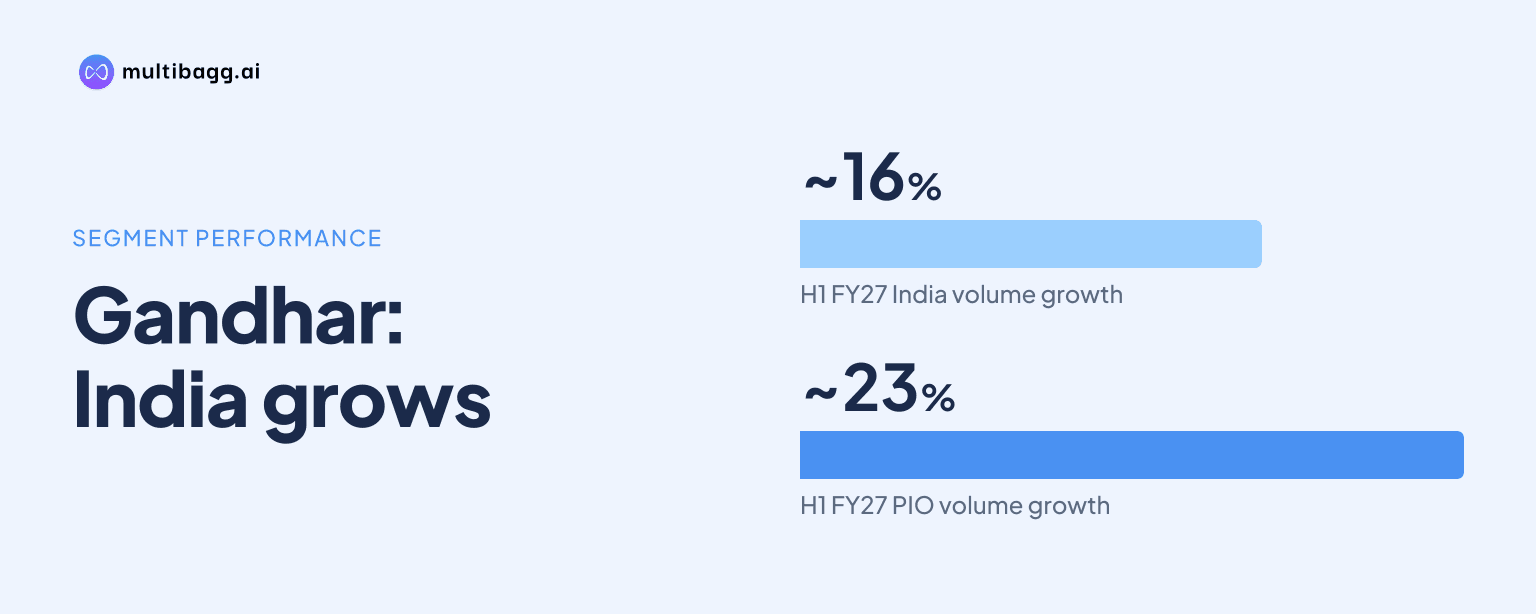
Gandhar reported about 16% year-on-year standalone volume growth in H1 FY27, but lower volumes at its UAE subsidiary constrained consolidated volumes as Strait of Hormuz disruption limited raw-material availability and logistics. Domestic sales increased about 15%, while overseas revenue including Texol was Rs 1,721 crore, or 48% of consolidated revenue.
Know Gandhar Oil Refinery (India) inside out
Results, valuation, peers and who's buying, in one view.
How did the Strait of Hormuz disruption affect Gandhar?
The Strait of Hormuz disruption reduced volumes at Gandhar’s UAE subsidiary, Texol, although Texol revenue increased during the quarter. Management said the UAE plant’s capacity and sales were affected by the geopolitical situation, resulting in lower volumes when Gandhar’s operations were considered on a consolidated basis.
The stated constraint was raw-material availability and transport rather than a disclosed fall in customer demand. Management said it could not obtain sufficient raw materials for the UAE facility because of the Gulf crisis and Strait of Hormuz issues, while shipping and logistics were also affected. Gandhar is seeking to mitigate the shortfall through domestic purchases and surface transport, but did not quantify Texol’s volume reduction.
Overseas revenue including Texol stood at Rs 1,721 crore, contributing 48% of consolidated revenue in H1 FY27. This exposure means the UAE disruption matters to group operations even as Texol recorded higher revenue during the quarter and Gandhar continued to supply international customers.
How fast did Gandhar’s India business grow in H1 FY27?
Gandhar’s standalone volume grew about 16% year on year in H1 FY27, while management put domestic sales growth at about 15%. Management distinguished this Indian performance from the consolidated volume trend, attributing the latter to lower activity at the UAE operation rather than a slowdown at domestic plants.
Standalone Indian-plant capacity utilisation was 82%, compared with consolidated utilisation of about 61%, which includes the impacted Sharjah operation. Gandhar reported consolidated installed capacity of 838,637 kilolitres, comprising 602,713 kilolitres at Indian plants and 235,924 kilolitres at Texol.
Product trends were uneven in H1 FY27. Process and insulating oil, or PIO, volume grew 23% year on year, supported by demand from transformer, power and rubber-industry customers. Personal care, healthcare and performance oils, or PHPO, were broadly in line with the prior-year first half, although PHPO volume declined in the second quarter as certain personal-care customers faced more competition from newer and smaller brands.
Lubricant volume was broadly stable year on year, but rose about 9% sequentially from the prior quarter. PIO was therefore the fastest-growing disclosed segment, while PHPO remained Gandhar’s largest product category and healthcare and pharmaceutical demand remained steady, according to management.
Got a follow-up? Ask IRIS
What did the volume split mean for Gandhar’s financial results?
Gandhar’s consolidated revenue increased 73% year on year to Rs 1,847 crore in Q2 FY27 despite the UAE volume pressure, while H1 FY27 revenue rose 82% to Rs 3,579 crore. Management said revenue growth reflected both higher realisations and volume growth, and said inventory gains were insignificant because it maintains low inventory levels.
Average realisation was about Rs 1.35 lakh per kilolitre at the time of the call, compared with close to Rs 80,000 per kilolitre at the end of the previous financial year. Q2 FY27 gross-margin spread was Rs 29,128 per kilolitre, compared with Rs 9,000 per kilolitre in Q2 FY26 and Rs 28,000 per kilolitre in Q1 FY27. Management attributed the spread to market pricing, disciplined sourcing and its index-linked pricing model.
A separate Indian disruption also affected reported profit in Q2 FY27. Flooding at Silvassa Unit 2 in July led to a one-time exceptional item of about Rs 21 crore, covering stock loss, stock contamination and costs to restart the facility. Gandhar resumed operations in early August and lodged an insurance claim; management said insurance proceeds would be recognised only when received.
How is Gandhar managing the UAE supply and logistics risk?
Gandhar is diversifying sourcing and using domestic purchases and surface transport to support the UAE operation while Gulf supply recovers in smaller quantities. Management said most base-oil supply comes from South Korea and remains uninterrupted, but refinery closures and vessel disruption have created a gap between base-oil demand and supply.
Freight rates were broadly unchanged quarter on quarter, with only a slight increase, according to management. However, vessels coming out of Hormuz carried an additional war-risk premium and insurance rates increased. Management said these costs were passed on to customers and that its sourcing strategy was intended to protect current margins.
Management said it was optimistic that lost UAE volumes and business would return once Strait conditions ease and the Strait is opened, but gave no timetable. It also said it was trying to meet its previously indicated FY27 volume-growth range of 8% to 11%, while acknowledging that geopolitical developments were beyond its control.
Conclusion
Gandhar’s H1 FY27 results show two different operating trends: standalone volume increased about 16%, including 23% growth in PIO, while lower Texol volumes limited the consolidated outcome because of UAE raw-material and logistics disruption. Consolidated revenue nevertheless rose to Rs 3,579 crore in H1 FY27, supported by average realisation of about Rs 1.35 lakh per kilolitre and a Q2 gross-margin spread of Rs 29,128 per kilolitre.
The next developments to watch are whether Gulf supplies recover beyond smaller quantities, whether Strait conditions allow Texol volumes to return, and whether Gandhar can achieve its 8% to 11% FY27 volume-growth range. Management also expects Indian-plant utilisation, currently 82%, to improve in Q3 and Q4 while retaining scope for further utilisation gains next year.