










Gandhar expects Rs 29,000-per-kl spreads through FY27 Q4
Key highlights
- Gandhar said its Rs 29,000-per-kl gross margin can be sustained in FY27 Q3 and Q4.
- Gandhar’s gross margin was Rs 8,000 to Rs 9,000 per kl before the war, versus Rs 29,000 per kl currently.
- Standalone first-half volume grew around 16% year on year, while the UAE facility faced raw-material shortages.
- Total installed capacity increased to 838,000 kl from 598,000 kl, while Indian plants operated at 82% utilization.
powered by IRIS
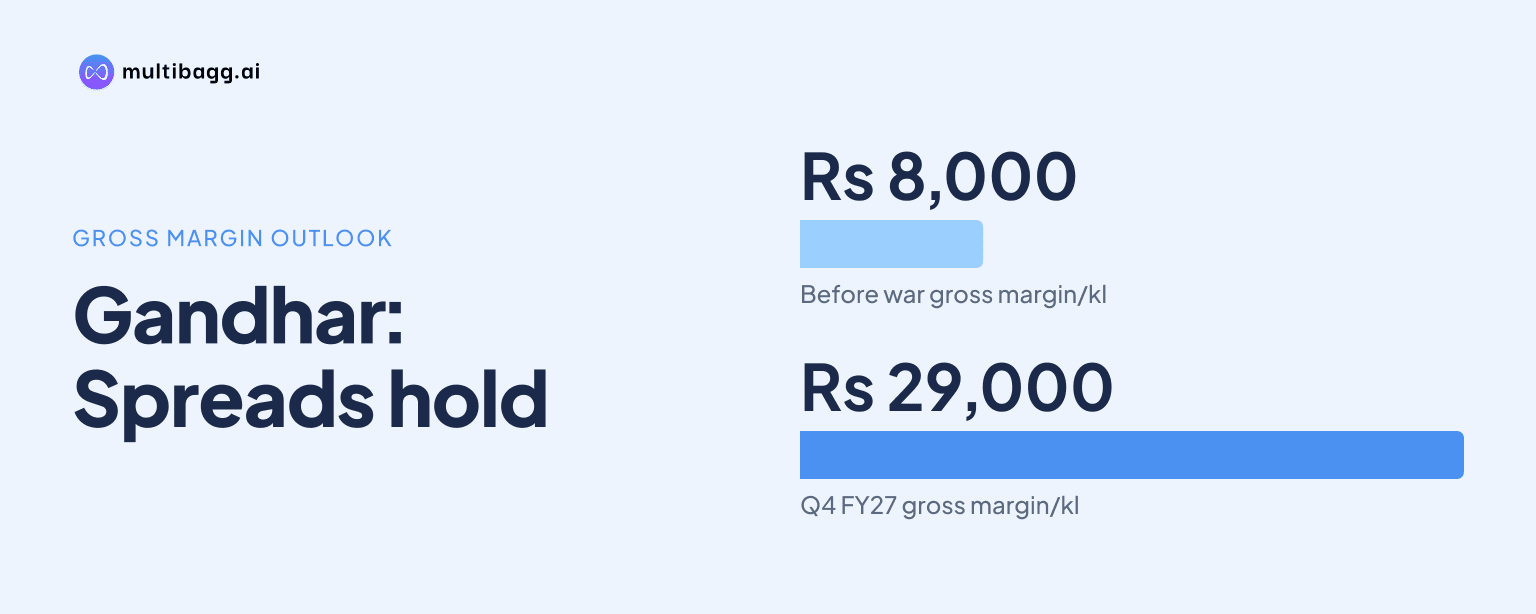
Gandhar said its current gross margin of Rs 29,000 per kilolitre can be maintained in FY27’s remaining Q3 and Q4, supported by sourcing and customer price pass-through, even as Gulf disruption constrains supplies. Management said South Korean sourcing remained uninterrupted, while Gulf deliveries had resumed only in smaller quantities.
Know Gandhar Oil Refinery (India) inside out
Results, valuation, peers and who's buying, in one view.
Can Gandhar sustain Rs 29,000-per-kl gross spreads through FY27?
Yes, management said Gandhar was optimistic that the Rs 29,000-per-kl gross-margin run rate could continue in Q3 and Q4 of FY27. The company linked that near-term position to its ability to protect current margins while raw-material availability remains difficult following the conflict and disruption around the Strait of Hormuz.
The Rs 29,000-per-kl level is above Gandhar’s pre-war range of Rs 8,000 to Rs 9,000 per kl. Management did not provide a full-year margin forecast beyond Q3 and Q4, but said it could offer near-term guidance based on margins achieved in the past two quarters.
Management’s position is conditional rather than a statement that the current spread is permanent. It said that if the war settles and Hormuz reopens, gross margin will reduce from Rs 29,000 per kl, but it does not expect a return to the earlier Rs 8,000-to-Rs-9,000 range. Management said the eventual level would settle somewhere between those two reference points, without quantifying it.
What is keeping Gandhar’s margin elevated?
Gandhar attributed the higher spread primarily to its sourcing strategy and price pass-through to customers, rather than inventory gains. Management said the company holds very low inventory and described inventory gains or losses as insignificant, meaning it did not identify stock revaluation as a meaningful contributor to the current gross margin.
Pricing has also moved sharply. Gandhar said average realization was about Rs 1.35 lakh per kl, compared with close to Rs 80,000 per kl at the end of the prior year, while standalone volume rose about 16% from the first half of the previous year to the first half of the current year. Management said the mix of higher realization and higher volume explained the revenue movement.
The company said it has passed higher costs, including the insurance increase associated with vessels coming out of Hormuz, to customers. Freight rates were broadly unchanged quarter on quarter, according to management, apart from a slight increase and the war-risk premium. Gandhar said demand had not fallen despite higher selling prices, allowing the pass-on effect to work.
Supply conditions remain central to the outlook. Management said there remains a gap between demand and supply because of refinery closures and vessel disruption. It said Gandhar is mitigating the risk through diversified sourcing partners, domestic suppliers and a focus on value-added customers while continuing to serve customers during the shortage.
Got a follow-up? Ask IRIS
How has Gulf disruption affected Gandhar’s volumes?
The Gulf disruption has affected Gandhar’s United Arab Emirates facility, while Indian operations recorded double-digit growth. Management said standalone volume increased around 16% year on year in the first half, and domestic standalone sales increased about 15%, but consolidated volume was affected because the Dubai plant could not obtain enough raw material.
Management said the Dubai facility is in the United Arab Emirates near the Strait of Hormuz and that the company has sought to mitigate shortages by buying locally and using road and surface transport. It said it expects lost volumes and business to return once the Strait reopens, but did not specify a reopening date or a volume-recovery timetable.
An analyst referred to about 1% first-half volume growth against Gandhar’s July guidance for 8% to 11% growth in FY27. Management responded that Indian standalone growth was around 16%, while the overseas subsidiary was constrained by the Gulf crisis. It said it was trying to achieve the indicated FY27 range, while acknowledging the geopolitical situation was outside its control.
The supply issue does not extend equally to all sourcing routes. Management said most of Gandhar’s base-oil supply comes from South Korea and that route remained uninterrupted. Gulf supply had resumed in smaller quantities, which management said helped protect margins, but the continued shortfall remains a constraint for the UAE operation.
Can capacity and product demand support Gandhar’s FY27 plan?
Gandhar said its Indian plants were operating at 82% utilization on an annualized basis, leaving room to raise utilization in Q3 and Q4 and further in the next year. The company said Indian installed capacity stood at 602,713, while its overseas facility had unchanged installed capacity of 235,924, taking total installed capacity to 838,000 after capital work-in-progress was capitalized.
Management described the expansion as largely capacity enhancement, combining debottlenecking, investments from initial public offering proceeds and internal accruals. Consolidated utilization was around 61%, compared with 82% at the standalone level, reflecting the impact on the overseas facility. Indian plants were operating in two shifts when management discussed utilization.
The company said higher gross margins were across its products rather than concentrated in one segment. It also pointed to growing transformer-oil demand from the power sector, including new data centers and rising national power requirements, and said volumes in that product had increased among both existing and new customers. Management said new value-added products were under research and development, but disclosed no launch date or expected revenue contribution.
Conclusion
Gandhar’s stated margin outlook rests on elevated realization, sourcing flexibility and customer pass-through during a supply shortage. The current Rs 29,000-per-kl gross margin compares with the Rs 8,000-to-Rs-9,000 pre-war range, while the company said standalone first-half volume rose around 16% despite disruption at its UAE facility.
The next factors to watch are Gandhar’s Q3 and Q4 delivery against its stated intention to sustain current margins, progress toward its 8% to 11% FY27 volume-growth indication, and any change in Strait of Hormuz access. Management has said spreads would decline if the conflict eases, although it does not expect them to return to the earlier Rs 8,000-to-Rs-9,000 range.