










Gandhar PIO volumes rise 23% as transformer demand grows in H1 FY27
Key highlights
- Gandhar’s PIO volume rose 23% year on year in H1 FY27.
- Gandhar reported consolidated H1 FY27 revenue of Rs 3,579 crore, up 82% year on year.
- Overseas revenue including Texol was Rs 1,721 crore, representing 48% of consolidated revenue.
- Gandhar’s consolidated installed capacity was 838,637 kilolitres, while standalone utilisation was 82%.
powered by IRIS
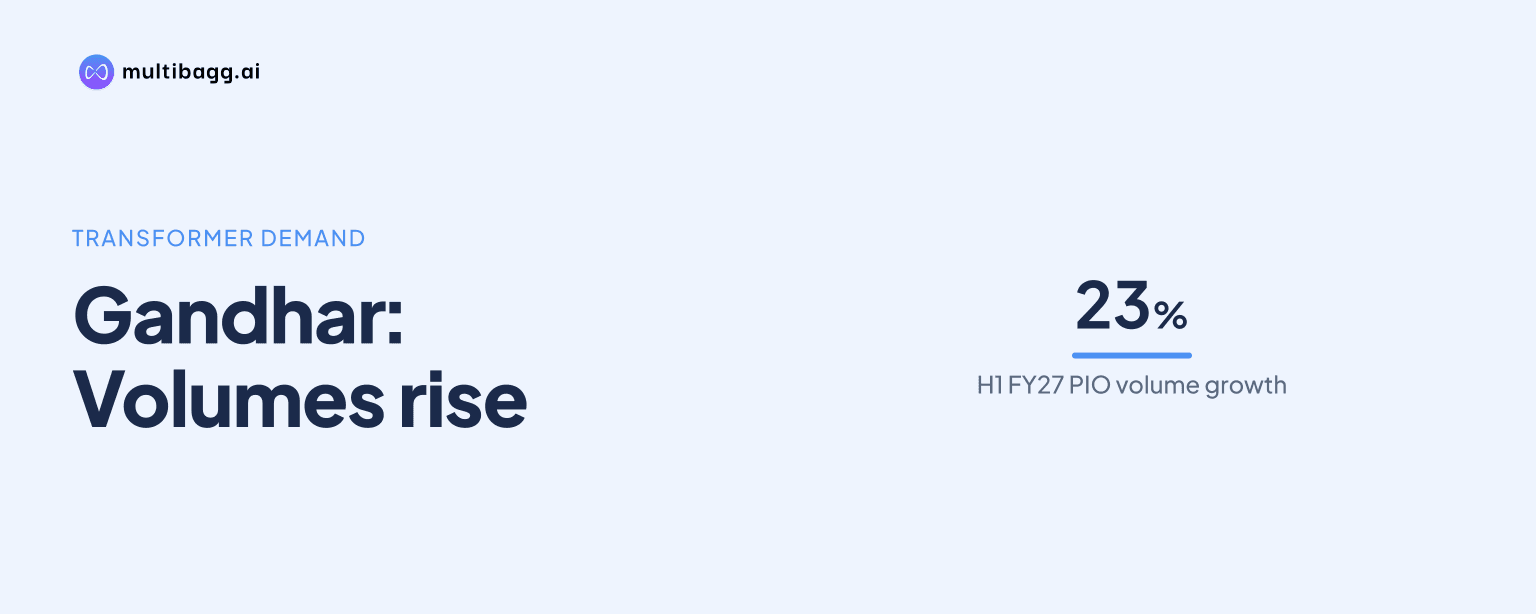
Gandhar Oil Refinery (India) Limited reported 23% year-on-year volume growth in its Process and Insulating Oil segment in H1 FY27, driven by demand from transformers, power applications and the rubber industry. The increase contrasted with broadly flat H1 volume in its largest Personal Care, Healthcare, Performance Oil business.
Know Gandhar Oil Refinery (India) inside out
Results, valuation, peers and who's buying, in one view.
Why did Gandhar’s PIO volumes rise 23%?
Gandhar’s Process and Insulating Oil (PIO) volume rose 23% year on year in H1 FY27 because transformer, power and rubber-industry demand remained healthy. Management said rising electricity demand and continued investment in power infrastructure in India and globally created an encouraging long-term opportunity for the segment.
The PIO gain differed from Gandhar’s Personal Care, Healthcare, Performance Oil (PHPO) segment, whose H1 FY27 volume remained broadly in line with the prior year. PHPO volume declined slightly in Q2 FY27 from Q2 FY26, as certain personal-care customers faced increased competition from newer and smaller brands, according to management.
PHPO remained Gandhar’s largest and most important product category in H1 FY27, even as PIO delivered the faster volume increase. Management said healthcare and pharmaceutical demand within PHPO was steady, while it was focused on strengthening customer relationships and responding to changing conditions in the personal-care market.
How did PIO growth compare with Gandhar’s overall H1 FY27 results?
PIO’s 23% volume growth came as Gandhar reported consolidated revenue of Rs 3,579 crore in H1 FY27, an 82% year-on-year increase, and profit after tax of Rs 392 crore, versus Rs 66 crore in H1 FY26. Gandhar did not disclose revenue, gross profit, earnings before interest, tax, depreciation and amortisation (EBITDA), or profit separately for PIO.
Gandhar’s Q2 FY27 consolidated revenue was Rs 1,847 crore, compared with Rs 1,068 crore in Q2 FY26 and Rs 1,732 crore in Q1 FY27. Management described Rs 1,847 crore as the company’s highest quarterly revenue, while Q2 EBITDA rose to Rs 288 crore from Rs 66 crore a year earlier.
The Q2 FY27 gross-margin spread was about Rs 29,128 per kilolitre, compared with Rs 9,000 per kilolitre in Q2 FY26 and about Rs 28,000 per kilolitre in Q1 FY27. Management attributed the change to current market pricing, disciplined sourcing and an index-linked pricing model, but did not assign any part of that spread to PIO.
Got a follow-up? Ask IRIS
How did domestic and overseas conditions affect Gandhar’s volumes?
Gandhar said domestic volumes recorded healthy quarter-on-quarter growth in Q2 FY27 despite price increases, while export volume moderated because geopolitical developments in West Asia affected shipping and logistics. Total overseas revenue, including its Texol subsidiary, was Rs 1,721 crore and accounted for 48% of consolidated revenue.
On a standalone basis, Gandhar’s sales volume grew about 16% year on year in H1 FY27, while domestic sales increased about 15%, management said in response to an analyst. Management linked the lower consolidated volume trend to disruption affecting the Dubai plant in the United Arab Emirates, which is located near the Strait of Hormuz.
Texol’s export volumes were lower in Q2 FY27 amid regional geopolitical instability, although revenue from the unit increased during the quarter. Management said it was monitoring potential effects on raw-material availability, shipping and logistics while maintaining customer service and operating efficiency.
Management said it expected lost Texol volumes and business to return once the Strait of Hormuz reopens, an expectation dependent on conditions easing rather than a financial forecast. Gandhar’s approach to raw-material supply in Q2 FY27 used long-term international suppliers as well as domestic base-oil producers, which management said supported uninterrupted customer supply.
Does Gandhar have capacity to support PIO and other segment growth?
Gandhar reported consolidated installed capacity of 838,637 kilolitres after capitalising projects previously classified as capital work in progress over roughly 1.5 to 2 years. Indian plants accounted for 602,713 kilolitres and Texol for 235,924 kilolitres, together representing an increase of about 240,000 kilolitres from the earlier capacity base of about 598,000 kilolitres.
Management said the capacity increase reflected debottlenecking, investments funded from initial public offering proceeds and internal accruals, and new capacity. Standalone utilisation was 82% at the time of the October 28, 2026 call, while consolidated utilisation was about 61%; Indian operations were running two shifts rather than three.
Silvassa Unit 2 resumed operations in early August 2026 after heavy rainfall and flood-like conditions affected the facility in July 2026. Gandhar recorded an inventory loss of about Rs 21 crore as an exceptional item, lodged an insurance claim and said insurance proceeds would be recognised only once received.
Gandhar’s consolidated borrowings declined to about Rs 85 crore on September 30, 2026, from Rs 168 crore in March 2026, while cash and bank balances were about Rs 135 crore. The standalone business was debt-free as of the call date, and total equity rose to Rs 1,771 crore from Rs 1,400 crore in March 2026.
Conclusion
Gandhar’s 23% H1 FY27 PIO volume increase indicates that transformer, power and rubber-industry demand expanded faster than PHPO, where half-year volume was broadly flat and Q2 volume declined slightly. This segment contrast occurred alongside an 82% increase in consolidated H1 FY27 revenue to Rs 3,579 crore, although Gandhar did not disclose PIO segment revenue or profitability.
The next developments to watch are demand from power infrastructure, use of the 838,637-kilolitre consolidated capacity base and shipping conditions in West Asia. Management also identified expanding capacity, entering new geographies and moving into higher-value products as priorities, while the Rs 21 crore Silvassa insurance claim remains unrecognised until proceeds are received.