










Ganesh retains 1,166 tonnes daily after Hyderabad plant sale
Key highlights
- Ganesh operates 1,166 tonnes per day of in-house capacity across seven facilities.
- Ganesh sold its 312-tonne-per-day Hyderabad job-work facility for Rs 32.50 crore on October 1, 2026.
- West Bengal facilities account for 676 tonnes per day, compared with 490 tonnes per day in Uttar Pradesh.
- Ganesh uses more than 70 brokers for wheat, gram and spices and serves more than 3.5 lakh general-trade outlets.
powered by IRIS
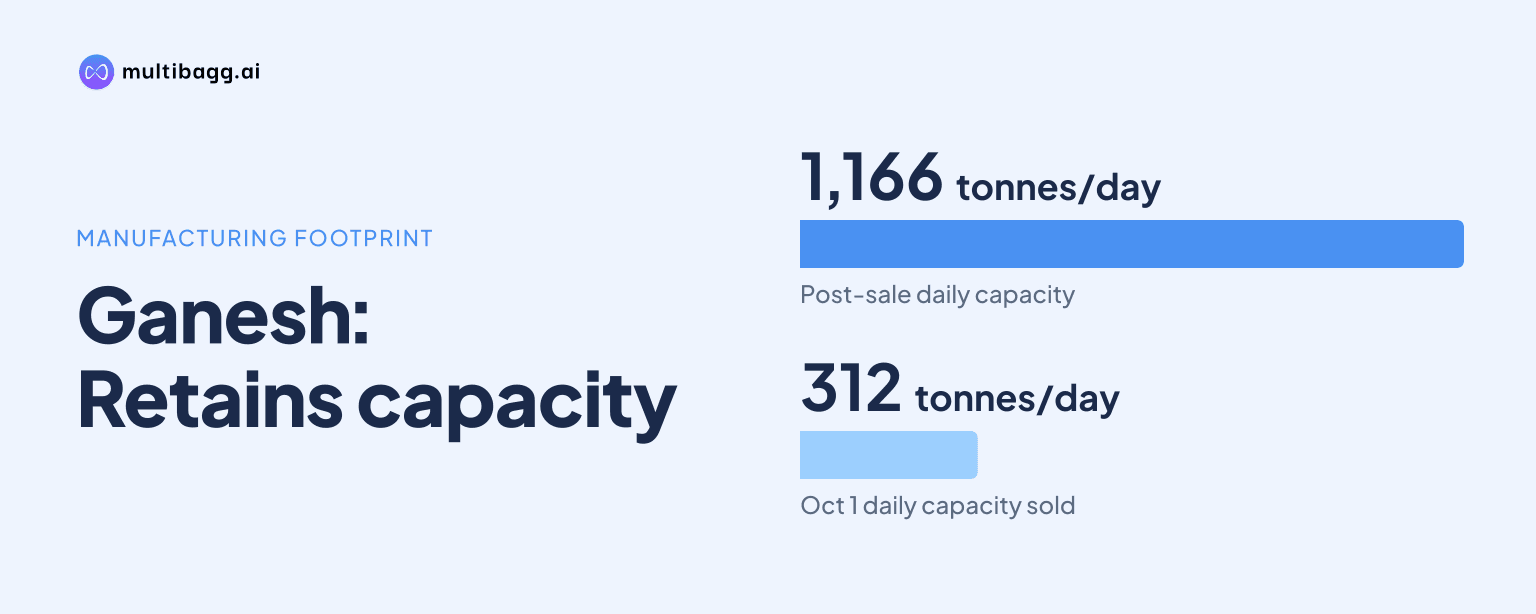
Ganesh Consumer Products retains 1,166 tonnes per day of in-house capacity across seven operating plants after selling its 312-tonne-per-day Hyderabad facility for Rs 32.50 crore on October 1, 2026. The Hyderabad unit, which performed job work for an FMCG player, represented about 1.4% of FY26 revenue.
Know Ganesh Consumer Products inside out
Results, valuation, peers and who's buying, in one view.
How is Ganesh's operating capacity distributed?
Ganesh's 1,166-tonne-per-day operating capacity is split between Uttar Pradesh and West Bengal, with West Bengal contributing 676 tonnes per day and Uttar Pradesh contributing 490 tonnes per day. The reported total excludes Hyderabad, which had 312 tonnes per day of capacity before its sale.
Ganesh's largest listed operating facility is the 384-tonne-per-day Padmavati Unit, while the Amta Plant is the smallest at 12 tonnes per day. Amta started commercial production in Q1 FY27, and the company identifies soya chunks as the product commissioned at that location during 2025-26.
The Agra and Varanasi plants are located near farms, which Ganesh says supports raw-material sourcing, while its Kolkata facilities are near its core market for logistics management. The Agra plant, with 304 tonnes per day of capacity, also commissioned atta and dalia units in 2025-26.
Why did Ganesh sell the Hyderabad facility?
Ganesh sold the Hyderabad facility because management described it as non-core and said the Rs 32.50 crore proceeds would be deployed in eastern India. The sale deed was executed on October 1, 2026, and the facility was engaged in job work for an FMCG player rather than the company's stated consumer-staples platform.
The 312-tonne-per-day Hyderabad plant contributed about 1.4% of FY26 revenue and was sold at about 2.7 times net block, according to the presentation. As of September 30, 2026, it was classified as assets held for sale at the lower of carrying amount and fair value less costs to sell.
Ganesh had received an advance of Rs 321.75 lakh for the facility, recognised under current liabilities as of September 30, 2026. Including Hyderabad, the eight listed facilities had 1,478 tonnes per day of capacity; the reported operating base is now 312 tonnes per day lower at 1,166 tonnes per day.
Management said in its Q2 FY27 commentary that it was working towards setting up plants in other eastern states to improve supply-chain efficiency. The presentation does not disclose proposed locations, investment amounts, capacity targets or commissioning dates for those facilities.
Got a follow-up? Ask IRIS
How does Ganesh connect procurement, production and distribution?
Ganesh connects its seven plants to raw-material sourcing through a network of more than 70 brokers across Uttar Pradesh, Bihar, Madhya Pradesh, Rajasthan, Haryana, Punjab and Maharashtra. The brokers procure wheat, gram and spices, and the company cites long-established relationships for grain quality and price discovery.
Ganesh states that its manufacturing and processing are 100% in-house across seven strategic plants, except for snacks launched in FY25 that form a very small part of revenue and are procured from a third-party manufacturer. The 1,166-tonne-per-day capacity figure therefore describes the in-house operating footprint rather than the snack supply arrangement.
On distribution, Ganesh reports 31 clearing and forwarding agents, 24 super stockists and more than 1,000 distributors. It also reports more than 3.5 lakh general-trade outlets, more than 200 modern-trade retail touchpoints and household reach of more than 10 million.
The company supplies 44 product categories and 273 stock-keeping units across carrier, value-added and emerging segments. Carrier products include wheat flour, value-added products include sooji, maida, besan, sattu and dalia, while emerging products include spices, instant mixes and ethnic flours.
What manufacturing and quality systems does Ganesh use?
Ganesh says Jalan Complex Unit I and Agra use Buhler machinery that raises sooji yield to 28%-32%, compared with a typical 6%-8%. The claim applies to these two units, which have combined capacity of 454 tonnes per day, rather than to all seven operating facilities.
Ganesh uses software applications to automate, monitor and control material flow, with consumption recorded in real time. Its Warehousing Management System is intended to provide visibility, space optimisation and real-time tracking, while its Distribution Management System provides real-time visibility across sales and distribution.
The company says customised machinery scans each grain before grinding and rejects immature, infected or discoloured material. Ganesh also cites an in-house quality laboratory and dedicated quality-assurance team covering the process from raw-material sourcing through final packaging.
Ganesh lists ISO 14001:2015 for environmental management, ISO 45001:2018 for occupational health and safety, Food Safety and Standards Authority of India compliance, and FSSC 22000 food-safety management. During Q2 FY27, revenue from operations declined 5.0% year on year, while management reported a 20.3% sequential increase and said it was aligning manufacturing more closely with eastern markets.
Conclusion
Ganesh has moved from eight listed facilities, including Hyderabad, to seven operating plants with 1,166 tonnes per day of in-house capacity. The sale removes a 312-tonne-per-day job-work asset that contributed about 1.4% of FY26 revenue, while retaining a manufacturing base split between Uttar Pradesh sourcing locations and West Bengal market-facing sites.
The next development to watch is management's plan to deploy Rs 32.50 crore of Hyderabad-sale proceeds in eastern India and work towards plants in other eastern states. Ganesh has not disclosed a location, capital-spending amount, capacity addition or commissioning schedule, leaving subsequent company disclosures to show how the plan changes its 1,166-tonne-per-day base.