










Ganesh B2C sales remain 92% concentrated in West Bengal
Key highlights
- West Bengal contributed 92% of Ganesh’s Q2FY27 B2C revenue mix.
- Atta fell to 30% of B2C revenue in H1 FY27 from 35% in FY26.
- Emerging products increased from 4% of B2C revenue in FY23 to 10% in H1 FY27.
- General trade generated 78.7% of Ganesh’s Q2FY27 B2C revenue.
powered by IRIS
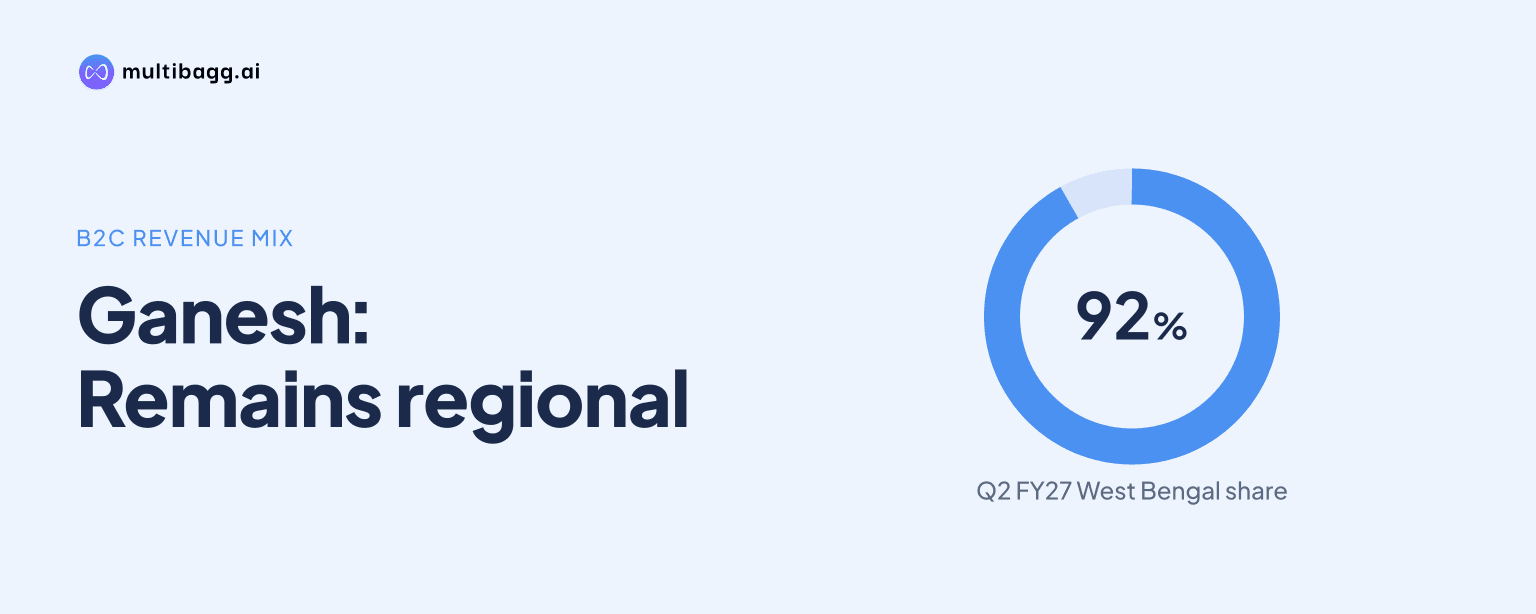
Ganesh Consumer Products derived 92% of its Q2FY27 business-to-consumer (B2C) sales from West Bengal. Atta fell to 30% of B2C revenue in H1 FY27 from 35% in FY26, while value-added products recovered to 60% and emerging products reached 10%. B2C accounted for 80% of Ganesh’s sales in Q2FY27.
Know Ganesh Consumer Products inside out
Results, valuation, peers and who's buying, in one view.
How concentrated are Ganesh's B2C sales in West Bengal?
Ganesh’s B2C sales were highly concentrated in West Bengal, which supplied 92% of the Q2FY27 B2C revenue mix. Jharkhand contributed 3%, Odisha contributed 2%, and the rest of East India contributed 3%, meaning that markets outside West Bengal collectively represented 8% of B2C revenue.
Ganesh’s presentation identifies it as the largest player in West Bengal wheat-based products and packaged sattu, and as a top-two player in packaged besan. Wheat-based products include wheat flour, maida, sooji and dalia, while gram-based flour products include besan and sattu. Across East India, Ganesh describes itself as the largest player in wheat-based derivatives excluding wheat flour, a top-two player in gram-based flour products, and the third-largest brand in packaged wheat flour.
Management’s stated response to this concentration is to consolidate West Bengal leadership while scaling in Jharkhand, Bihar, Odisha and the North-East. The disclosed expansion mechanisms are strengthening the regional supply chain, expanding the agent and distributor network, increasing people strength and deepening market penetration. Bihar is part of the stated plan, although it is not separately shown in the Q2FY27 B2C revenue mix.
What changed in Ganesh's product mix?
Ganesh reduced atta’s share of B2C revenue to 30% in H1 FY27 from 35% in FY26, while value-added products increased to 60% from 56%. Emerging products rose by 1 percentage point from 9% to 10% over the same comparison, making the latest mix change primarily a shift away from atta and back toward value-added categories.
Value-added products, comprising maida, sooji, sattu, besan and dalia, remained Ganesh’s largest B2C category throughout FY23 to H1 FY27. Their share ranged between 56% and 62%. Emerging products, which include spices, instant mixes and millet flour, increased from 4% in FY23 to 10% in H1 FY27, a rise of 6 percentage points over the disclosed period.
Ganesh has linked the portfolio shift to its objective of extending core staples into everyday kitchen adjacencies and moving toward branded formats. Recent launches include whole spices, blended spices, CTC spices, sabudana and soya chunks. Management also disclosed a broader commercial rollout of ethnic snacks during Q3FY27 and a planned packaged-sweets launch using the existing Amta manufacturing unit.
Got a follow-up? Ask IRIS
How is Ganesh supporting expansion beyond West Bengal?
Ganesh is supporting B2C expansion with 71 manufacturing plants, 24 super stockists, 31 clearing and forwarding agents, more than 1,000 distributors and more than 3.5 lakh retail or customer touchpoints. The plant figure excludes a plant held for sale. These infrastructure measures are paired with the plan to build presence in eastern states where the recorded Q2FY27 revenue contribution remains limited.
General trade generated 78.7% of Ganesh’s Q2FY27 B2C revenue, compared with 14.2% from e-commerce and 7.1% from modern trade. E-commerce routes include third-party online marketplaces, quick commerce and Ganesh’s own website. Modern trade covers more than 200 stores in East India, while general trade is supported by the company’s distributor and retail-touchpoint network.
Ganesh’s presentation also shows a contrast between category demand and its availability in West Bengal. The packaged wheat-based products market, covering atta, maida and sooji, declined 2.5% quarter on quarter, while Ganesh’s weighted distribution increased 1.2%. Weighted distribution measures the share of category sales generated by stores where Ganesh products are available; the presentation says Ganesh broadly held share during the category contraction.
What do Ganesh's financial figures show alongside the mix strategy?
Ganesh reported Rs 415.3 crore of revenue from operations in H1 FY27, while its earnings before interest, tax, depreciation and amortisation (EBITDA) margin was 12.2%, up from 9.8% in FY26. H1 FY27 is a six-month period and is therefore not directly comparable with the Rs 871.4 crore revenue reported for the full FY26.
EBITDA was Rs 50.6 crore in H1 FY27, compared with Rs 85.6 crore in FY26, and profit after tax was Rs 31.3 crore, compared with Rs 42.4 crore for FY26. The H1 FY27 profit-after-tax margin was 7.5%, versus 4.8% in FY26. These reported changes coincide with atta declining from 35% of B2C mix in FY26 to 30% in H1 FY27, although the presentation does not disclose profitability by product category.
Ganesh reported Rs 11.9 crore of net cash from operating activities in H1 FY27, compared with Rs 80.5 crore in FY26. The presentation states a 32-day cash conversion cycle and says 100% of general-trade sales are on an advance basis. It notes an exception for spices, where the credit period is 15 to 30 days, a working-capital feature relevant to the expanding spices portfolio.
Conclusion
Ganesh’s reported mix shows that geographic diversification and product diversification are at different stages. West Bengal still supplied 92% of Q2FY27 B2C sales, but atta’s share fell to 30% in H1 FY27 as value-added products returned to 60% and emerging products reached 10%. The company is therefore broadening categories while revenue remains concentrated in its principal state.
The next disclosed operating milestone is management’s planned broader ethnic-snacks rollout in Q3FY27, followed by the intended packaged-sweets launch from the Amta unit. The key measures to watch are whether the stated additions to supply chain, agents, distributors and people increase the 8% B2C contribution currently recorded outside West Bengal, and whether newer categories continue to grow beyond their 10% emerging-products mix in H1 FY27.