










GE Vernova T&D India places over 90% capex in existing plants
Key highlights
- GE Vernova T&D India said more than 90% of investment is being made in existing plants.
- An analyst cited Rs 1,100 crore of capital expenditure during the call.
- TBCB project delivery timelines have moved from 18-21 months to 24-30 months, management said.
- Management expects significant HVDC execution from financial year 2028 onwards.
powered by IRIS
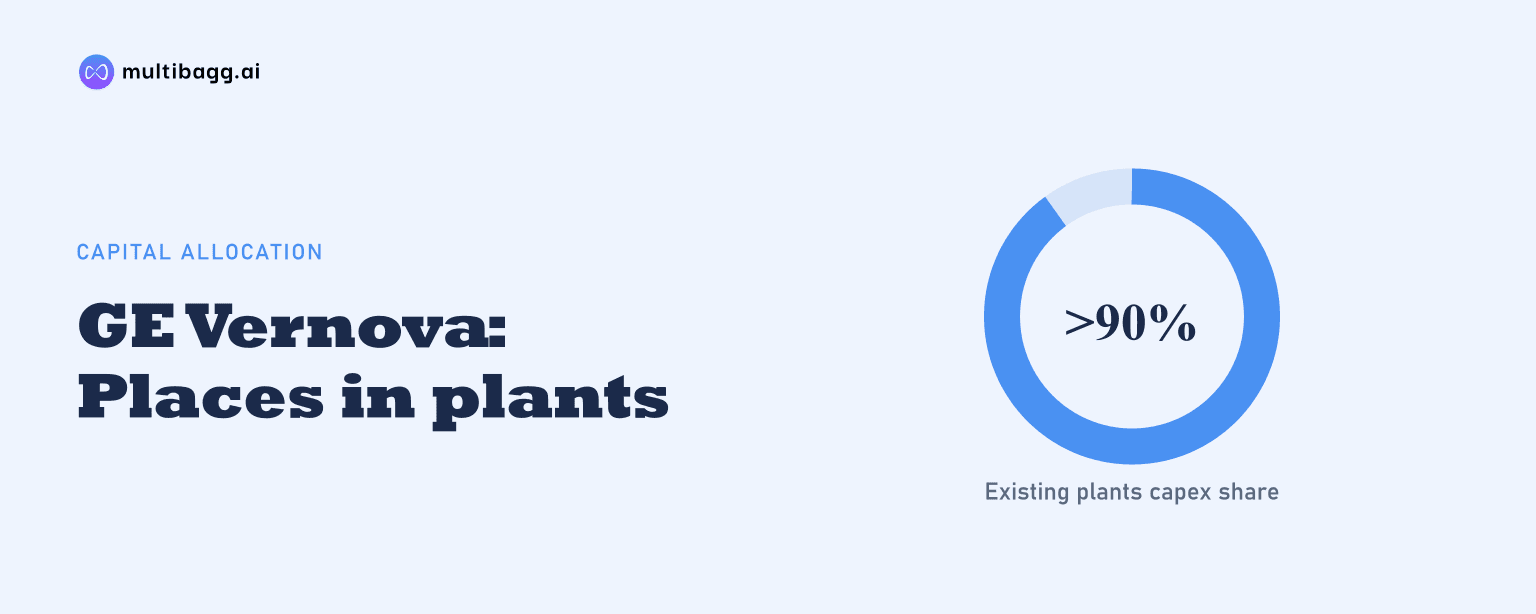
GE Vernova T&D India Limited said more than 90% of the capital expenditure discussed as Rs 1,100 crore is going into existing plants, using owned land and infrastructure to lower investment needed for similar or higher output. Management described the approach during an analyst discussion of manufacturing expansion and demand conditions.
Know GE Vernova T&D India inside out
Results, valuation, peers and who's buying, in one view.
Why is GE Vernova T&D India using existing plants?
GE Vernova T&D India is putting more than 90% of its investment into existing plants because it already owns the land and can undertake what management called an integrated expansion. The approach is intended to add manufacturing capability without first creating a new site and its related base infrastructure.
An analyst cited Rs 1,100 crore of capital expenditure while asking whether the programme was conservative relative to global and domestic demand. Management said its investment decisions follow an informed assessment of the market, supply chain, the company's ability to participate in that market, and Board due diligence, rather than a simple response to competitors' expansion plans.
How does existing infrastructure reduce GE Vernova T&D India’s capital needs?
GE Vernova T&D India said its existing sites reduce the capital needed to generate similar or higher volumes because the company already has the land and plant infrastructure. The stated mechanism is reuse of these assets, rather than a claim that every product line requires the same level of incremental spending.
Management also said it considers what maximises returns to shareholders when setting capital expenditure. That framework does not include a plant-by-plant capacity target, commissioning date or revenue forecast for the additional facilities, but it explains why the company sees its capital requirement as lower than that of an expansion needing a new site.
The distinction matters across the company's product lines. Management said capacity additions in India are occurring mainly in transformers, while expansion is less extensive in switchgear, so supply conditions and investment requirements are not uniform across transformers, switchgear and grid automation.
Will new transformer capacity pressure domestic prices?
GE Vernova T&D India said it does not see much pressure on domestic prices if other companies follow through on their stated plans to use most announced capacity for exports. Management's view was conditional on those export plans being implemented, rather than a prediction that all new capacity will necessarily be absorbed outside India.
Management contrasted substantial transformer capacity expansion with lower expansion in switchgear. An analyst had asked whether ordering in calendar 2027 could differ from the previous two years as additional transformer and switchgear capacity enters the market; the response indicated that the likely supply change is concentrated more in transformers.
GE Vernova T&D India also said it has not so far seen extensive direct competition from Indian companies in global markets. Management declined to quantify a future effect because it would depend on the country, product and tender, such as a European bid involving several Indian suppliers.
Got a follow-up? Ask IRIS
When could demand become equipment orders for GE Vernova T&D India?
GE Vernova T&D India said tariff-based competitive bidding, or TBCB, developers typically award products three to five months after winning a project, although transformers can be ordered earlier than other equipment. The interval means a tender award does not automatically produce immediate demand for all equipment categories.
Management said TBCB project delivery periods have lengthened from 18 to 21 months previously to 24 to 30 months. It said the longer schedule gives developers more flexibility after winning projects, making it difficult to estimate how much of the Rs 1 lakh crore TBCB pipeline cited by an analyst will convert into orders for equipment makers during the year.
High-voltage direct current, or HVDC, projects have a longer execution profile. Management said there will be no significant execution from HVDC orders in the current financial year and no significant contribution in the following financial year, with significant HVDC execution expected from financial year 2028 onwards.
What could constrain GE Vernova T&D India’s expansion?
GE Vernova T&D India identified supply chain conditions as a potential operational constraint, citing high global demand and recurring geopolitical disturbances. Management said these factors can have a severe impact on operations, meaning an existing-plant expansion does not remove dependency on externally sourced materials and components.
That dependency is visible in HVDC equipment. Management said it manufactures transformers, valve assemblies and the engineering solution in India, but sources thyristors and insulated-gate bipolar transistor, or IGBT, components externally. It described localisation as a component-by-component process rather than an immediate move from zero to 100% local sourcing.
Export growth also requires customer approvals. Management said European and US customers require factory approvals, while requirements vary between utilities and data centres; utilities generally impose stricter technical specifications, and data centres represented less than 2% of backlog at the time of the call.
Conclusion
GE Vernova T&D India’s central message is that its manufacturing expansion is designed to reuse assets it already owns, with more than 90% of investment going into existing plants. The company said this integrated approach lowers the capital needed for similar or higher output, while its comments on transformers, switchgear and export approvals show that market conditions differ by product and customer segment.
The next items to watch are the timing of TBCB equipment awards and the start of HVDC execution. Management said TBCB products are generally awarded three to five months after a developer wins a project, while significant HVDC execution is expected from financial year 2028 onwards; supply-chain availability and component localisation could also affect output from the existing-plant expansion.