










GE Vernova T&D India says HVDC scope can reach 65%
Key highlights
- GE Vernova T&D India said its addressable equipment share in an HVDC project is about 40% to 65%.
- GE Vernova T&D India said TBCB product awards normally follow a developer win within three to five months.
- TBCB delivery periods have increased from 18-21 months to 24-30 months, according to management.
- GE Vernova T&D India expects significant HVDC execution from FY28 onward.
powered by IRIS
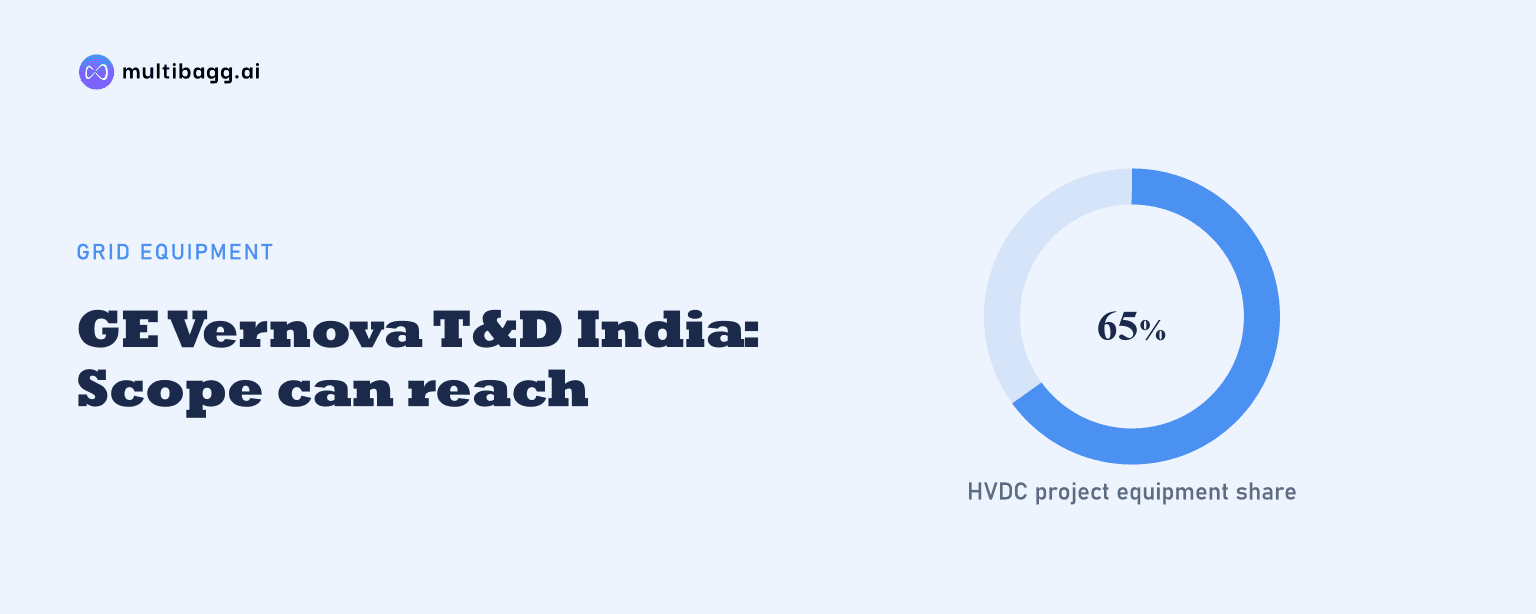
GE Vernova T&D India Limited said equipment addressable by it can account for about 40% to 65% of a high-voltage direct current, or HVDC, project’s value, depending mainly on line length and project composition. Management also said tariff-based competitive bidding, or TBCB, equipment orders are normally awarded three to five months after developers win projects.
Know GE Vernova T&D India inside out
Results, valuation, peers and who's buying, in one view.
What share of an HVDC project can GE Vernova T&D India address?
GE Vernova T&D India said its addressable equipment content is typically about 40% to 65% of an HVDC project, rather than a fixed share. Management gave the range in response to an analyst’s example of a Rs 20,000 crore HVDC project and said the percentage depends on line length and other project factors.
The company illustrated this variation through projects with transmission lines of 800 kilometres, 1,200 kilometres and 1,500 kilometres. A longer line changes the mix of spending between line-related work and equipment, so the addressable share for GE Vernova T&D India can move within the stated 40% to 65% range. The disclosure is an indicative equipment-scope measure, not a forecast for a particular tender or project.
GE Vernova T&D India said it designs and manufactures the complete valve assembly for voltage-source converter, or VSC, HVDC systems, even when insulated-gate bipolar transistors, or IGBTs, are sourced externally from suppliers such as Mitsubishi Electric. For line-commutated converter, or LCC, systems, it similarly sources thyristors externally while manufacturing the thyristor valve as a unit.
Management said externally sourcing IGBTs does not determine the gross margin of a VSC HVDC project. It compared the model with sourcing cold-rolled grain-oriented steel for transformer production, while retaining design and manufacturing responsibility for the completed equipment. The company did not provide gross-margin guidance for HVDC work because mix can vary between products and projects, and between domestic and export orders.
When does GE Vernova T&D India receive TBCB equipment orders?
GE Vernova T&D India said product packages are normally awarded three to five months after a developer wins a TBCB project. Management added that transformers may be ordered earlier, while awards for some other products can be delayed. A developer’s project award therefore does not immediately translate into an equipment order for the company.
The ordering sequence has changed as TBCB delivery periods have lengthened from 18 to 21 months to 24 to 30 months. Under the earlier 18-to-21-month timeline, developers moved quickly to award packages to protect execution schedules. The current 24-to-30-month period gives developers additional time to decide on suppliers after winning a project.
An analyst cited close to Rs 1 lakh crore of TBCB projects that had been tendered, but management did not estimate how much would become equipment orders during the year. It said developers control package-award timing under the longer delivery framework, creating a period of flexibility that rests with them. GE Vernova T&D India therefore did not convert the tender value into an annual market estimate.
How large is the intrastate TBCB opportunity for GE Vernova T&D India?
GE Vernova T&D India said many states have indicated that future expansion at 400 kilovolt and 765 kilovolt could be pursued through TBCB. Management did not quantify an annual intrastate opportunity, saying such figures are more likely to be tracked by project developers than equipment manufacturers.
The intrastate pipeline would extend the opportunity beyond recent interstate tenders, but its order timing remains unquantified. Management’s comments identify the intended procurement route for 400 kilovolt and 765 kilovolt expansion, not the value, timing or equipment content of future state-level projects.
For Power Grid tenders, management said tender activity normally occurs regularly and is based on the TBCB pipeline. This links the company’s potential equipment opportunities to developers’ project wins and subsequent package decisions, rather than to a single bulk-order cycle. No order value or award timetable was disclosed for future Power Grid packages.
Management also said supply chain remains a risk to operations amid high global demand and geopolitical disturbances. That operational constraint applies alongside the TBCB timing issue, because projects may require equipment to be sourced and manufactured after developers finalise package awards. The company described supply chain as a factor capable of having a severe effect on operations.
Got a follow-up? Ask IRIS
When will HVDC execution affect GE Vernova T&D India revenue?
GE Vernova T&D India said significant HVDC execution is expected from financial year 2028, or FY28, onward. Management said HVDC execution will not form part of revenue in the current financial year and is not expected to make a significant contribution in the following financial year. This separates near-term revenue execution from the later HVDC delivery cycle.
For three prospective HVDC projects, two in Barmer and one in Navadiya, management said the projects had not yet received clearance and were expected in 2027. It did not disclose tender values, equipment values or expected order dates for these projects. The timing is therefore a management view on project progress rather than a revenue forecast.
Management said a possible 1,150 kilovolt corridor was still some distance away because the number of projects, bays and transformers had not been established. It said the addressable market would depend on the eventual pipeline and product scope. Competition would also vary by product, including instrument transformers and transformers.
GE Vernova T&D India cited a Rs 21,400 crore backlog plus an HVDC lowest-bidder, or L1, position, and said this could support average revenue growth of more than 30% over the next three years. Management linked that assessment to executing the order backlog, not to material HVDC revenue in the current financial year or the following financial year.
What supports GE Vernova T&D India’s nearer-term execution?
GE Vernova T&D India said its factory-expansion programme totals Rs 1,000 crore, with more than 90% directed to existing plants where it already owns the land. Management said this integrated approach requires less capital than a new-site build to produce similar or higher volumes. The company did not identify individual capacity additions in this discussion.
Management maintained mid-20s earnings before interest, tax, depreciation and amortisation, or EBITDA, guidance for the current financial year after reporting EBITDA of more than 26% in the first half. It said gross margin was about 45% in the quarter and had been at a similar level in the prior financial year, while declining to guide gross margin because quarterly mix changes.
Export flow orders and orders spread across multiple geographies are generally short-cycle, according to management, while some larger projects have delivery periods of three to five years. It also said export orders remain at higher margins than domestic orders without providing the current difference. Data-centre-related backlog was less than 2%, limited to some 220 kilovolt products and grid automation.
Conclusion
GE Vernova T&D India has quantified the potential equipment scope of HVDC work at 40% to 65% of overall project value, but the share depends on line length and specific project composition. Its TBCB comments show why project tenders and developer wins may not immediately generate equipment orders: developers now operate with 24-to-30-month delivery windows and typically award products within three to five months.
Investors should watch for progress on the two Barmer and one Navadiya HVDC projects expected in 2027, as well as the pace of TBCB package awards after developer wins. Management expects significant HVDC execution from FY28 onward, while nearer-term performance depends on delivery of the Rs 21,400 crore backlog and the Rs 1,000 crore factory-expansion programme.