








Genus to Bid Selectively as 4 Crore-Meter Pipeline Emerges
MAX Plan at ₹4,999/yr

Find your next multibaggerBe a Pro Investor
Research stocks and track your picks on the go. Download the app.
Key highlights
- Tamil Nadu’s live tender covers 2 crore smart meters and replaced an earlier 3 crore-meter tender that was scrapped.
- Genus expects West Bengal and Haryana opportunities of 1.7 crore to 2.2 crore meters within 30 to 60 days of November 19, 2026.
- Genus reported an order book of Rs 22,634 crore as of September 30, 2026, compared with Rs 24,000 crore cited for June 2026.
- Genus said its GIC platform can support 3 crore to 5 crore additional meters without fresh capital.
powered by IRIS
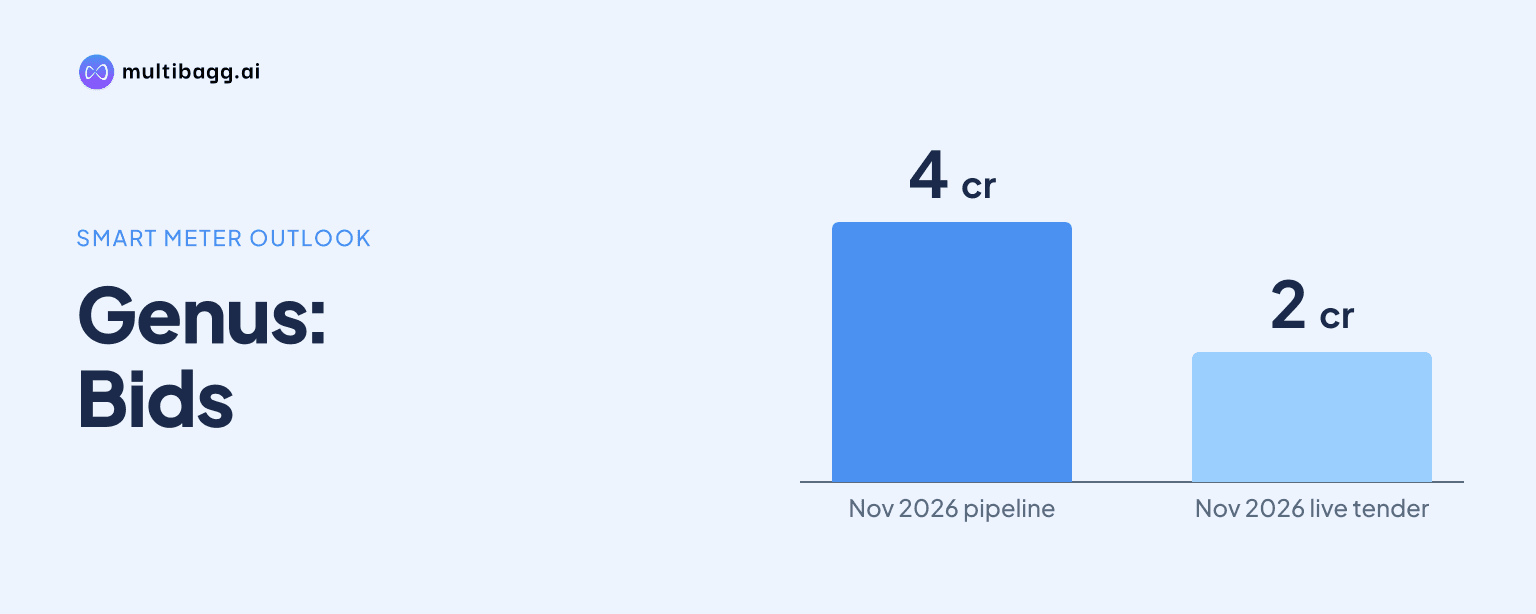
Genus Power Infrastructures Limited said on November 19, 2026 that it will bid selectively for a disclosed smart-meter pipeline of about 4 crore meters, led by Tamil Nadu’s live 2 crore-meter tender, because eight-to-nine-year contracts must meet its return thresholds. The pipeline follows an order book of Rs 22,634 crore as of September 30, 2026.
Know Genus Power Infrastructures inside out
Results, valuation, peers and who's buying, in one view.
Which smart-meter tenders is Genus expecting?
Genus expects Tamil Nadu, West Bengal and Haryana to create a near-term pipeline of 3.7 crore to 4.2 crore meters based on the tender sizes disclosed by management. Tamil Nadu has a live tender for 2 crore meters, West Bengal was preparing a 1 crore-to-1.5 crore-meter tender, and Haryana was expected to tender 0.70 crore meters.
Tamil Nadu’s live opportunity replaced an earlier 3 crore-meter tender that management said had been scrapped by the state’s new government. The replacement tender is under the Revamped Distribution Sector Scheme, or RDSS, and management said submissions are due in February. In response to an analyst’s question, management agreed that an award could occur at the start of FY28 rather than during FY27.
Management said the West Bengal and Haryana tenders were expected within 30 to 60 days of the November 19 call. It separately described the two states as representing at least 2 crore meters, although the specific volumes given on the call total 1.7 crore to 2.2 crore meters. The eventual tender sizes, bid participation and awards remain dependent on the states’ procurement processes.
Why will Genus bid selectively on new projects?
Genus said it will bid only for tenders that clear its return thresholds because smart-meter contracts are serviced for eight to nine years. Management said the company would preserve its margin strategy rather than accept every RDSS project, and cited Madhya Pradesh tenders decided during the preceding six months where it did not participate because bid levels were too low.
This approach coincides with a reduction in the reported order book through project execution. Genus reported an order book of Rs 22,634 crore, including special-purpose vehicles, or SPVs, and the GIC platform but excluding taxes, on September 30, 2026. An analyst cited Rs 24,000 crore in June 2026, Rs 25,173 crore in March 2026 and Rs 30,110 crore at an earlier point; management did not provide a target for the order book at March 2027.
Genus’s existing advanced metering infrastructure service provider, or AMISP, portfolio comprised about 3.6 crore awarded meters, with about 1.7 crore installed as of September 30, 2026. Utilities can add up to 30% more meters under the same contract terms, and management expects the awarded portfolio to exceed 4 crore meters as new service connections are added.
Can Genus finance additional smart-meter awards?
Genus said its GIC platform can support 3 crore to 5 crore additional meters without fresh capital. Management attributed that capacity to long-term non-recourse project financing and AA- rated project SPVs, which it said would allow the company to participate in new tenders while maintaining its stated return discipline.
The funding position sits alongside higher net debt. Net debt was Rs 1,746 crore on September 30, 2026, compared with Rs 1,560 crore on March 31, 2026, an increase of Rs 186 crore. Management said the level remained below its indicated peak net-borrowing limit of about Rs 2,000 crore and expects the pace of increase to moderate as receivables are converted into cash.
Operating cash flow turned positive at Rs 127 crore in H1 FY27, versus an outflow of Rs 158 crore in H1 FY26, a Rs 285 crore change. Management attributed this to operating profit before working-capital changes rising to Rs 481 crore from Rs 441 crore and the working-capital increase falling to Rs 236 crore from Rs 522 crore; inventory also declined by more than Rs 100 crore in the half-year.
Got a follow-up? Ask IRIS
How is execution affecting Genus’s current outlook?
Genus said it installed about 0.41 crore meters in H1 FY27, including about 0.18 crore in Q2, and the lower Q2 pace reduced quarterly revenue. Management attributed the slowdown to a prolonged monsoon, project-specific factors and slower installation activity in Uttar Pradesh, where it expects installations to normalise after elections from April onwards.
Standalone Q2 FY27 revenue was Rs 1,133 crore, compared with Rs 1,149 crore in Q2 FY26, while revenue declined 17% sequentially. In H1 FY27, however, standalone revenue increased 19.4% year on year to Rs 2,497 crore, earnings before interest, tax, depreciation and amortisation, or EBITDA, rose 9.2% to Rs 485 crore, and profit after tax increased 7% to Rs 296 crore.
Management maintained its FY27 revenue guidance of Rs 6,000 crore to Rs 6,500 crore and said it remains positioned to install about 1 crore smart meters during the year. It expects the seasonally stronger second half to have a better Q3 than Q2 and a better Q4 than Q3, but did not provide quarterly revenue estimates. Manufacturing capacity exceeds 1.8 crore meters a year, supporting AMISP projects as well as supplies to utilities and other AMISP operators.
What revenue base supports Genus while tenders proceed?
Genus said operating and maintenance, or O&M, revenue was about Rs 150 crore in H1 FY27 and is expected to exceed Rs 300 crore in FY27. Management said EBITDA margins from O&M should remain similar to those of its installation business, while it expects O&M income to become substantial from FY28 as the installed base enters its operating phase.
Certification progress is central to that revenue and cash-collection transition. More than 1.45 crore of Genus’s 1.7 crore installed meters had undergone site acceptance testing, or SAT, by distribution companies as of the call, leaving roughly two to three months of installations awaiting SAT. Management distinguished this payment certification measure from operational go-live, which it said applied to the entire 3.6 crore-meter awarded portfolio.
Management estimated India’s smart-meter requirement at 31 crore to 32 crore meters, with about 15 crore meters yet to be tendered. That estimate provides context for the Tamil Nadu, West Bengal and Haryana opportunities, but Genus did not disclose a target market share, expected order intake or order-book level for FY28.
Conclusion
Genus is seeking to replenish an order book of Rs 22,634 crore through a prospective 3.7 crore-to-4.2 crore tender pipeline, but management has made returns a condition for participation. Its current position includes 3.6 crore awarded meters, annual manufacturing capacity above 1.8 crore meters and a GIC platform that management says can finance 3 crore to 5 crore additional meters without fresh capital.
The next disclosed markers are Tamil Nadu’s February submission deadline, the expected West Bengal and Haryana tender launches within 30 to 60 days of November 19, and potential Tamil Nadu award timing around the start of FY28. Execution also bears watching: management targets about 1 crore installations and Rs 6,000 crore to Rs 6,500 crore of FY27 revenue, while expecting Uttar Pradesh installations to normalise from April.

