










GHV Infra Projects Limited shifts backlog to industrial, overseas
Key highlights
- GHV reported Rs 10,426 crore of order inflow in H1FY27, compared with Rs 5,885 crore in FY26.
- Industrial projects accounted for Rs 8,777 crore, or 53%, of GHV’s Rs 16,541 crore order book.
- International work represented 47% of GHV’s backlog, and the company reported presence in 3 countries.
- The Rs 7,000 crore Cameroon Tyre Manufacturing Project was GHV’s largest international EPC award.
powered by IRIS
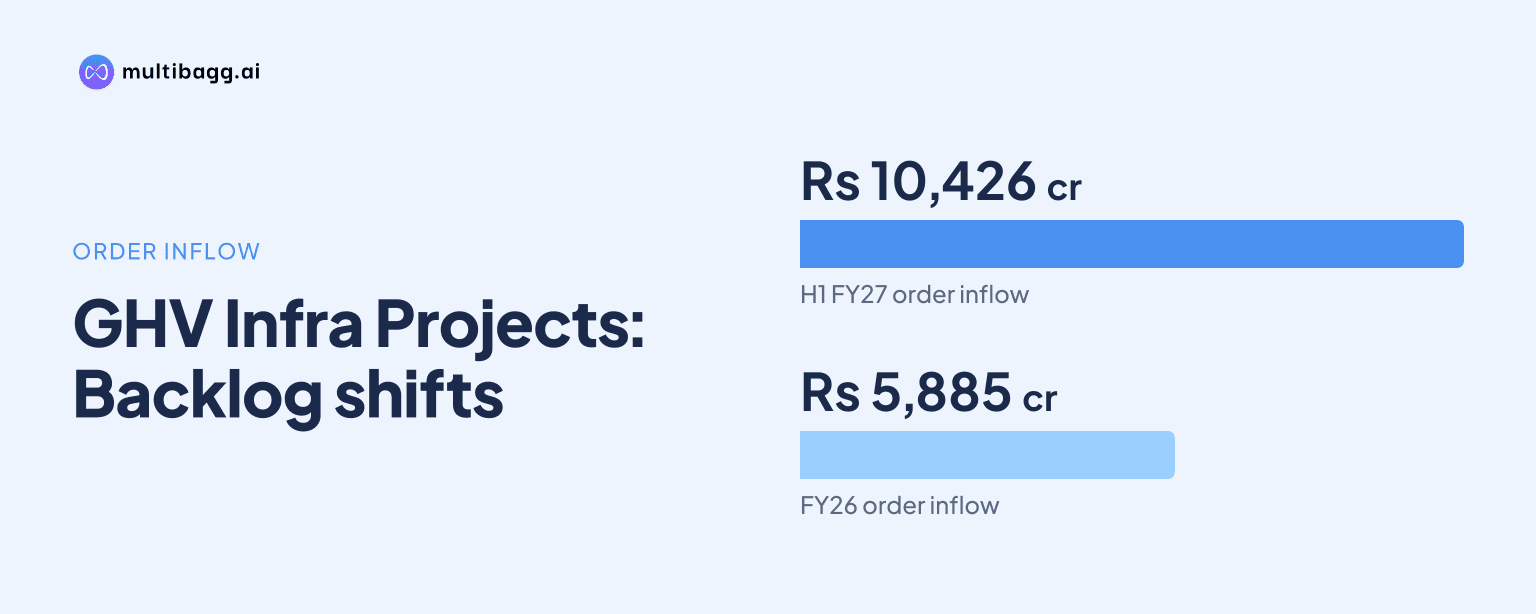
GHV Infra Projects Limited’s Rs 10,426 crore order inflow in the first half of FY27, or H1FY27, lifted its order book to Rs 16,541 crore, with industrial projects comprising 53% and international work 47% of the backlog. The shift was led by the Rs 7,000 crore Cameroon manufacturing project and a Rs 840 crore US renewable natural gas and fertilizer assignment.
Know GHV Infra Projects inside out
Results, valuation, peers and who's buying, in one view.
What changed in GHV’s H1FY27 order book?
GHV’s order inflow reached Rs 10,426 crore in H1FY27, exceeding the Rs 5,885 crore booked in the full FY26 and Rs 2,875 crore in FY25. The company reported a Rs 16,541 crore order book as of November 2026, spanning infrastructure, building, coastal, industrial, energy and data-centre verticals, with 24 ongoing projects.
The scale of fresh awards increased faster than reported revenue. Revenue rose from Rs 185 crore in FY25 to Rs 615 crore in FY26, while H1FY27 revenue was Rs 519 crore. H1FY27 order inflow was therefore more than 20 times first-half revenue, although GHV says the majority of the order book is expected to convert into revenue over the next couple of years rather than within one reporting period.
EBITDA means earnings before interest, tax, depreciation and amortisation. The comparison shows revenue rose by Rs 430 crore between FY25 and FY26, while order inflow rose by Rs 3,010 crore; H1FY27 inflow then added a further Rs 4,541 crore versus the whole of FY26. This widening gap reflects the rapid expansion of contracted work relative to revenue already recognised.
How is GHV’s backlog split by business segment?
Industrial work is GHV’s largest disclosed backlog segment at Rs 8,777 crore, or 53% of the Rs 16,541 crore order book. Infrastructure is next at Rs 5,087 crore, or 31%, followed by building at Rs 2,000 crore, or 12%, and energy at Rs 677 crore, or 4%.
Industrial work exceeds infrastructure by Rs 3,690 crore. GHV describes its industrial capability as civil and mechanical, electrical and plumbing work for refineries, steel plants, petrochemical plants and power plants, as well as lump-sum turnkey process units. Its infrastructure activities include highways, railways, bridges, runways, dams, irrigation and pipelines.
The four disclosed segment values total Rs 16,541 crore, matching the overall order-book figure. Coastal infrastructure and data centres are identified as new verticals in the presentation, but GHV does not disclose separate order-book amounts for either. The segment split therefore shows that the largest identified source of contracted work is industrial rather than the company’s 31% infrastructure segment.
How much of GHV’s order book is international?
International projects represent 47% of GHV’s order book by geography, while domestic projects represent 52%. The total of 99% reflects the presentation’s rounded figures, which GHV says are consolidated and rounded to the nearest digit.
GHV lists Rs 7,840 crore of international orders and Rs 8,609 crore of domestic orders in its order-book highlights. Those amounts total Rs 16,449 crore, Rs 92 crore below the separately stated Rs 16,541 crore overall order book. The presentation does not provide a reconciliation between the geographic figures and the total, so the percentage and value disclosures should be treated as company-reported views rather than exact matching calculations.
The company reports international presence in the United States, West Africa and the United Arab Emirates, alongside operations across nine Indian states. Its presentation describes 24 ongoing projects and an international presence in three countries, while the listed domestic locations include Gujarat, Maharashtra, Karnataka, Andhra Pradesh, Haryana, Madhya Pradesh, Jharkhand, West Bengal and Assam.
Got a follow-up? Ask IRIS
Which contracts drove GHV’s H1FY27 order inflow?
The Rs 7,000 crore Cameroon Tyre Manufacturing Project was GHV’s largest international engineering, procurement and construction, or EPC, award and the principal disclosed contributor to H1FY27 inflow. The project covers EPC work for a greenfield tyre manufacturing facility in West Africa and amounts to roughly two-thirds of the Rs 10,426 crore order inflow reported for H1FY27.
Other disclosed wins included two Maharashtra road projects worth Rs 1,250 crore and Rs 815 crore, a Rs 840 crore DUCTOR Green and Fertilizer Project in the United States, and railway industrial-infrastructure orders worth Rs 429 crore. These identified awards total Rs 10,334 crore, close to the Rs 10,426 crore H1FY27 inflow, with the presentation not detailing the remaining Rs 92 crore.
GHV also said its wholly owned US subsidiary, GHV Infra Inc., was incorporated by early May in Ohio. The US assignment concerns renewable natural gas and fertilizer, adding an energy-related industrial project to the company’s overseas work. The Cameroon award and US project help explain the reported 47% international share and Rs 8,777 crore industrial backlog.
What does GHV expect from backlog conversion and margins?
GHV expects improved execution conditions in Q3FY27 and Q4FY27 after rainfall affected EPC activity during H1FY27, particularly in Q2FY27. Q2FY27 revenue was Rs 300 crore, up 63% year on year, and H1FY27 revenue was Rs 519 crore, up 96% year on year. The company expects a substantial share of FY27 revenue to be booked in the second half, but gives no numerical FY27 revenue target.
EBITDA was Rs 59 crore in H1FY27, compared with Rs 99 crore in FY26, while the EBITDA margin was 11% against 16% in FY26. Profit after tax, or PAT, was Rs 25 crore in H1FY27, and the PAT margin was 5%, compared with Rs 49 crore and an 8% margin in FY26. These comparisons cover a partial year versus a full year, but they show the margin profile presented for the first half was below FY26.
Management attributes the H1FY27 margin profile to a mix-led phase of execution. It says higher-margin energy, coastal and data-centre projects are expected to scale as they progress through the Rs 16,541 crore order book, creating scope for margin improvement. That statement is management’s expectation, while the reported figures remain Rs 59 crore of H1FY27 EBITDA and an 11% EBITDA margin.
Conclusion
GHV’s H1FY27 awards changed both the size and composition of its contracted pipeline. The Rs 10,426 crore inflow took the order book to Rs 16,541 crore, with industrial work at 53% and international projects at 47%. The Rs 7,000 crore Cameroon manufacturing project, Rs 840 crore US assignment and Rs 2,065 crore of disclosed Maharashtra road work combine overseas industrial EPC with domestic infrastructure activity.
The next disclosed test is second-half FY27 execution after rainfall constrained work in H1FY27, particularly in Q2FY27. Management expects conditions to improve in Q3FY27 and Q4FY27 and says most of the order book should convert into revenue over the next couple of years. It will also be important to monitor the scale-up of energy, coastal and data-centre projects that management expects to support margins.