










GHV Infra lists Rs 7,840 crore in overseas EPC projects
Key highlights
- GHV lists the Cameroon tyre-factory assignment at Rs 7,000 crore with a 36-month execution period.
- GHV’s Ohio RNG and fertiliser project is valued at Rs 840 crore and scheduled for 24 months.
- The Cameroon facility is planned for annual production capacity of 7.6 million tyres.
- The two overseas projects total Rs 7,840 crore within Rs 10,426 crore of stated FY26-27 new wins.
powered by IRIS
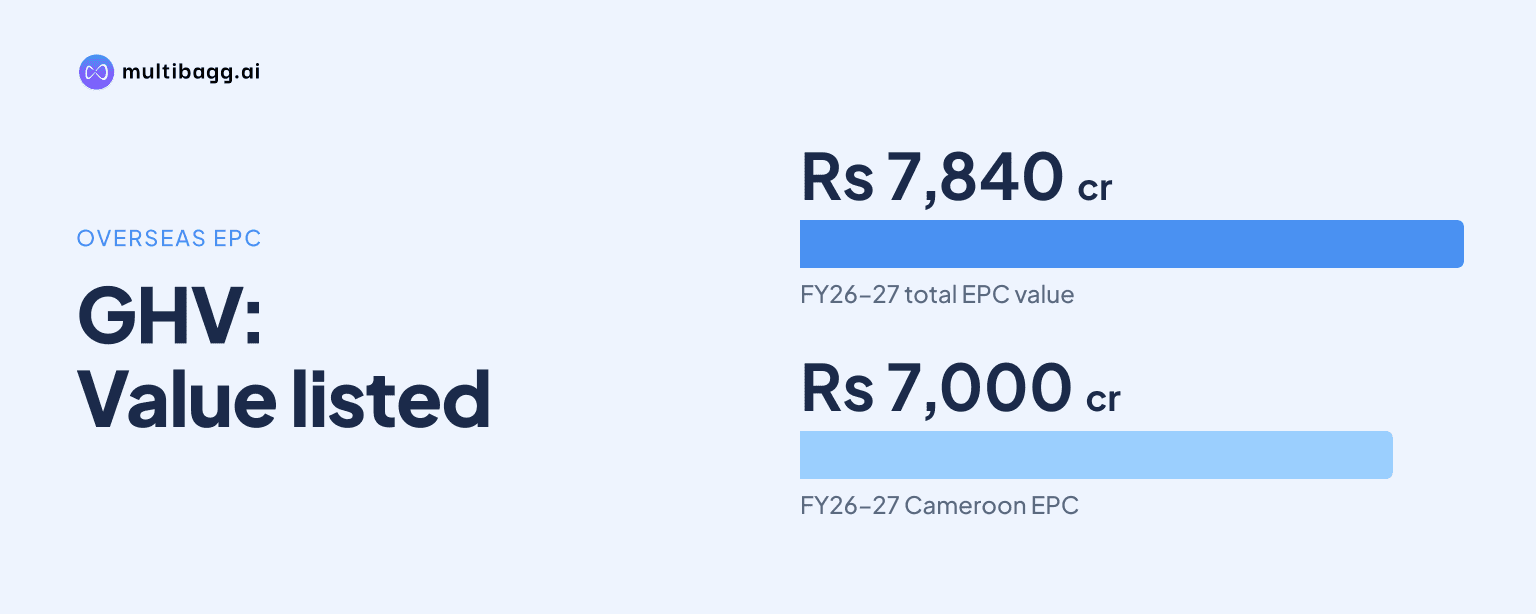
GHV Infra’s H1FY27 presentation lists Rs 7,840 crore of overseas engineering, procurement and construction (EPC) work: a Rs 7,000 crore Cameroon tyre facility scheduled for 36 months and a Rs 840 crore Ohio renewable natural gas and fertiliser facility scheduled for 24 months. The presentation frames the projects as entry into Africa and the United States.
Know GHV Infra Projects inside out
Results, valuation, peers and who's buying, in one view.
What does GHV’s Cameroon tyre project involve?
GHV’s Cameroon assignment involves EPC work for a greenfield tyre manufacturing facility at Bekoko, Douala, in Cameroon’s Littoral Region. It has a stated value of Rs 7,000 crore, planned output of 7.6 million tyres a year and a 36-month execution period from Notice to Proceed, the instruction to begin work. The work is on a lump-sum turnkey (LSTK) basis.
The presentation describes the project as industrial manufacturing rather than a roads assignment, extending GHV’s stated focus into manufacturing, energy and sustainable infrastructure. However, its strategic highlights call the Rs 7,000 crore Cameroon opportunity a letter of intent (LOI) and a potential order-book addition. The FY26-27 new-order-wins table and the order book both list it as a Rs 7,000 crore EPC project, creating a distinction between the LOI description and its order-book presentation.
How does GHV’s Ohio RNG project compare with Cameroon?
GHV’s Ohio assignment is Rs 6,160 crore smaller than the Cameroon project and has a 12-month shorter execution period, but its stated scope specifically includes commissioning. The DUCTOR RNG Project, named DRAKE, is an integrated renewable natural gas (RNG) and fertiliser facility in Versailles, Ohio, with a Rs 840 crore value and a 24-month schedule from Notice to Proceed.
The order book identifies Ductor Americas Inc. as the Ohio project’s client and classifies the Rs 840 crore contract as industrial. The Rs 7,000 crore Cameroon project is also classified as industrial. This differs from several domestic order-book categories, which include infrastructure, power and building work, while the two overseas assignments add tyre manufacturing and RNG-fertiliser execution.
How do the overseas projects affect GHV’s stated new-order mix?
The two overseas projects account for Rs 7,840 crore of the Rs 10,426 crore of new order wins that GHV lists for FY26-27. The remaining listed wins include Rs 1,250 crore of expressway-connector work from Jalna to Nanded in Maharashtra and Rs 815 crore of road construction work in Maharashtra. On the values presented, the overseas work represents the largest portion of that new-wins table.
GHV’s broader order book also contains a Rs 2,000 crore building project at Malad East in Mumbai, Rs 1,060 crore of elevated viaducts and roads on stilts over mangroves in Mumbai, and a Rs 473 crore diversion-dam and pumping-system project. The stated pipeline therefore spans industrial, infrastructure, power and building segments rather than roads alone. The presentation does not provide project-level billing dates or revenue-recognition schedules for the Cameroon or Ohio assignments.
The company also presents a Rs 125 crore electric locomotive-unit project at Dahod, Gujarat, as a domestic industrial-execution reference. That factory was inaugurated in May 2025 and has capacity for 120 locomotives annually, scalable to 150. The Cameroon plant’s 7.6 million-tyre annual capacity is in a different manufacturing segment and carries a much larger stated contract value.
Got a follow-up? Ask IRIS
What delivery and financial mechanisms does GHV disclose?
GHV says its contract-management system seeks mobilisation advances to fund early project activity and reduce initial working-capital requirements. It also links collections to certified milestones, while describing price-escalation clauses, variation and claims tracking, and centralised billing oversight. Those mechanisms are relevant to projects with 36-month and 24-month execution periods because work and collections may extend across several reporting periods.
The presentation does not confirm that either the Rs 7,000 crore Cameroon assignment or the Rs 840 crore Ohio assignment has specific mobilisation advances, escalation clauses or claims terms. These are company-level practices described on the contracts-management page, not disclosed commercial provisions for the two overseas projects. The Cameroon project’s Notice to Proceed is also not dated in the presentation.
For H1FY27, GHV reported consolidated revenue from operations of Rs 519 crore, compared with Rs 264 crore in H1FY26, while earnings before interest, tax, depreciation and amortisation (EBITDA) rose to Rs 59 crore from Rs 31 crore. EBITDA margin was 11% in H1FY27 versus 12% a year earlier. Management targets 100% year-on-year revenue growth in FY27 and has maintained 13% EBITDA-margin guidance, citing cost optimisation and operational efficiencies.
Conclusion
GHV’s presentation shows that its international EPC push is concentrated in two large industrial assignments with different delivery models: a 7.6 million-tyre-a-year LSTK facility in Cameroon and an RNG and fertiliser facility in Ohio. Their combined Rs 7,840 crore stated value changes the mix of disclosed new wins toward overseas industrial and energy-related work alongside domestic roads, water, rail, power and buildings.
The next point to watch is whether the Cameroon LOI progresses to a dated Notice to Proceed and fully executable terms, given its separate treatment as an LOI and an order-book project. Investors can also monitor GHV’s progress toward management’s FY27 targets of 100% revenue growth and a 13% EBITDA margin, as well as milestone-based execution on the 24-month Ohio plan.