










GHV Infra targets 100% FY27 growth after rain disruption
Key highlights
- GHV Infra is targeting 100% year-on-year revenue growth in FY27 after reporting Rs 615 crore in FY26.
- H1FY27 revenue rose 96% year on year to Rs 519 crore, while Q2FY27 revenue was Rs 300 crore.
- GHV Infra reported an order book of Rs 16,541 crore and H1FY27 order inflow of Rs 10,426 crore.
- H1FY27 EBITDA margin was 11%, compared with 16% in FY26 and management’s FY27 guidance of 13%.
powered by IRIS
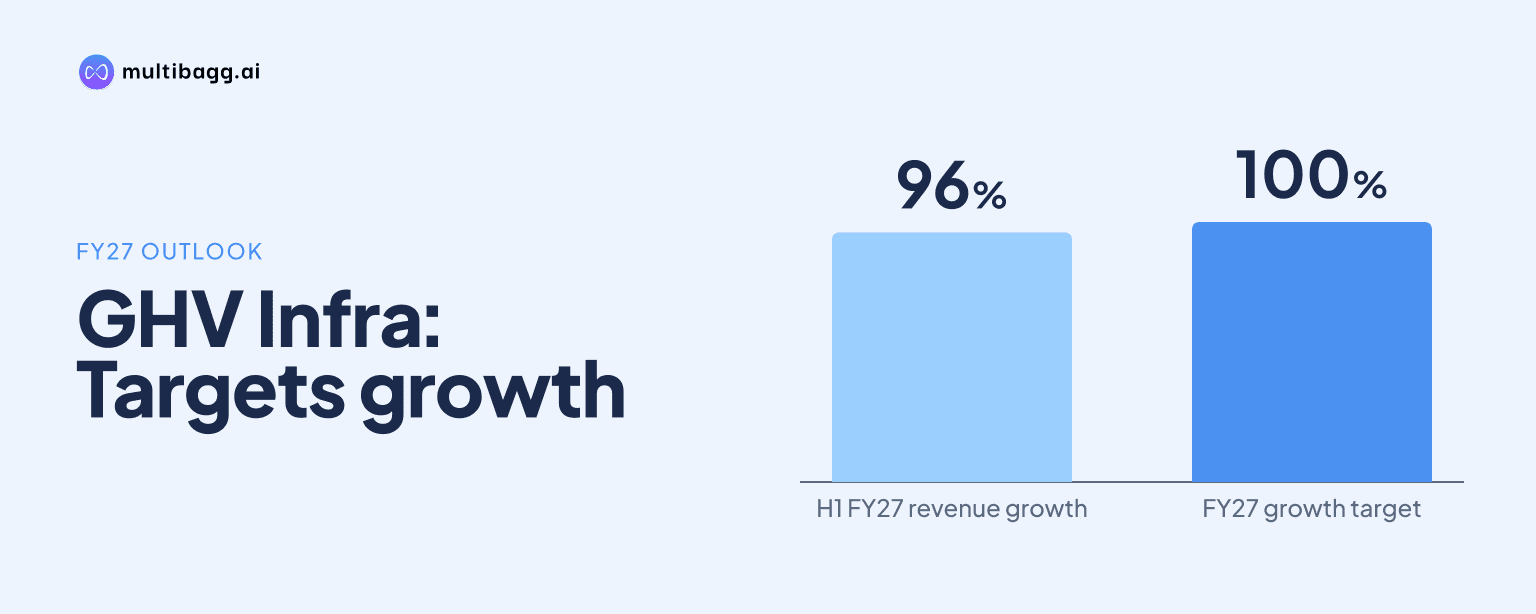
GHV Infra Projects Limited is targeting 100% year-on-year revenue growth in FY27 after rainfall, particularly in Q2FY27, affected first-half engineering, procurement and construction execution; it reported Rs 519 crore in H1FY27 and expects a substantial share of annual revenue in the second half.
Know GHV Infra Projects inside out
Results, valuation, peers and who's buying, in one view.
How is GHV Infra targeting 100% FY27 revenue growth?
GHV Infra is targeting 100% year-on-year revenue growth in FY27, management’s guidance following Rs 615 crore of revenue in FY26. That guidance implies approximately Rs 1,230 crore of FY27 revenue, although management has not published a rupee target. It also maintained EBITDA, or earnings before interest, tax, depreciation and amortisation, margin guidance of 13%, with gradual improvement expected from cost optimisation and operational efficiencies.
The plan rests on an order book of Rs 16,541 crore and H1FY27 order inflow of Rs 10,426 crore. Management expects the majority of the order book to convert into revenue over the next couple of years, rather than stating that all of it will convert during FY27. Its strategy includes pursuing data centres, coastal roads, marine infrastructure and modern rail or locomotive plants across six EPC verticals.
What did rainfall do to GHV Infra’s H1FY27 execution?
GHV Infra says rainfall affected EPC execution in H1FY27, particularly in Q2FY27, while it expects improved execution conditions in Q3FY27 and Q4FY27. Q2FY27 revenue was Rs 300 crore, up 63% year on year, and H1FY27 revenue was Rs 519 crore, up 96% year on year. Management says a substantial portion of annual revenue should be booked in the second half.
An implied Rs 1,230 crore FY27 revenue outcome would require about Rs 711 crore in H2FY27, compared with Rs 519 crore reported in H1FY27. That comparison shows the degree of second-half acceleration embedded in the guidance. The presentation does not provide separate revenue objectives for Q3FY27 or Q4FY27, leaving project execution after the rainy period as the key disclosed dependency.
How did GHV Infra’s profits and margins change in H1FY27?
GHV Infra reported H1FY27 EBITDA of Rs 59 crore, up 93% year on year, while profit after tax rose 55% to Rs 25 crore. In Q2FY27, EBITDA was Rs 35 crore, up 57% year on year, and profit after tax was Rs 17 crore, up 55% year on year. Revenue growth of 96% in H1FY27 therefore exceeded the reported growth in profit after tax.
The EBITDA margin declined to 11% in H1FY27 from 16% in FY26 and 13% in FY25, while the profit-after-tax margin was 5%, compared with 8% and 9%, respectively. Management says the current margin profile reflects a mix-led phase of execution. It expects Energy, Coastal and Data Center projects to scale through the order book, but this is a management expectation rather than a reported margin outcome.
Got a follow-up? Ask IRIS
Which projects and segments support GHV Infra’s conversion plan?
GHV Infra’s disclosed order book is led by Industrial projects at Rs 8,777 crore, followed by Infrastructure at Rs 5,087 crore, Building at Rs 2,000 crore and Energy at Rs 677 crore. Industrial is therefore larger than Infrastructure by Rs 3,690 crore. Coastal and Data Centre are identified as new verticals, but the presentation does not separately disclose their order-book values.
The largest disclosed international win is the Cameroon greenfield tyre manufacturing project, valued at about Rs 7,000 crore. The project is described as a letter of intent and involves engineering, procurement and construction work for a facility with planned capacity of 7.6 million tyres a year. The presentation also cites Maharashtra road projects worth Rs 1,250 crore and Rs 815 crore, a Rs 840 crore renewable natural gas and fertiliser project in Ohio, and Rs 429 crore of railways industrial infrastructure orders.
How diversified is GHV Infra’s backlog and footprint?
GHV Infra reports 47% of its order book as international and 52% as domestic, with the one-percentage-point gap attributable to rounded presentation figures. By client type, GHV India represented 24%, other domestic clients 28% and international clients 47%. The company reported 24 ongoing projects spanning nine Indian states and three countries in H1FY27.
Maharashtra accounted for 76% of the disclosed state-wise order-book split, compared with 8% for Gujarat, 5% for Karnataka and 11% for other states. GHV Infra also cited its asset-light model and access to group equipment, including a listed fleet of 1,181 units. Its gross debt-to-equity ratio nevertheless increased to 2.0 times in H1FY27 from 1.5 times in FY26, as short-term debt rose to Rs 378 crore from Rs 24 crore.
What operational measures does GHV Infra plan to use?
GHV Infra plans to improve productivity through digital project monitoring, automation and value engineering, while maintaining cost discipline to move EBITDA margins towards 15%. This longer-term operational objective is separate from management’s FY27 EBITDA-margin guidance of 13%. The company also plans to expand across nine Indian states and international markets while using joint-bidding capabilities within the GHV Group.
The group equipment schedule includes 450 tippers, 290 diesel-generator sets, 125 transit mixers and 56 excavators, which GHV Infra says support asset-light execution without heavy upfront capital expenditure. Asset turnover rose to 1.0 times in FY26 from 0.8 times in FY25, while net worth increased to Rs 131 crore from Rs 43 crore. These figures describe the capital base entering the FY27 execution period.
Conclusion
GHV Infra’s FY27 growth target depends on converting a Rs 16,541 crore order book into revenue after weather constrained H1FY27 work. Revenue of Rs 519 crore in the first half was already 84% of FY26 revenue of Rs 615 crore, but management’s 100% growth guidance implies about Rs 711 crore must be delivered in H2FY27.
The next results should show whether improved Q3FY27 and Q4FY27 conditions produce the substantial second-half revenue booking management anticipates. Investors can also watch progress on the Rs 7,000 crore Cameroon letter of intent, the Rs 840 crore Ohio project, and whether the reported 11% H1FY27 EBITDA margin moves toward management’s 13% FY27 guidance.