










GHV Infra H1FY27 revenue rose 96% as PAT margin fell to 5%
Key highlights
- GHV Infra reported H1FY27 revenue of Rs 519 crore, up 96% from Rs 264 crore in H1FY26.
- H1FY27 finance cost rose 200% to Rs 25 crore, while PAT margin declined to 5% from 6%.
- Short-term borrowings increased to Rs 378 crore at H1FY27 from Rs 24 crore at FY26.
- GHV Infra reported Rs 10,426 crore of H1FY27 order inflow and a Rs 16,541 crore order book.
powered by IRIS
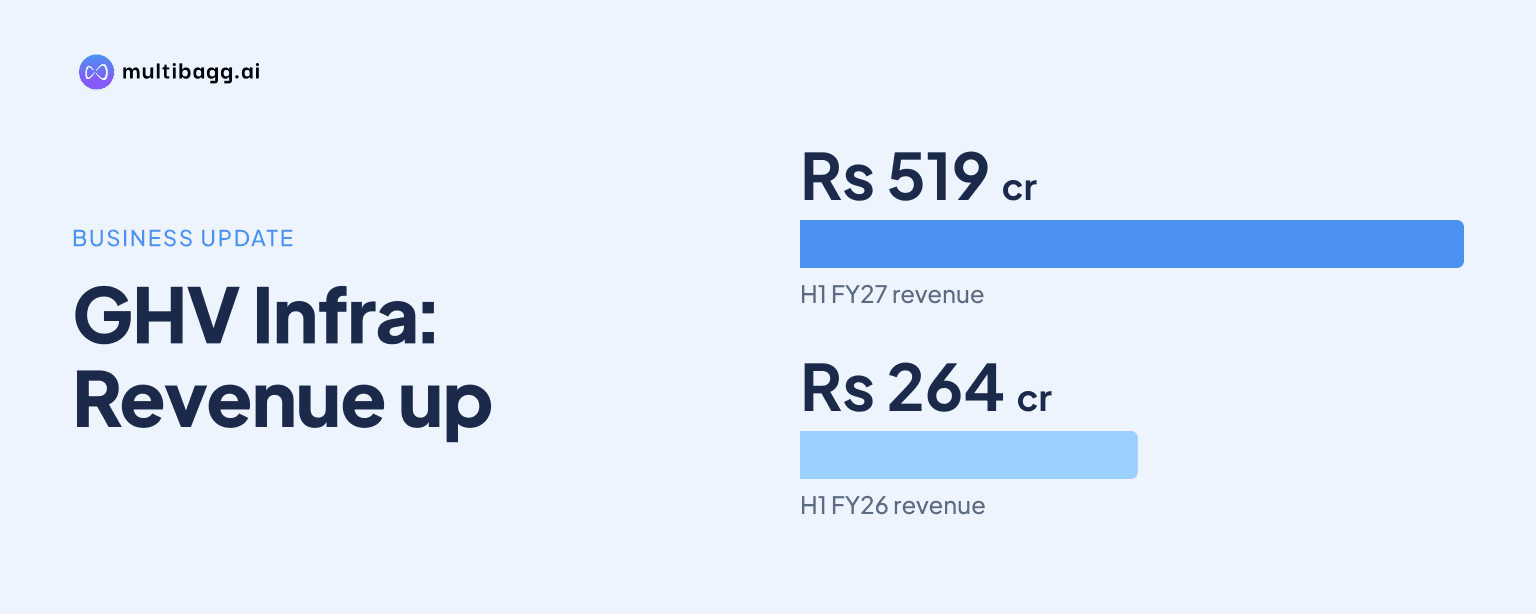
GHV Infra Projects Limited reported H1FY27 revenue of Rs 519 crore, up 96% year on year, but finance cost rose 200% to Rs 25 crore and profit after tax margin declined to 5% from 6%. The faster rise in borrowing and working-capital balances accompanied the revenue expansion.
Know GHV Infra Projects inside out
Results, valuation, peers and who's buying, in one view.
How fast did GHV Infra's H1FY27 revenue and profit grow?
GHV Infra's H1FY27 revenue grew 96% year on year to Rs 519 crore from Rs 264 crore in H1FY26, while earnings before interest, tax, depreciation and amortisation, or EBITDA, rose 93% to Rs 59 crore from Rs 31 crore. Profit after tax, or PAT, increased 55% to Rs 25 crore from Rs 16 crore, meaning profit growth trailed both revenue and EBITDA growth.
The second quarter accounted for Rs 300 crore of H1FY27 revenue, up 63% from Rs 184 crore in Q2FY26 and 37% from Rs 219 crore in Q1FY27. Q2 PAT was Rs 17 crore, compared with Rs 11 crore a year earlier and Rs 7 crore in the preceding quarter. Basic earnings per share were Rs 3.43 for H1FY27, versus Rs 2.21 in H1FY26.
The half-year result also puts H1FY27 revenue at Rs 519 crore against the Rs 615 crore reported for all of FY26. Management has targeted 100% year-on-year revenue growth in FY27, while maintaining EBITDA-margin guidance of 13%. That target will depend on the conversion of its stated Rs 16,541 crore order book and Rs 10,426 crore of H1FY27 order inflow into billed project work.
Why did GHV Infra's margins decline despite higher revenue?
GHV Infra's PAT margin fell to 5% in H1FY27 from 6% in H1FY26, while EBITDA margin declined to 11% from 12%. Gross margin declined to 16% from 17%, as cost of goods sold rose 98% to Rs 434 crore, marginally faster than the 96% rise in revenue.
Finance cost was the larger movement below operating profit: it increased to Rs 25 crore in H1FY27 from Rs 8 crore in H1FY26. Earnings before interest and tax rose 88% to Rs 57 crore, but profit before tax increased only 48% to Rs 33 crore. Tax expense rose 28% to Rs 8 crore, resulting in the 55% increase in PAT.
The quarter-on-quarter figures show some operating-margin recovery. Q2FY27 EBITDA margin was 12%, compared with 11% in Q1FY27, and Q2 PAT margin was 6%, compared with 3% in Q1FY27. Management said the current profile reflects a mix-led execution phase and expects higher-margin energy, coastal and data-centre projects to scale as they progress through the order book; this is a stated expectation rather than a reported result.
Got a follow-up? Ask IRIS
How did GHV Infra's debt and working capital change in H1FY27?
GHV Infra's short-term borrowings rose to Rs 378 crore at H1FY27 from Rs 24 crore at FY26, while long-term borrowings declined to Rs 34 crore from Rs 168 crore. Total borrowings therefore increased to Rs 412 crore from Rs 192 crore, reflecting a substantial shift toward current funding during the half year.
Gross debt to equity increased to 2.0 times at H1FY27 from 1.5 times at FY26, and net debt to equity rose to 1.9 times from 1.4 times. Total equity increased to Rs 206 crore from Rs 131 crore, including Rs 166 crore of other equity. The equity increase did not prevent the debt-equity ratios from rising because current borrowings expanded more quickly.
Trade debtors increased to Rs 278 crore at H1FY27 from Rs 127 crore at FY26, while other current assets grew to Rs 591 crore from Rs 275 crore. Current assets reached Rs 912 crore, versus Rs 428 crore at FY26, and current liabilities reached Rs 731 crore, versus Rs 293 crore. Cash equivalents and bank balances were Rs 23 crore at H1FY27, compared with Rs 9 crore at FY26.
What projects support GHV Infra's order book and FY27 plan?
GHV Infra reported a Rs 16,541 crore order book across infrastructure, building, energy and industrial work, with industrial projects valued at Rs 8,777 crore and infrastructure at Rs 5,087 crore. Building represented Rs 2,000 crore and energy Rs 677 crore, making industrial the largest disclosed segment in the order-book split.
H1FY27 order inflow of Rs 10,426 crore included a Rs 7,000 crore Cameroon greenfield tyre-manufacturing project and an Rs 840 crore renewable natural gas and fertiliser project in Ohio, United States. The Cameroon project has a stated 36-month execution period and a capacity of 7.6 million tyres annually, while the Ohio project has a 24-month execution period.
Management's strategy is to pursue complex projects in data centres, coastal roads, marine infrastructure and modern rail or locomotive plants, while seeking to move EBITDA margin towards 15% through cost management and operational efficiencies. Its stated FY27 guidance remains 100% revenue growth and a 13% EBITDA margin, with gradual improvement expected through optimisation measures.
Conclusion
GHV Infra delivered substantial H1FY27 revenue and EBITDA growth, with revenue approaching its FY26 full-year level in six months. However, the reported rise in finance cost, short-term borrowings, debtors and other current assets coincided with lower gross, EBITDA and PAT margins, so the scale-up did not translate proportionately into net profit.
The next measures to watch are execution against management's FY27 targets of 100% revenue growth and a 13% EBITDA margin, as well as the progression of the Rs 10,426 crore H1FY27 order intake. The company has also identified higher-margin energy, coastal and data-centre work as a prospective source of margin improvement as projects advance.