










Ginni Filaments profit falls 9% as expenses outpace sales
Key highlights
- Ginni Filaments' September-quarter profit fell 9.0% to Rs 9.33 crore from Rs 10.26 crore.
- Revenue from operations increased 6.5% to Rs 101.21 crore in the quarter ended September 30, 2026.
- Cost of materials consumed rose 12.6% to Rs 47.02 crore, while other expenses increased 27.6% to Rs 34.86 crore.
- Half-year purchases of property, plant and equipment were Rs 14.74 crore, compared with Rs 2.16 crore a year earlier.
powered by IRIS
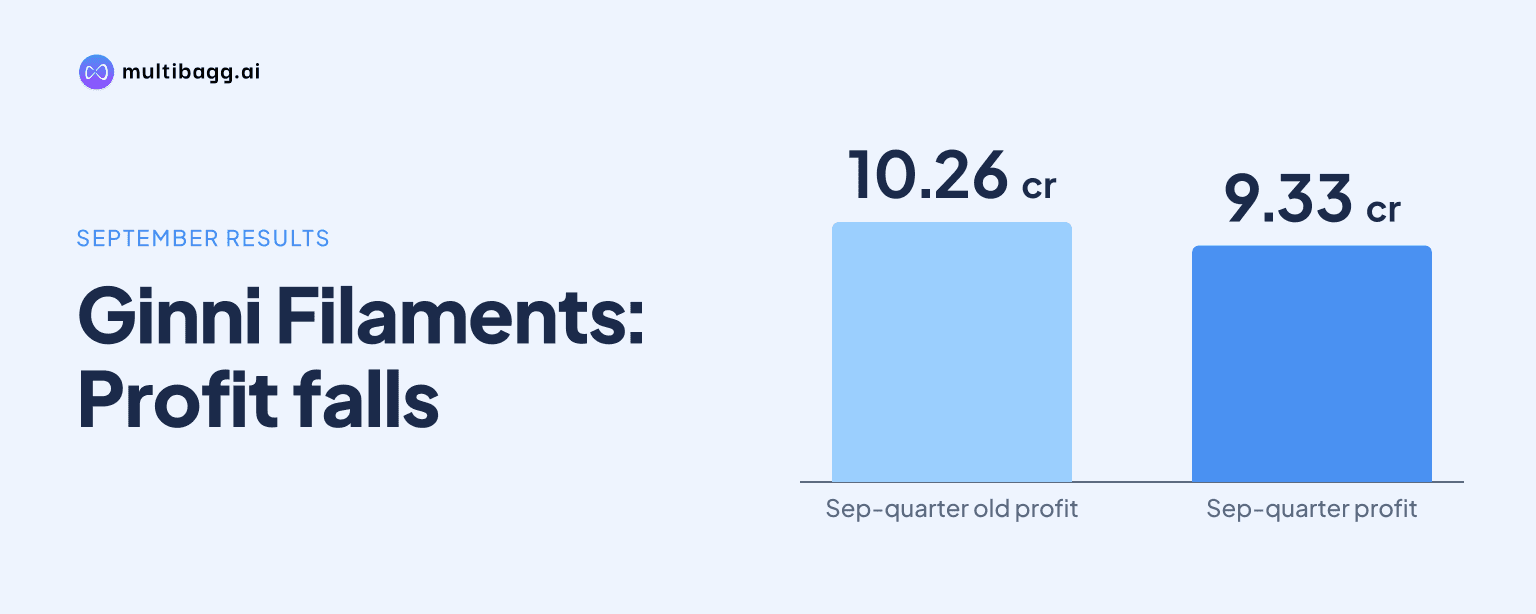
Ginni Filaments Limited reported profit for the period of Rs 9.33 crore for the quarter ended September 30, 2026, down 9.0% from Rs 10.26 crore a year earlier, as revenue from operations rose 6.5% to Rs 101.21 crore but total expenses increased 8.9% to Rs 89.45 crore.
Know Ginni Filaments inside out
Results, valuation, peers and who's buying, in one view.
Why did Ginni Filaments' September-quarter profit decline?
Ginni Filaments' September-quarter profit declined because expense growth exceeded the increase in operating revenue. Revenue from operations rose by Rs 6.18 crore year on year to Rs 101.21 crore, while total expenses rose by Rs 7.32 crore to Rs 89.45 crore, reducing profit before tax to Rs 12.49 crore from Rs 13.32 crore.
Profit from continuing operations fell 6.9% to Rs 9.33 crore from Rs 10.03 crore in the quarter ended September 30, 2025. The reported profit-for-the-period decline was larger because the prior-year quarter also contained Rs 22.73 lakh of profit from discontinued operations, whereas the September 2026 quarter had no discontinued-operations contribution.
The tax expense was Rs 3.16 crore in the September 2026 quarter, compared with Rs 3.29 crore a year earlier. This lower tax charge partly offset the Rs 82.87 lakh fall in profit before tax, but it did not prevent the decline in continuing-operations profit.
Which costs rose faster than Ginni Filaments' sales?
Ginni Filaments' materials cost and other expenses rose faster than sales during the September 2026 quarter. Cost of materials consumed increased 12.6% to Rs 47.02 crore from Rs 41.76 crore, while other expenses rose 27.6% to Rs 34.86 crore from Rs 27.32 crore.
Together, those two expense lines increased by Rs 12.79 crore from the September 2025 quarter, more than twice the Rs 6.18 crore increase in operating revenue. Inventory changes partly offset this pressure, producing a Rs 3.01 crore credit in September 2026 against a Rs 1.88 crore expense a year earlier.
Employee benefits expense declined to Rs 7.28 crore from Rs 7.44 crore, while depreciation and amortisation fell to Rs 2.36 crore from Rs 2.50 crore. Finance costs also declined to Rs 94.18 lakh from Rs 1.23 crore, but these reductions were insufficient to offset the increases in materials and other expenses.
How did Ginni Filaments' textile and consumer businesses perform?
Ginni Filaments' textiles business recorded the faster revenue growth, while consumer products recorded the larger fall in segment earnings. Textiles revenue increased 13.1% to Rs 64.96 crore in the September 2026 quarter from Rs 57.45 crore a year earlier, whereas consumer products revenue rose 0.7% to Rs 55.14 crore.
Textiles segment result, defined as earnings before interest and tax, slipped to Rs 7.32 crore from Rs 7.37 crore despite the revenue increase. Consumer products segment result fell 14.7% to Rs 6.12 crore from Rs 7.17 crore, reducing combined segment results to Rs 13.43 crore from Rs 14.55 crore.
For the half year ended September 30, 2026, textiles revenue increased to Rs 133.12 crore from Rs 126.84 crore, but its segment result declined to Rs 18.10 crore from Rs 21.39 crore. Consumer products revenue rose to Rs 113.16 crore from Rs 108.90 crore, while its segment result fell to Rs 8.35 crore from Rs 13.97 crore.
Got a follow-up? Ask IRIS
What do Ginni Filaments' cash flow and balance sheet show?
Ginni Filaments generated net cash inflow from operating activities of Rs 23.25 crore during the half year ended September 30, 2026, compared with Rs 27.97 crore in the prior-year half from continuing operations. The current-period figure followed Rs 24.80 crore of profit before tax from continuing operations and a Rs 6.29 crore reduction in trade receivables.
The working-capital movement also included a Rs 5.01 crore increase in inventories, compared with a Rs 3.92 crore reduction in inventories in the prior-year half. Cash generated from operations was Rs 28.95 crore, and income tax paid was Rs 5.70 crore, resulting in the reported operating cash inflow.
Investing activities used Rs 12.90 crore in the September 2026 half year, compared with an inflow of Rs 1.26 crore in the corresponding prior-year period. Purchases of property, plant and equipment totalled Rs 14.74 crore, while capital work-in-progress increased to Rs 13.90 crore at September 30, 2026 from Rs 3.01 crore at March 31, 2026.
Cash and cash equivalents stood at Rs 6.29 crore at September 30, 2026, compared with Rs 24.98 lakh at March 31, 2026. Total assets increased to Rs 343.41 crore from Rs 328.65 crore, while total equity rose to Rs 253.77 crore from Rs 235.56 crore and total liabilities declined to Rs 89.64 crore from Rs 93.09 crore.
What changed after Ginni Filaments closed its garment division?
Ginni Filaments' Board approved the closure of its Garment Division on May 7, 2025, and the related assets were disposed of during the year ended March 31, 2026. The company has therefore presented the undertaking separately as discontinued operations under Indian Accounting Standard 105, or Ind AS 105.
The closure resulted in an exceptional loss of Rs 5.46 crore in the quarter ended June 30, 2025. The company said that loss reflected the remeasurement of assets classified as held for sale at the lower of carrying amount and fair value less costs to sell.
There was no exceptional item or discontinued-operations profit or loss in the quarter ended September 30, 2026. Ginni Filaments' segment information for textiles and consumer products excludes discontinued operations, making the segment comparison focused on continuing businesses.
The September 2026 results were unaudited and were approved by the Board on November 2, 2026. Doogar & Associates issued a limited review report dated November 2, 2026, stating that nothing had come to its attention to indicate a material misstatement or inadequate disclosure under the applicable listing requirements.
Conclusion
Ginni Filaments lifted September-quarter operating revenue by 6.5% to Rs 101.21 crore, supported by a 13.1% increase in textiles revenue, but profit for the period fell 9.0% to Rs 9.33 crore. Materials consumption and other expenses rose faster than sales, while consumer products segment earnings fell and textiles segment earnings were broadly unchanged.
The next results will indicate whether the Rs 14.74 crore half-year spending on property, plant and equipment and the increase in capital work-in-progress to Rs 13.90 crore affect operations. The filing also leaves inventory, which increased by Rs 5.01 crore during the half year, and segment profitability in textiles and consumer products as measures to watch.