










Globus Prestige & Above nears EBITDA breakeven, revenue up 54%
Key highlights
- Globus Prestige & Above revenue rose 54% year-on-year to Rs 59.9 crore in Q2 FY27.
- Globus Prestige & Above volume increased 64% year-on-year to 0.46 million cases in Q2 FY27.
- Globus reduced the Prestige & Above EBITDA loss to Rs 20 lakh in Q2 FY27.
- Globus had five profitable states across its 12-market Prestige & Above footprint.
powered by IRIS
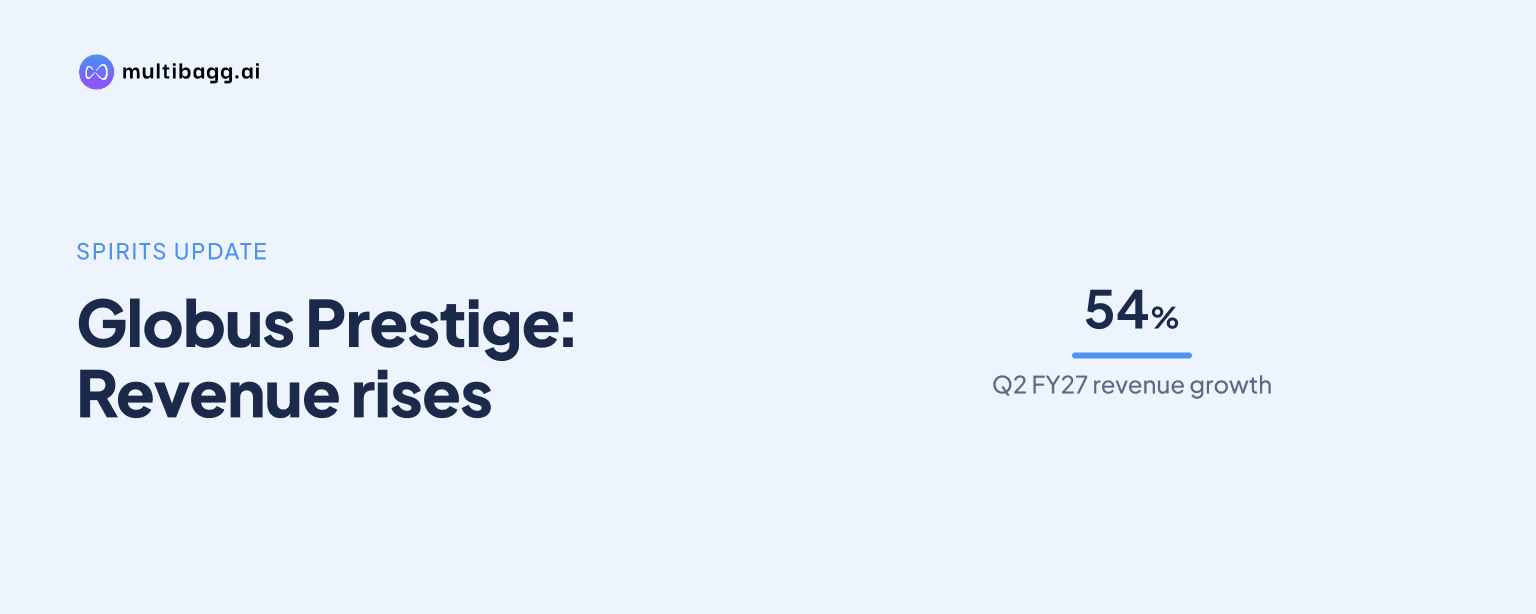
Globus Spirits Limited’s Prestige & Above business was within Rs 20 lakh of earnings before interest, tax, depreciation and amortisation (EBITDA) breakeven in the second quarter (Q2) of fiscal year 2027 (FY27), after revenue rose 54% year-on-year to Rs 59.9 crore. Management attributed the reduced loss to higher volumes and improved cost absorption.
Know Globus Spirits inside out
Results, valuation, peers and who's buying, in one view.
How close is Globus Prestige & Above to EBITDA breakeven?
Globus’ Prestige & Above, or P&A, segment recorded an EBITDA loss of Rs 20 lakh in Q2 FY27, placing it close to quarterly breakeven. Revenue reached Rs 59.9 crore and volume increased 64% year-on-year to 0.46 million cases. Sequentially, revenue rose 9% and volume increased 10%, showing that the business expanded both from the preceding quarter and from a year earlier.
Management said increasing scale improved P&A operating economics during the quarter. Gross margin was broadly unchanged sequentially despite input-cost inflation, while higher volume improved the absorption of fixed costs and reduced the EBITDA loss. In the first half (H1) of FY27, P&A generated approximately Rs 114.9 crore of revenue from approximately 0.88 million cases.
P&A’s result differed from the larger Regular and Others, or R&O, segment. R&O revenue rose 14% year-on-year to Rs 242.8 crore in Q2 FY27, while EBITDA increased 4% to Rs 38.6 crore. P&A therefore delivered faster revenue growth, but R&O remained the established earnings contributor, generating more than four times P&A revenue and reporting positive EBITDA.
What is improving Globus Prestige & Above profitability?
Globus said rising volume is improving P&A cost absorption and limiting the effect of input-cost inflation on profitability. The segment sold 0.46 million cases in Q2 FY27, 10% more than in the prior quarter, while revenue grew 9% sequentially. Management linked that increase in scale to the improvement in quarterly EBITDA.
Globus had five profitable states in its 12-market P&A footprint at the October 30, 2026 earnings call. Management said net sales value trends had stabilised sequentially and that it would deepen established markets while entering additional markets only where it saw a clear route to profitable scale. The near-breakeven result is therefore being used to support expansion rather than to limit investment.
The group result provides wider context for the consumer segment’s progress. Globus reported total Q2 FY27 revenue of Rs 758 crore, up 15% year-on-year, and group EBITDA of Rs 63.8 crore, up 2%. P&A’s Rs 20 lakh EBITDA loss means the premium business had not yet added positive quarterly EBITDA even as its revenue grew faster than total company revenue.
Got a follow-up? Ask IRIS
Where is Globus expanding its Prestige & Above business?
Globus plans to add five duty-free channels and enter two new states during FY27, extending a P&A operation that covered 12 markets at the time of the call. Management said expansion would remain selective and focused on markets where the segment can attain profitable scale, rather than pursuing distribution growth without that path.
Globus also targeted entry into CSG during Q3 FY27, subject to approvals. The transcript does not define CSG or quantify its potential sales contribution, so the timing and commercial effect of that entry remain uncertain. Management said its wider consumer strategy is to build growth across more markets rather than depend on a limited set of states.
DWAAR, Globus’ new Indian blended luxury whiskey, was initially launched in Haryana, Chandigarh and Goa. Management said it planned to build distribution through consumer trials in those three markets. The company did not disclose DWAAR revenue, volumes or profitability in Q2 FY27, so its contribution to the 54% P&A revenue increase was not specified.
Why is Globus expanding before P&A reaches profit?
Globus is continuing selective P&A expansion because management views scale as the mechanism for achieving sustained profitability. The segment’s 64% year-on-year volume increase to 0.46 million cases reduced its Q2 FY27 EBITDA loss to Rs 20 lakh. The FY27 plan includes five duty-free additions and entry into two new states, alongside investment in established markets.
Globus completed a Rs 200 crore qualified institutional placement during the quarter and had used Rs 155 crore of the proceeds for long-term debt repayment by September-end. Management said the fundraise strengthened the balance sheet and created additional room for consumer-business growth, without identifying a separate amount allocated specifically to P&A. Total debt fell by Rs 200 crore between March and September.
The reported debt-to-EBITDA ratio fell from 2.63 times at March-end to about 2 times at September-end. Management estimated interest savings of approximately Rs 6 crore in H2 FY27, or Rs 11 crore to Rs 12 crore on an annualised basis. Operating cash flow, however, declined to Rs 139 crore in H1 FY27 from Rs 270 crore in H1 FY26 as trade receivables increased with business volume.
Conclusion
Globus’ Q2 FY27 result shows P&A moving closer to its operating threshold: revenue increased 54% to Rs 59.9 crore, volume rose 64% to 0.46 million cases, and the EBITDA loss narrowed to Rs 20 lakh. R&O, by comparison, generated Rs 38.6 crore of quarterly EBITDA on revenue growth of 14%, illustrating the difference in maturity between the two consumer segments.
The next disclosed milestones are five duty-free additions, two new-state entries and targeted Q3 FY27 entry into CSG, subject to approvals. Management’s consumer-growth plan also includes building DWAAR distribution beyond its initial Haryana, Chandigarh and Goa launch markets, while the segment’s future EBITDA outcome will depend on whether higher volumes continue to improve cost absorption.