










Globus Spirits manufacturing EBITDA rises 27% in H1 FY27
Key highlights
- Globus Spirits’ manufacturing EBITDA rose 27% year on year to Rs 62.2 crore in H1 FY27.
- Manufacturing revenue increased 11% to Rs 927 crore, while sales volume rose 7% to 111.37 million litres in H1 FY27.
- Q2 FY27 manufacturing EBITDA fell 5% year on year to Rs 25.4 crore, with EBITDA per litre at Rs 4.6.
- Globus Spirits reduced term loans by Rs 155 crore between April and September 2026 after receiving Rs 200 crore from a qualified institutional placement.
powered by IRIS
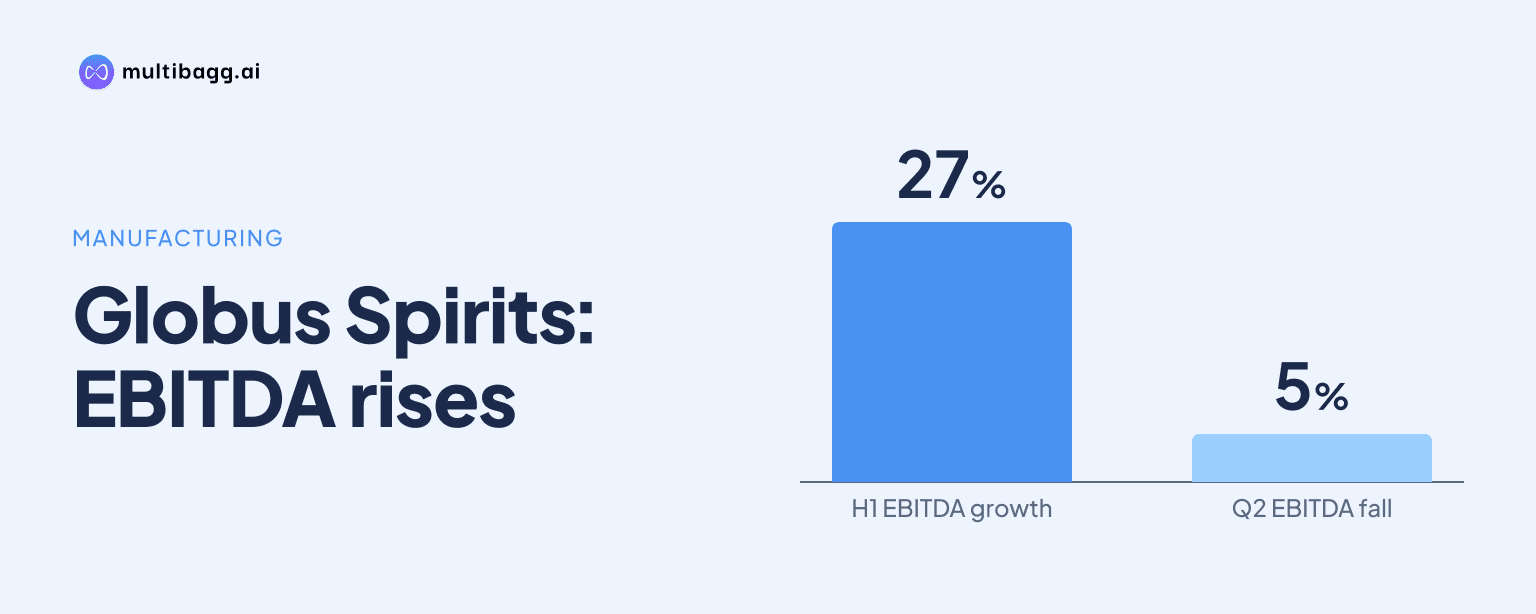
Globus Spirits Limited reported manufacturing earnings before interest, tax, depreciation and amortisation (EBITDA) of Rs 62.2 crore in H1 FY27, up 27% year on year, on Rs 927 crore of revenue. The H1 advance contrasted with Q2 FY27, when EBITDA fell 5% to Rs 25.4 crore and EBITDA per litre was Rs 4.6 because product and raw-material mix affected realisation.
Know Globus Spirits inside out
Results, valuation, peers and who's buying, in one view.
What did Globus Spirits’ manufacturing segment report in H1 FY27?
Globus Spirits reported Rs 62.2 crore of manufacturing EBITDA in H1 FY27, a 27% increase from H1 FY26, alongside 7% growth in sales volume to 111.37 million litres. Segment revenue rose 11% year on year to Rs 927 crore, while volume grew at a slower 7% rate over the six-month period.
The H1 outcome differed from the second-quarter trend. Q2 FY27 manufacturing revenue was Rs 455 crore, up 11% year on year but down 4% sequentially, while volume was 55.26 million litres, up 11% year on year and down 2% sequentially. EBITDA of Rs 25.4 crore was 5% lower year on year and 31% below Q1 FY27.
Manufacturing contributed 60% of Globus Spirits’ H1 FY27 revenue in the company’s two-engine framework, compared with 40% from consumer operations. Manufacturing revenue of Rs 927 crore was therefore greater than the combined Rs 614.1 crore reported by the consumer businesses during the half year.
Why did Globus Spirits’ Q2 manufacturing profitability decline?
Globus Spirits attributed the Q2 movement to a change in product and raw-material mix that affected realisation per litre. Manufacturing EBITDA per litre was Rs 4.6 in Q2 FY27, compared with Rs 5.59 for H1 FY27, placing the second-quarter outcome below the half-year average.
The per-litre outcome occurred despite Q2 sales volume of 55.26 million litres, nearly half of the 111.37 million litres sold in H1 FY27. Revenue declined 4% sequentially to Rs 455 crore and EBITDA declined 31% sequentially to Rs 25.4 crore, while volume declined 2%, indicating a different quarterly relationship between volume and profitability.
The presentation’s annual series shows variation in manufacturing EBITDA per litre across periods. It was Rs 3.4 in FY24, Rs 2.0 in FY25 and Rs 6.2 in FY26, before reaching about Rs 5.6 in H1 FY27. The H1 FY27 level was below the FY26 full-year figure but above the Rs 4.6 recorded in Q2 FY27.
How large is Globus Spirits’ manufacturing network?
Globus Spirits operated six manufacturing sites with about 334 million litres of annual distillation capacity and reported 82% capacity utilisation in Q2 FY27. The facilities are in Haryana, West Bengal, Rajasthan, Jharkhand, Bihar and Uttar Pradesh.
Panagarh, West Bengal, is the largest listed site at 102 million litres of capacity, followed by Behragoda, Jharkhand, at 68 million litres and Behror, Rajasthan, at 54.4 million litres. Samalkha, Haryana, has 47.6 million litres, Lakhimpur Kheri, Uttar Pradesh, has 34 million litres, and Hajipur, Bihar, has 28.9 million litres.
The sites serve consumer and bulk requirements, with product ranges differing by location. Samalkha and Panagarh produce regular and other consumer products, prestige and above products, Extra Neutral Alcohol (ENA), ethanol and contract bottling, while Behragoda produces ENA, ethanol and prestige and above products. Hajipur is listed for ENA and ethanol, while Behror and Lakhimpur Kheri include ENA alongside selected consumer categories.
Got a follow-up? Ask IRIS
How did manufacturing compare with Globus Spirits’ consumer businesses?
Globus Spirits’ manufacturing revenue of Rs 927 crore in H1 FY27 exceeded the combined Rs 614.1 crore reported by its consumer segments. Consumer regular and other revenue was Rs 499.2 crore, up 12% year on year, while prestige and above revenue was Rs 114.9 crore, up 44%.
The consumer segments reported different H1 profitability results. Regular and other EBITDA was Rs 82.6 crore, up 9% year on year, whereas prestige and above recorded negative EBITDA of Rs 1.5 crore, an improvement of 38% from the prior-year loss. Manufacturing EBITDA was Rs 62.2 crore, up 27% year on year.
At company level, revenue from operations rose 14% to Rs 1,551.2 crore in H1 FY27 and EBITDA increased 17% to Rs 143.3 crore. In Q2 FY27, total-company EBITDA rose 2% to Rs 63.8 crore, but the EBITDA margin was 8%, compared with 9% in Q2 FY26, alongside the manufacturing segment’s 5% EBITDA decline.
What manufacturing investment and financing developments should readers track?
Globus Spirits said capital work in progress increased by Rs 36 crore between March 2026 and September 2026, primarily because of malt and bottling capital expenditure. Fixed assets, including capital work in progress, were Rs 1,260 crore in September 2026, compared with Rs 1,250.7 crore in March 2026.
The company reported a Rs 155 crore reduction in term loans between April and September 2026 after receiving Rs 200 crore from a qualified institutional placement. Long-term borrowings were Rs 68.9 crore in September 2026, down from Rs 223.3 crore in March 2026, while treasury investments including bank deposits and cash totalled Rs 165.32 crore.
Management estimated that loan repayment could reduce finance costs by about Rs 6 crore in H2 FY27 and Rs 11 crore to Rs 12 crore on an annualised basis. Management also estimated H2 FY27 interest income of Rs 2.5 crore from investments, with an annualised expectation of Rs 5 crore and an indicated yield of about 7.3%.
Conclusion
Globus Spirits’ manufacturing business delivered higher H1 FY27 revenue, volumes and EBITDA, with EBITDA rising 27% to Rs 62.2 crore. However, Q2 EBITDA fell 5% to Rs 25.4 crore and per-litre EBITDA was Rs 4.6, showing that the half-year increase coexisted with quarterly sensitivity to product and raw-material mix.
The next indicators to watch are whether EBITDA per litre moves toward the H1 FY27 figure of Rs 5.59 and whether Q2 capacity utilisation of 82% changes across the approximately 334 million-litre network. The disclosed malt and bottling capital expenditure, together with management’s estimated Rs 6 crore H2 FY27 finance-cost saving, are also scheduled factors in subsequent reported performance.