










Globus Spirits retains annual Rs 5 to Rs 7 ethanol margin target
Key highlights
- Globus Spirits reported Q2 FY27 manufacturing EBITDA of Rs 4.60 per litre, versus Rs 5.59 per litre in H1 FY27.
- Management retained annual manufacturing EBITDA guidance of Rs 5 to Rs 7 per litre despite a Rs 3-per-litre maize-ethanol price reduction.
- Management estimated OMC demand for grain-based ethanol at about 900 crore litres in the coming ethanol year.
- Maize represented about 60% of Globus Spirits’ H1 FY27 ethanol volume, but management may change the feedstock mix.
powered by IRIS
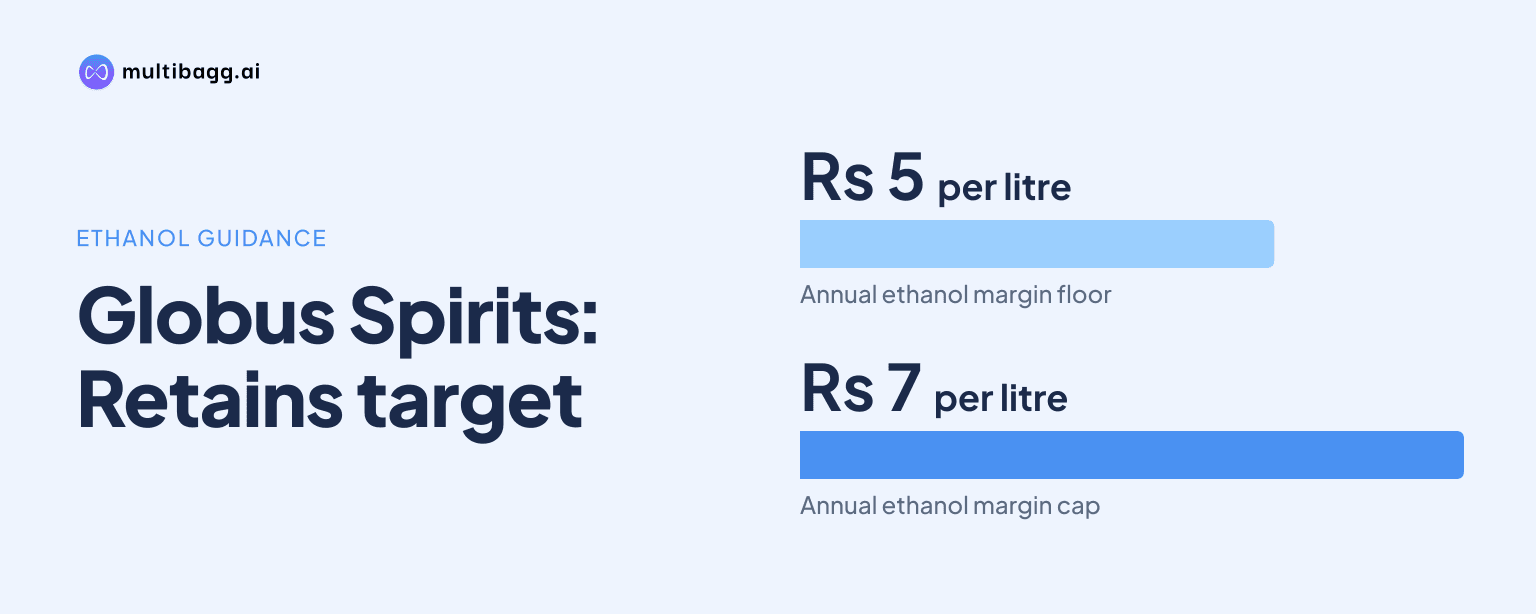
Globus Spirits Limited retained its annual manufacturing EBITDA target of Rs 5 to Rs 7 per litre for FY27 even after a Rs 3-per-litre cut in maize-ethanol pricing, citing feedstock flexibility and expected higher grain-ethanol utilisation as sugar-based supply declines. Manufacturing EBITDA was Rs 4.60 per litre in Q2 FY27.
Know Globus Spirits inside out
Results, valuation, peers and who's buying, in one view.
Why does Globus Spirits expect higher ethanol volumes?
Globus Spirits expects higher ethanol volumes in the ethanol supply year beginning around November because management anticipates lower availability of sugar-based ethanol and greater procurement opportunities for grain-based producers. Management estimated oil marketing company, or OMC, demand for grain-based ethanol at about 900 crore litres, compared with chemical-industry demand of about 100 crore to 150 crore litres and beverage-industry demand of about 300 crore to 400 crore litres.
The expected increase also reflects Globus Spirits’ offtake arrangements and plant mix. Management said its Bengal, Jharkhand and Haryana facilities have long-term OMC offtake agreements, while its Bihar facility was excluded from that arrangement. Rajasthan and Uttar Pradesh do not have ethanol capacity. The company had generally operated at 80% to 85% capacity utilisation, and management expects utilisation to become meaningfully higher in the coming ethanol year.
Uttar Pradesh provides a separate volume mechanism because management said country liquor in the state is shifting from molasses-based to grain-based alcohol. Globus Spirits said Uttar Pradesh utilisation had increased over the preceding three to four months, without disclosing the rate. Management expects much higher volumes between November and October, although it said the new ethanol year could begin later than its scheduled 1 November start.
Can Globus Spirits maintain its Rs 5 to Rs 7 target after the price cut?
Globus Spirits believes it can maintain annual manufacturing EBITDA of Rs 5 to Rs 7 per litre by switching feedstocks and products rather than relying solely on maize ethanol. Management said the Rs 3-per-litre reduction in maize-ethanol pricing would affect raw-material economics, but the company can use Food Corporation of India, or FCI, rice, broken rice, maize, ethanol and extra-neutral alcohol, or ENA.
FCI allocations and revised rice-quality rules underpin management’s view on alternatives to maize. The permissible broken-grain content in raw rice is being reduced to 10% from 25% during the Kharif marketing season 2026-27, which management expects to increase broken-rice supply. Management also said visibility on FCI rice allocations at the start of the ethanol year should provide a fixed-price option and limit upward pressure on rice prices.
The company does not expect to shift all output from ethanol to ENA. Management said ENA is difficult to move across states because of state taxes and import or export duties, while Globus Spirits has local demand near facilities in Rajasthan, Haryana, Uttar Pradesh, Bengal and Jharkhand. Its stated margin plan instead combines changes in ethanol feedstock, selective ENA production, OMC offtake agreements and by-products including distillers dried grains with solubles, or DDGS, and corn oil.
Got a follow-up? Ask IRIS
What does Q2 FY27 manufacturing performance show?
Globus Spirits reported Q2 FY27 manufacturing revenue of Rs 455 crore from 5.526 crore litres, producing EBITDA of Rs 25.4 crore, or Rs 4.60 per litre. The quarterly result was below Rs 5.59 per litre in H1 FY27 and approximately Rs 6.60 per litre over the trailing 12 months, showing that Q2 profitability was lower than both the half-year and longer-period measures.
Management attributed the Q2 movement to higher grain and fuel costs before the new crop season and scheduled plant maintenance. Rice prices were about Rs 24 to Rs 25 per kilogram at the end of Q1 and about Rs 27 to Rs 28 per kilogram at September-end; maize moved from about Rs 21 to Rs 22 per kilogram to about Rs 23 to Rs 24 per kilogram. Management expects new-crop arrivals from around mid-Q3 to moderate these costs and evaluates manufacturing performance over 12 months rather than one quarter.
Management said Globus Spirits had operated within its Rs 5 to Rs 7 per-litre guidance range for six to eight quarters despite the Q2 FY27 result. It described manufacturing as the base business for using capacity and generating incremental cash flow, with annual sales volume of roughly 20 crore to 25 crore litres. That distinction is management’s rationale for retaining the annual target despite quarterly cost volatility.
What could affect Globus Spirits’ volume and margin plans?
Globus Spirits’ outlook depends on OMC allocations, tender timing and actual offtake. Management said it had not completed all FY26 ethanol orders and expected completion by around 30 November, while hoping the new OMC tender would also conclude by then. Lower allocations, slower tender completion or weaker OMC offtake could reduce utilisation even if sugar-based ethanol supply contracts.
Feedstock costs could also change the production mix. Maize represented about 60% of H1 FY27 ethanol volume, but management said the share could fall to about 30% if FCI rice or broken rice delivers better economics. It did not offer a fixed future mix, saying it would choose among ethanol, ENA, FCI rice, damaged grain and maize based on the combination that supports the Rs 5 to Rs 7 per-litre objective.
Management also said the opportunity would not be uniform across Indian distilleries because substantial capacity exists. It distinguished between producers with long-term OMC agreements, producers without such agreements and the smaller group with both ENA and ethanol flexibility. Globus Spirits’ confidence therefore rests on its own agreements, plant locations, feedstock options and by-product revenue, rather than on a claim that all grain distilleries will see the same economics.
Conclusion
Globus Spirits’ manufacturing outlook combines an expected rise in grain-based ethanol utilisation with a plan to manage unit economics through feedstock and product flexibility. Q2 FY27 EBITDA of Rs 4.60 per litre was below the Rs 5.59 per litre reported in H1, but management attributed the gap to seasonal grain and fuel costs and retained its annual Rs 5 to Rs 7 target.
The next indicators are the completion of FY26 ethanol orders around 30 November and the timing and outcome of the new OMC tender. Management’s plan also depends on FCI rice allocations, the supply impact from the reduction in permissible broken grain from 25% to 10%, post-harvest maize and rice prices, and whether utilisation moves above its historical 80% to 85% range.