










Globus Spirits Q2 FY27 Revenue Rises 15% to INR 762 Crore
Key highlights
- Globus Spirits reported Q2 FY27 revenue of INR 762.4 crore, up 15% year on year.
- Q2 FY27 profit after tax was INR 14.9 crore, down 36% year on year.
- Prestige & Above revenue rose 54% to INR 59.9 crore, with volume up 64% to 0.46 million cases.
- Debt fell by INR 200 crore between March and September, taking debt-to-EBITDA to about 2 times from 2.63 times.
powered by IRIS
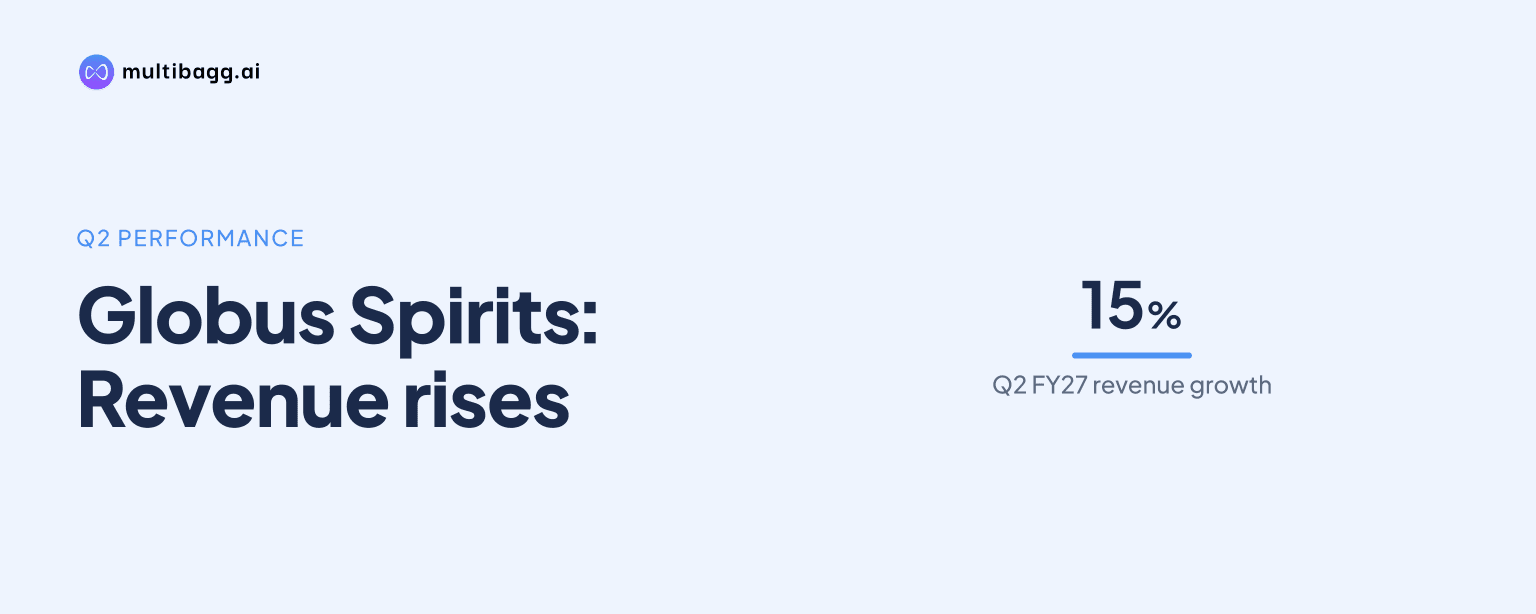
Globus Spirits Limited reported Q2 FY27 revenue of INR 762.4 crore, up 15% year on year, supported by consumer-business growth, although profit after tax declined 36% to INR 14.9 crore amid higher grain and fuel costs in manufacturing. The company also disclosed the audio recording of its October 30 earnings call under SEBI disclosure rules.
Know Globus Spirits inside out
Results, valuation, peers and who's buying, in one view.
What did Globus Spirits report for Q2 and H1 FY27?
Globus Spirits reported revenue of INR 762.4 crore in the quarter ended September 30, 2026, compared with a 15% year-on-year increase, according to its investor presentation. Q2 EBITDA rose 2% year on year to INR 63.8 crore, with EBITDA margin reported at 9%. Profit after tax was INR 14.9 crore, down 36% from the corresponding quarter.
For the first half of FY27, revenue increased 14% year on year to INR 1,551.2 crore, while profit after tax rose 1% to INR 42.4 crore. The earnings-call transcript separately described H1 revenue at INR 1,541 crore and growth of 11%. The figures in the investor presentation provide the more detailed reported revenue amount used in this summary.
The company held its Q2 and H1 FY27 conference call on October 30, 2026, with Chief Executive Officer and Joint Managing Director Shekhar Swarup, Consumer Division Chief Executive Officer Paramjit Singh Gill, and Chief Financial Officer Nilanjan Sarkar participating. Globus Spirits subsequently made the call audio available on its website in compliance with Regulation 30 of the SEBI Listing Obligations and Disclosure Requirements Regulations.
Why did manufacturing profitability decline in the quarter?
Manufacturing revenue was INR 455 crore in Q2 FY27 on volumes of 55.26 million litres, while segment EBITDA was INR 25.4 crore. EBITDA per litre was INR 4.6, lower than the company's stated INR 5 to INR 7 per-litre guidance range, as higher grain and fuel costs weighed on the quarter.
Management said Q2 is typically the period with the highest raw-material and fuel inflation before the new crop season. Scheduled plant maintenance also affected the period. Swarup said these pressures generally begin easing from the middle of the third quarter and advised investors to assess manufacturing performance over a 12-month period rather than one quarter alone.
The company reported H1 manufacturing EBITDA per litre of INR 5.59 and trailing 12-month EBITDA per litre of about INR 6.6. Management retained its INR 5 to INR 7 per-litre manufacturing guidance and did not see a basis to raise it, citing the large amount of capacity available in India.
How is the consumer business contributing to growth?
The Prestige & Above, or P&A, portfolio was the main consumer-business growth driver cited during the call. P&A revenue rose 54% year on year to INR 59.9 crore in Q2 FY27, while volumes increased 64% to 0.46 million cases. The segment's EBITDA loss narrowed to INR 0.2 crore, bringing it close to break-even.
Five of the 12 P&A markets are profitable, according to management. The portfolio currently relies on Uttar Pradesh, West Bengal, Delhi and Jharkhand as key states. Management identified Odisha as the first of the planned new additions, while noting that Haryana is contributing but is not growing as meaningfully as Uttar Pradesh.
The next stage of the consumer plan includes five additional duty-free channels, entry into two new states during FY27 and a targeted consumer special group, or CSG, entry in Q3, subject to approvals. Management also reiterated EBITDA-margin guidance of 16% to 18% for the retail and other business, stating that current margins are within that range.
Got a follow-up? Ask IRIS
What did the company say about debt and input costs?
Globus Spirits used INR 155 crore by the end of September to repay long-term debt. This was part of an overall debt reduction of INR 200 crore between March and September, according to the chief financial officer. The debt-to-EBITDA ratio improved from 2.63 times to about 2 times.
The debt repayment is estimated to reduce interest costs by about INR 6 crore in the second half of FY27, or INR 11 crore to INR 12 crore on an annualised basis. This is relevant because the Q2 profit-after-tax decline came despite revenue growth and a modest rise in EBITDA.
On raw materials, management said ethanol-price changes generally flow through to input prices. It cited clarity on Food Corporation of India rice allocation at the beginning of the year and greater broken-rice availability after the permissible broken-grain content was reduced from 25% to 10%. Management said maize prices were expected to remain lower in the new ethanol year and also referred to flexibility in extra neutral alcohol, or ENA, sourcing.
What does the Q2 performance mean for investors?
The quarter showed that revenue growth from the consumer portfolio and other operations continued even as manufacturing margins faced seasonal cost pressure. The contrast between 15% Q2 revenue growth and a 36% decline in profit after tax illustrates the effect that grain, fuel and maintenance costs can have on earnings in a manufacturing-heavy business.
For investors, the P&A portfolio is a measurable area of progress because its revenue and case volumes expanded faster than consolidated revenue, while losses narrowed to INR 0.2 crore. However, the segment remains dependent on execution across existing and new state markets, where liquor distribution and product approvals are state-specific.
The reduction in debt is another relevant operating development. A lower debt-to-EBITDA ratio and expected interest savings may support the financial profile, but the company has retained, rather than increased, its manufacturing-margin guidance. That stance reflects management's view that industry capacity remains substantial despite a potentially easier raw-material environment.
Conclusion
Globus Spirits delivered 15% Q2 FY27 revenue growth to INR 762.4 crore, with consumer premiumisation supporting the top line. But higher grain and fuel costs, alongside plant maintenance, held manufacturing EBITDA per litre to INR 4.6 and coincided with a 36% decline in quarterly profit after tax to INR 14.9 crore.
The next items to watch are the expected easing of seasonal input pressures from mid-Q3, the planned entry into two additional states and five duty-free channels during FY27, and the proposed Q3 CSG entry subject to approvals. Investors will also track whether debt repayment produces the estimated INR 6 crore interest saving in the second half.