










GO COLORS! expects 100-200 bps Q3 gross-margin pressure
Key highlights
- GO COLORS! estimates 100-200 bps of gross-margin pressure in Q3 FY27 after a 200-bps Q2 impact.
- GO COLORS! reported Q2 FY27 revenue of Rs 218 crore, gross profit of Rs 132 crore and a 60.8% gross margin.
- GO COLORS! estimates blended yarn and fabric inflation at 8%-10%.
- GO COLORS! raised H1 FY27 advertising spending to Rs 12.63 crore from Rs 7.85 crore.
powered by IRIS
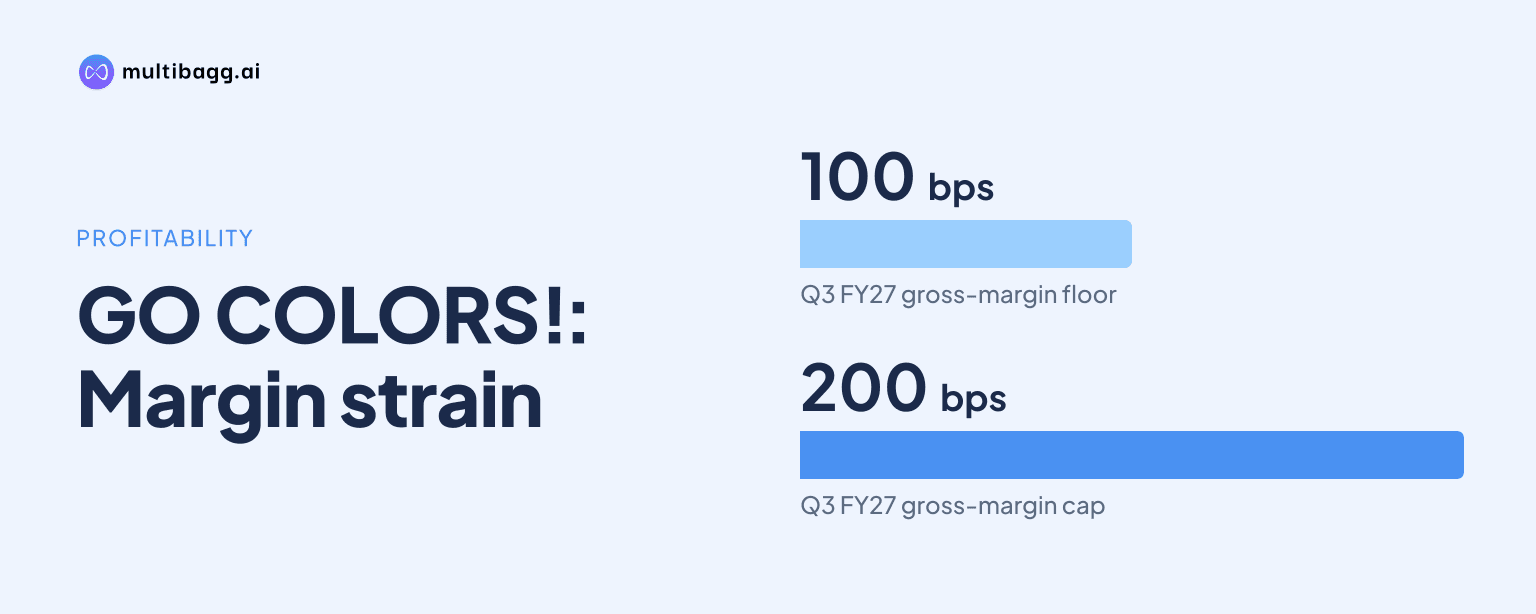
Go Fashion (India) Limited expects 100-200 basis points of gross-margin pressure in Q3 FY27 after an estimated 200-basis-point Q2 impact, because 8%-10% blended yarn and fabric inflation is moving through sales. Management said recent and post-festive price increases should stabilise margins within the next two quarters.
Know Go Fashion (India) inside out
Results, valuation, peers and who's buying, in one view.
Why does GO COLORS! expect gross-margin pressure in Q3 FY27?
GO COLORS! expects a 100-200-basis-point, or bps, gross-margin impact in Q3 FY27, according to Managing Director Gautam Saraogi’s estimate on the October 30, 2026 earnings call. He said Q2 FY27 had already absorbed an estimated 200-bps impact from higher raw-material costs, while cautioning that the Q3 range was difficult to calculate precisely.
GO COLORS! reported Q2 FY27 revenue of Rs 218 crore, down 3% year on year, and gross profit of Rs 132 crore, resulting in a 60.8% gross margin. In H1 FY27, revenue was Rs 440 crore, down 1.5% year on year, while gross profit was Rs 272 crore and gross margin was 61.8%.
The H1 FY27 gross margin was 1 percentage point above the Q2 FY27 level, showing that the more recent quarter carried a lower margin than the half-year aggregate. Management attributed the Q2 impact to raw-material costs, even as it had started increasing prices on selected articles.
How much raw-material inflation is GO COLORS! facing?
GO COLORS! estimates blended yarn and fabric inflation at 8%-10%, based on management’s assessment of monthly changes in input prices. Management had expected prices to cool in July-August, and said they did ease somewhat, but remained high enough to require price increases for products facing a larger cost effect.
The company said the inventory effect cannot be determined simply by comparing its March-end inventory with H1 cost of goods sold and subcontracting expenses. Fast-moving products can have lower inventory days, while slower items may retain older stock purchased at earlier prices, causing higher-cost goods to affect sales at different times.
An analyst noted that lower-margin large-format-store, or LFS, sales had declined while exclusive brand outlets, or EBOs, were continuing to perform. GO COLORS! nevertheless estimated a 200-bps gross-margin impact in Q2 FY27, indicating that raw-material costs outweighed any potential benefit from that channel mix during the quarter.
Will GO COLORS! price hikes restore gross margin?
GO COLORS! expects phased price actions to stabilise gross margin within the next two quarters, but management gave no specific margin target or date for a complete recovery. The company has recently raised prices on certain articles and plans further increases after the festive period for products where input-cost pressure has been larger.
Management said the increase in average selling price, or ASP, was not yet mainly the result of the recent price hikes. It attributed the movement to a mix of value-added bottomwear selling at about Rs 800-Rs 900 and higher-priced topwear sold through 21 dailywear-concept stores.
The recent price increases were implemented too late to have materially affected reported ASP, according to management. Because some increases are already in place and others are scheduled after the festive period, GO COLORS! said the offset to raw-material inflation would take a couple of quarters rather than appear fully in Q3 FY27.
Got a follow-up? Ask IRIS
What other costs affected GO COLORS! profit in H1 FY27?
GO COLORS! said higher advertising spending and exceptional store-related charges were the principal drivers of increased other expenses in H1 FY27. Advertising spending rose to Rs 12.63 crore from Rs 7.85 crore in the preceding-year period after the company brought on a brand ambassador, while store-closure write-offs rose to Rs 9.87 crore from Rs 1.73 crore.
Employee costs remained broadly flat in Q2 despite annual April increments, at Rs 46.3 crore versus Rs 45.75 crore in Q2 of the preceding year. Rent rose to Rs 37 crore from Rs 36 crore as the company opened larger stores and faced rent escalation, partly offset by savings from smaller-store closures.
GO COLORS! reported earnings before interest, tax, depreciation and amortisation, or EBITDA, before exceptional expenses of Rs 56 crore in Q2 FY27, equal to a 25.8% margin, while profit after tax was Rs 9 crore. H1 FY27 EBITDA before exceptional expenses was Rs 123.4 crore, with a 28.0% margin, and cash flow from operations before Ind AS 116 was Rs 52.6 crore.
What could change GO COLORS! margin outlook after Q3 FY27?
GO COLORS!’s Q3 FY27 margin outcome depends on input-cost movements, the rollout of post-festive price increases and product-level inventory turnover. Management said it could not precisely identify how much higher-cost inventory had been reflected in Q2 sales because products sell at different rates, which underpins its 100-200-bps Q3 estimate.
Store closures may reduce a separate source of profit-and-loss pressure. GO COLORS! closed more than 58 or 59 stores in Q1 FY27 and 23 in Q2 FY27, while management’s then-current visibility indicated 15-20 closures in Q3 FY27.
Management said margins should improve directionally as closures decline, but did not provide a 12-month closure forecast because it depends on available real estate. GO COLORS! had 737 EBOs at the time of the call, and management said stores above 750 square feet were delivering same-store sales growth, or SSSG, of 2%-3% or more while smaller stores were negative.
Conclusion
GO COLORS! is managing two distinct FY27 pressures: 8%-10% blended raw-material inflation that management estimated cut Q2 gross margin by 200 bps, and higher spending on advertising, store closures and renovations. Its Q2 FY27 revenue of Rs 218 crore, 60.8% gross margin and 25.8% EBITDA margin before exceptional expenses show how merchandise costs and operating charges are affecting earnings simultaneously.
The next disclosed milestones are Q3 FY27 performance against management’s 100-200-bps gross-margin estimate, the implementation of post-festive price increases and the expected reduction in closures to 15-20 stores. Management also said the advertising campaign that began after July could be assessed after the festive period, while price actions are expected to stabilise margins over the next two quarters.