










Go Fashion Plans Eventual Exit From Sub-300 Sq Ft Stores
Key highlights
- Go Fashion said it eventually plans to exit all bottomwear stores below 300 sq ft.
- Management estimated 120-150 of 737 stores were below 300 sq ft, while about 90-100 exceeded 700 sq ft.
- Go Fashion's long-term target for core bottomwear stores is 700-900 sq ft.
- Management indicated visibility for 15-20 store closures in Q3, subject to real-estate availability.
powered by IRIS
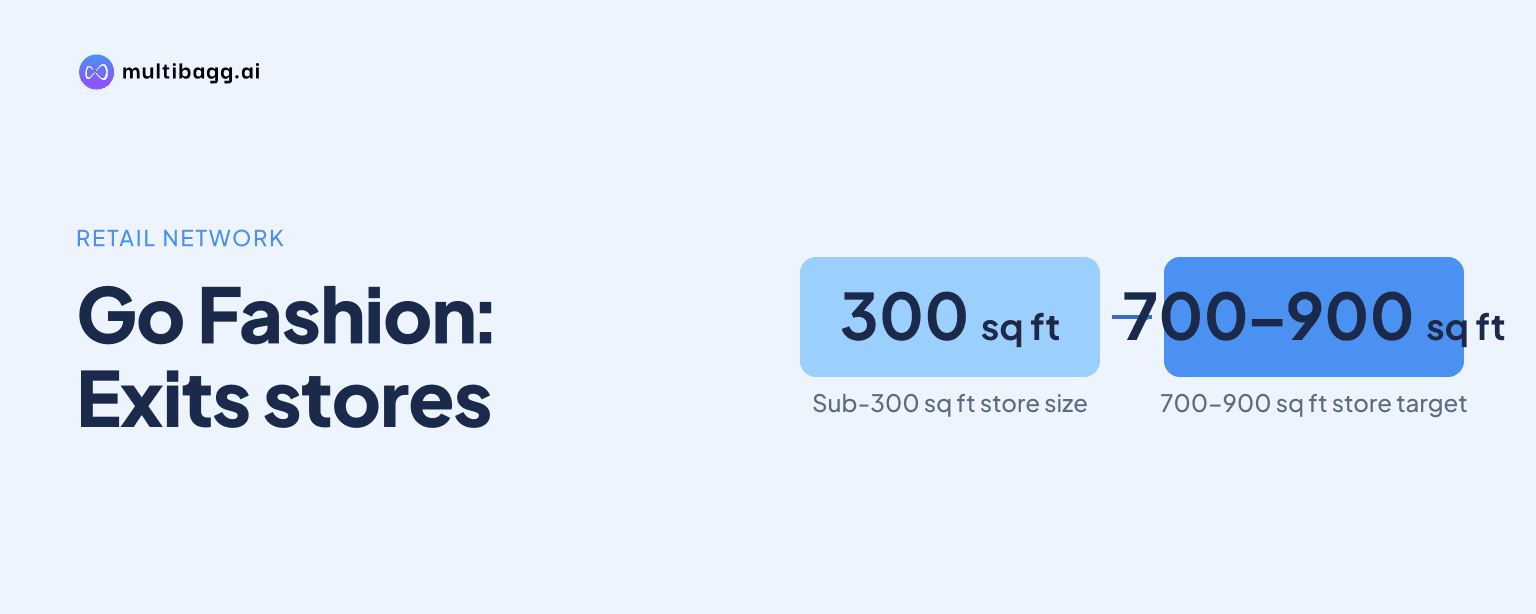
On October 30, 2026, Go Fashion (India) Limited said it eventually plans to exit all sub-300-square-foot bottomwear stores, a cohort management estimated at 120-150 of its 737 stores. Go Fashion intends to shift its core bottomwear format towards 700-900 square feet, saying limited store size is the main drag on growth.
Know Go Fashion (India) inside out
Results, valuation, peers and who's buying, in one view.
How will Go Fashion change its bottomwear store network?
Go Fashion plans to move its bottomwear stores towards 700-900 square feet over a longer time horizon. Management said 700-800 square feet, or slightly more, should provide sufficient room for the format and reduce the risk that stores become space-constrained again after three years. The plan therefore extends beyond closing the smallest outlets and includes enlarging stores in the 400-500-square-foot range.
Management estimated that 120-150 of the 737 stores were below 300 square feet, while about 90-100 stores exceeded 700 square feet. It described both figures as preliminary and said detailed store-size buckets would be shared separately. Management also estimated that the broader problem cohort represented 20%-30% of the network, with sub-300-square-foot stores presenting the larger issue.
Why does Go Fashion see store size as its main growth constraint?
Go Fashion says most stores with negative same-store sales growth, or SSSG, are below 300 square feet, although it did not say every small store is negative. Management noted that a store can also be affected by the performance of its mall and local market. Its assessment was that the negative SSSG pattern became more evident from FY 2024 or FY 2025 after developing gradually over a longer period.
Management linked the issue to the range customers perceive before entering a store. It said a smaller outlet typically has 10-12 feet of frontage, compared with at least 19-20 feet for a 700-square-foot store. The wider frontage allows more visual merchandising and product display, which management believes can support repeat purchases and new customer acquisition.
Go Fashion said its bottomwear portfolio is diversified for younger and millennial consumers, while acknowledging that every brand can have product gaps. Management also said competition from larger formats, including retailers carrying bottomwear alongside topwear, existed before the last two years and before COVID. It therefore attributed the growth headwind to the store format rather than merchandise or a recent change in competition.
Got a follow-up? Ask IRIS
When will Go Fashion close its smaller stores?
Go Fashion will close or replace smaller stores when suitable larger real estate becomes available rather than through a fixed network-wide timetable. Management cited its 200-square-foot store at Inorbit Mall in Hyderabad, which it said performs extremely well. It does not expect a 600-700-square-foot opportunity at that location within the next 15 months, so the small store may remain until larger space is available.
Management said it ultimately intends to exit all smaller stores, but the timing depends on property availability. For Q3, it indicated visibility for 15-20 closures, while cautioning that the number can change as real-estate opportunities emerge. It did not specify how many Q3 closures would be sub-300-square-foot locations or how many larger replacement stores would open in the same period.
The transition also includes stores that are larger than 300 square feet but remain below the preferred format. Management said 400-500-square-foot outlets are not as significant a problem as the smallest cohort, yet these stores would also need upgrades over time. That distinction means the 120-150 estimate for sub-300-square-foot stores does not capture the full potential scope of the network overhaul.
Is Go Fashion's dailywear pilot part of the bottomwear store plan?
Go Fashion says its 1,500-2,000-square-foot dailywear pilot is separate from the core bottomwear store-format programme. Of the 737 stores discussed, 736 were in India, and management said 21 Indian stores were above 1,500 square feet and closer to 2,000 square feet. These pilot locations carry bottomwear, women's topwear and a limited menswear offering.
Management said it had worked on the pilot for two years and planned to add another 8-9 stores before assessing its performance further. Women receive 80%-85% or more of the pilot-store space, while menswear receives 10%-12%. Management said menswear sales were proportionate to that allocation, as male shoppers accompanying women were making purchases in the stores.
The dailywear pilot is not presented as the remedy for the 120-150 small bottomwear stores. Its stores are substantially larger than the 700-900-square-foot bottomwear target and are designed to test a wider merchandise offer. Management said a successful pilot could make topwear another growth engine alongside bottomwear, while retaining the company-owned, company-operated model for inventory control.
Conclusion
Go Fashion's stated strategy is a gradual physical-network reset rather than a short-term merchandise response. Management sees restricted frontage, product display and range perception in sub-300-square-foot outlets as the principal cause of slower growth, while its 700-900-square-foot target is intended to provide a more durable format for the core bottomwear business.
The next milestones are the 15-20 Q3 closures management identified, the availability of larger replacement properties, and the detailed store-size data it said would be provided through SGA. Management also plans to add 8-9 dailywear pilot stores, whose results will determine whether topwear becomes an additional growth engine alongside the bottomwear network.