










Go Fashion’s H1 write-offs hit Rs 9.87 crore as advertising rises
Key highlights
- Go Fashion recorded Rs 9.87 crore of H1 FY '27 store-closure write-offs, versus Rs 1.73 crore in H1 FY '26.
- Go Fashion’s H1 FY '27 advertising spending rose to Rs 12.63 crore from Rs 7.85 crore a year earlier.
- Go Fashion closed 89 stores and opened 24 in H1 FY '27, ending September with 737 EBOs.
- Go Fashion reported H1 FY '27 revenue of Rs 440 crore, down 1.5%, and EBITDA before exceptional expenses of Rs 123.4 crore.
powered by IRIS
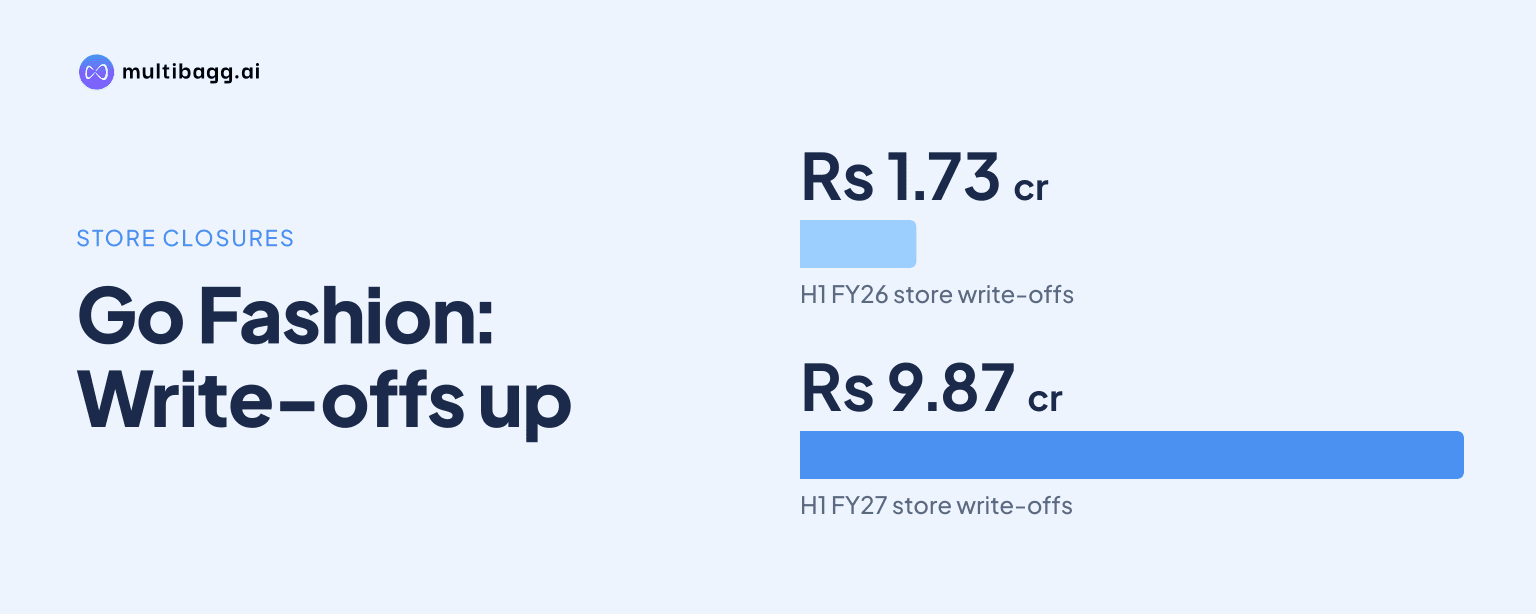
In H1 FY '27, Go Fashion (India) Limited recorded Rs 9.87 crore of one-off write-offs on closed stores, versus Rs 1.73 crore a year earlier, while advertising spending reached Rs 12.63 crore from Rs 7.85 crore. The closure charges and campaign spending limited the cost savings from closing smaller outlets.
Know Go Fashion (India) inside out
Results, valuation, peers and who's buying, in one view.
Why did Go Fashion’s costs remain elevated after store closures?
Go Fashion’s costs remained elevated because employee-cost and rental savings from smaller-store closures were offset by higher advertising, exceptional write-offs and some store-renovation expenditure. Management said employee costs stabilised despite annual staff increments in April, while the company increased marketing after appointing Shraddha Kapoor as brand ambassador in July 2026.
The Q2 FY '27 cost comparison shows the effect. Employee salaries were Rs 46.3 crore, compared with Rs 45.75 crore in Q2 FY '26, while rent increased to Rs 37 crore from Rs 36 crore. Management attributed the rent movement to larger stores and contractual rent escalations, which outweighed savings from outlets that had been closed.
Advertising was the main recurring increase identified by management. H1 FY '27 advertising spending rose by Rs 4.78 crore year on year to Rs 12.63 crore, following the launch of the first campaign featuring the new brand ambassador. Management said store renovations also contributed to other expenses, although it did not disclose their monetary value.
What caused Go Fashion’s Rs 9.87 crore write-off?
Go Fashion’s Rs 9.87 crore H1 FY '27 write-off was capital expenditure written off after store closures under its network-consolidation programme. Management described the charge as a one-off item directly resulting from the closure strategy. It recognised Rs 3.4 crore of exceptional expense in Q2 FY '27, taking the half-year total to about Rs 9.9 crore in prepared remarks and Rs 9.87 crore in the subsequent discussion.
The company opened 24 stores and closed 89 stores during the six months ended September 30, 2026, ending the period with 737 exclusive brand outlets, or EBOs, in 196 cities. Closures were concentrated in smaller formats located near an existing or planned larger store. Go Fashion said this approach allows a substantial portion of sales from two smaller outlets to move to one larger replacement store within months.
The store count declined, but retail space increased to approximately 4.4 lakh square feet on September 30, 2026, from 4.34 lakh square feet on March 31, 2026. Average EBO size was about 608 square feet. Management said stores above 750 square feet reported same-store sales growth, or SSSG, of 2% to 3% or higher, while smaller stores remained negative.
Got a follow-up? Ask IRIS
How did the restructuring affect Go Fashion’s H1 FY '27 results?
Go Fashion reported H1 FY '27 revenue of Rs 440 crore, down 1.5% year on year, and earnings before interest, tax, depreciation and amortisation, or EBITDA, before exceptional expenses of Rs 123.4 crore. EBITDA margin before exceptional expenses was 28.0%, meaning the Rs 9.87 crore closure-related charge was outside that measure. Gross profit was Rs 272 crore and gross margin was 61.8%.
Q2 FY '27 revenue was Rs 218 crore, down 3% year on year, while profit after tax was Rs 9 crore. Management linked the revenue decline partly to the late festive calendar, which shifted some September demand and large-format store, or LFS, partner dispatches into October. LFS contributed about 23% of H1 FY '27 sales.
Higher raw-material costs added pressure to margins. Q2 gross margin was 60.8%, and management estimated raw-material inflation reduced it by 200 basis points. It estimated a further 100 to 200 basis points of gross-margin impact in Q3, while saying that price increases on selected articles and further increases after the festive period could offset the effect over the next two quarters.
Operating cash flow before Indian Accounting Standard 116, or Ind AS 116, was Rs 52.6 crore in H1 FY '27. Inventory days improved to 94 at September-end from 100 at the end of Q1, within management’s indicated 90-to-100-day range. Cash and cash equivalents stood at Rs 211.4 crore on September 30, 2026.
When could Go Fashion’s closure-related costs start easing?
Go Fashion expects closure-related costs to ease as the closure pace declines after H1 FY '27. Management said Q1 had more than 58 or 59 closures, Q2 had 23, and Q3 closures should be lower again. It said a lower closure rate should directionally improve profit-and-loss margins, but did not give a full-year margin target.
The company is still pursuing selective expansion in larger formats. Management said Go Fashion could potentially nearly double its retail square footage over five years by adding high-potential locations across Tier-1, Tier-2 and Tier-3 cities. The plan does not specify a target for new EBO openings or closures in FY '27.
Go Fashion is also expanding its dailywear concept, which had 21 operating stores in Q2 FY '27 compared with 15 in Q1. Management targets 25 to 30 dailywear stores by the end of FY '27 and said the 21 stores were generating about Rs 1,000 of sales per square foot per month. It plans to add another eight or nine stores before using a roughly 30-store sample to assess future expansion.
Conclusion
The H1 FY '27 figures show that Go Fashion’s network transition has raised near-term expenses even as staff costs remained broadly flat and retail space increased. Revenue declined 1.5% to Rs 440 crore, while the shift toward larger stores continued through 89 closures and 24 openings. Advertising investment and raw-material inflation added to the immediate pressure on profitability.
The next indicators are the lower Q3 closure count management expects, the effect of price increases after the festive period and its assessment of the campaign launched in July 2026. Management also expects the festive quarter to provide evidence on dailywear performance and remains focused on achieving positive SSSG for FY '27 after EBO SSSG was broadly flat in Q2.