










Godawari cuts FY27 iron-ore target to 2.5 million tonnes
Key highlights
- Godawari reduced FY27 iron-ore mining guidance by 0.90 million tonnes to 2.50 million tonnes.
- Godawari mined 0.99 million tonnes in H1FY27, equal to 40% of revised FY27 guidance.
- Godawari's mining capacity rose to 6.70 million tonnes in FY26 from 3.05 million tonnes in FY25.
- Godawari targets full-scale Ari Dongri operations from FY28 after phased ramp-up begins in Q4FY27.
powered by IRIS
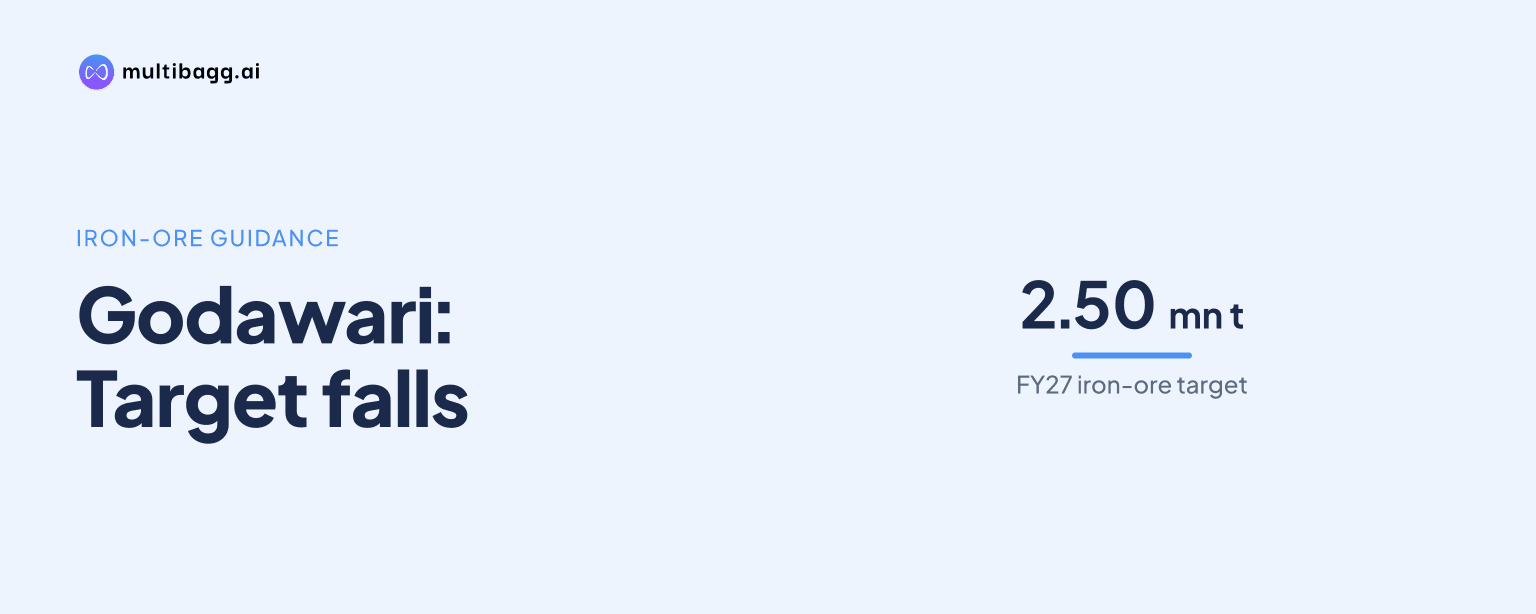
Godawari Power & Ispat cut its financial year 2027 (FY27) iron-ore mining guidance to 2.50 million tonnes from 3.40 million tonnes, while mining 0.99 million tonnes in H1FY27, or 40% of the revised goal. Godawari said tree-cutting approval for dumping-ground land was expected shortly as it prepares a phased Ari Dongri ramp-up from Q4FY27.
Know Godawari Power & Ispat inside out
Results, valuation, peers and who's buying, in one view.
What is Godawari's revised FY27 mining guidance?
Godawari's revised FY27 iron-ore mining target is 2.50 million tonnes, down 0.90 million tonnes from its earlier 3.40 million-tonne guidance. The FY27 guidance table also shows that iron-ore pellet production guidance was reduced to 3.50 million tonnes from 4.00 million tonnes.
Godawari mined 0.99 million tonnes in H1FY27, equivalent to 40% of its revised full-year mining goal. This was the lowest achievement percentage among the six disclosed production lines: pellet output was at 49%, sponge iron at 54%, steel billets at 48%, rolled products at 50%, and ferro alloys at 55% of their respective FY27 targets.
Godawari would need to produce the remaining 1.51 million tonnes in the second half of FY27 to meet the 2.50 million-tonne mining target. The presentation does not provide a quarterly mining-output split, so it does not quantify the volume expected in the third quarter of FY27 (Q3FY27) or Q4FY27.
What approvals remain for Godawari's Ari Dongri ramp-up?
Godawari said approval for tree cutting on land intended for the dumping ground was expected shortly, and it expects phased Ari Dongri ramp-up to start in Q4FY27. The presentation does not explicitly quantify output affected by the pending approval or expressly state that it caused the guidance reduction.
Godawari received Consent To Operate from the Chhattisgarh Environment Conservation Board (CECB) in February 2026 to increase Ari Dongri mine capacity from 2.35 million tonnes to 6.00 million tonnes. It also said approvals were secured and orders placed for an ore-quality upgrade roadmap, with the associated beneficiation plant targeted for commissioning by Q3FY27.
Godawari had incurred Rs 258 crore of capital expenditure on the mining and beneficiation programme by September 30, 2026. Management's timetable places full-scale Ari Dongri operations in FY28, following the planned Q4FY27 phased ramp-up rather than immediate use of the mine's 6.00 million-tonne stated capacity.
The 6.00 million-tonne Ari Dongri figure is mine capacity, while the 2.50 million-tonne FY27 figure is Godawari's production guidance for the year. The presentation therefore distinguishes between the approved expansion scale and the production level management expects during the FY27 transition period.
How much did Godawari's mining capacity expand?
Godawari's iron-ore mining capacity rose to 6.70 million tonnes in FY26 from 3.05 million tonnes in FY25, following a 3.65 million-tonne capacity increase in February 2026. Production increased by 0.41 million tonnes to 2.75 million tonnes in FY26 from 2.34 million tonnes in FY25.
Mining capacity was unchanged at 3.05 million tonnes between FY24 and FY25, while production increased by 0.03 million tonnes. In FY26, capacity rose by 3.65 million tonnes but production increased by 0.41 million tonnes, widening the difference between stated capacity and annual output during the expansion year.
Godawari also plans to raise beneficiation capacity to 9.30 million tonnes in FY27E from 3.90 million tonnes in FY26. Mine-site beneficiation capacity is planned to increase from 0.60 million tonnes to 6.00 million tonnes, while at-plant capacity remains 3.30 million tonnes in both periods.
Got a follow-up? Ask IRIS
What does the mining revision mean for Godawari's downstream output plans?
Godawari reduced FY27 pellet guidance by 0.50 million tonnes to 3.50 million tonnes, and H1FY27 pellet production of 1.70 million tonnes represented 49% of that revised target. The simultaneous revisions place mining and pellet production targets below their respective expanded capacities for FY27.
Godawari completed a pellet expansion that raised capacity by 74% to 4.70 million tonnes, with Rs 600 crore of capital expenditure. Management expects utilisation of the 4.70 million-tonne pellet plant to ramp up to 75% in FY27, rather than to its full nameplate capacity.
Godawari's other FY27 output goals are 0.65 million tonnes of sponge iron, 0.525 million tonnes of steel billets and 0.44 million tonnes of rolled products, alongside 95,000 tonnes of ferro alloys. H1FY27 output was 0.35 million tonnes of sponge iron, 0.25 million tonnes of billets, 0.22 million tonnes of rolled products and 52,001 tonnes of ferro alloys.
The operational revision coincided with standalone H1FY27 net sales of Rs 2,897 crore, up 27% year on year, while earnings before interest, tax, depreciation and amortisation (EBITDA) declined 12% to Rs 480 crore. Standalone EBITDA margin was 16.57% in H1FY27 compared with 23.83% in H1FY26, while profit after tax fell 33% to Rs 301 crore.
What milestones could change Godawari's mining outlook?
Godawari identifies tree-cutting approval for dumping-ground land, beneficiation-plant commissioning by Q3FY27 and phased Ari Dongri ramp-up from Q4FY27 as its near-term mining milestones. Management targets full-scale Ari Dongri operations from FY28, so the presentation does not indicate full-scale operations throughout FY27.
Godawari is also developing captive power infrastructure for Ari Dongri and Boria Tibu mines and pellet operations. A 25-megawatt solar plant was commissioned and grid-synchronised in May 2026, while a 100-megawatt solar project and a 45-megawatt-hour battery energy storage system (BESS) were expected to be completed by December 2026.
By September 30, 2026, Godawari had spent Rs 240 crore on the 100-megawatt solar project and Rs 39 crore on the BESS. Upon commissioning, installed solar-generation capacity is expected to reach 290 megawatts from 190 megawatts before the expansion programme.
Conclusion
Godawari has reduced its FY27 mining expectation despite FY26 mining capacity more than doubling to 6.70 million tonnes. The revised 2.50 million-tonne target, H1FY27 production of 0.99 million tonnes and lower 3.50 million-tonne pellet target show that FY27 production plans remain below the group's expanded mining and processing capacity.
The next disclosed matters to watch are the expected tree-cutting approval for dumping-ground land, the Q3FY27 beneficiation-plant commissioning target and the planned Q4FY27 phased Ari Dongri ramp-up. Management targets full-scale Ari Dongri operations from FY28, making delivery against those steps relevant to future production levels.