










GPIL Q2 EBITDA dropped 25% as margin fell to 12.01% in FY27
Key highlights
- GPIL’s Q2FY27 consolidated revenue increased 25% year on year to Rs 1,632 crore.
- GPIL’s Q2FY27 EBITDA declined 25% to Rs 196 crore and EBITDA margin reached 12.01%.
- GPIL’s iron ore pellet realisation declined 10% sequentially to Rs 9,354 per tonne in Q2FY27.
- GPIL reduced FY27 iron ore mining guidance to 2.50 million tonnes from 3.40 million tonnes.
powered by IRIS
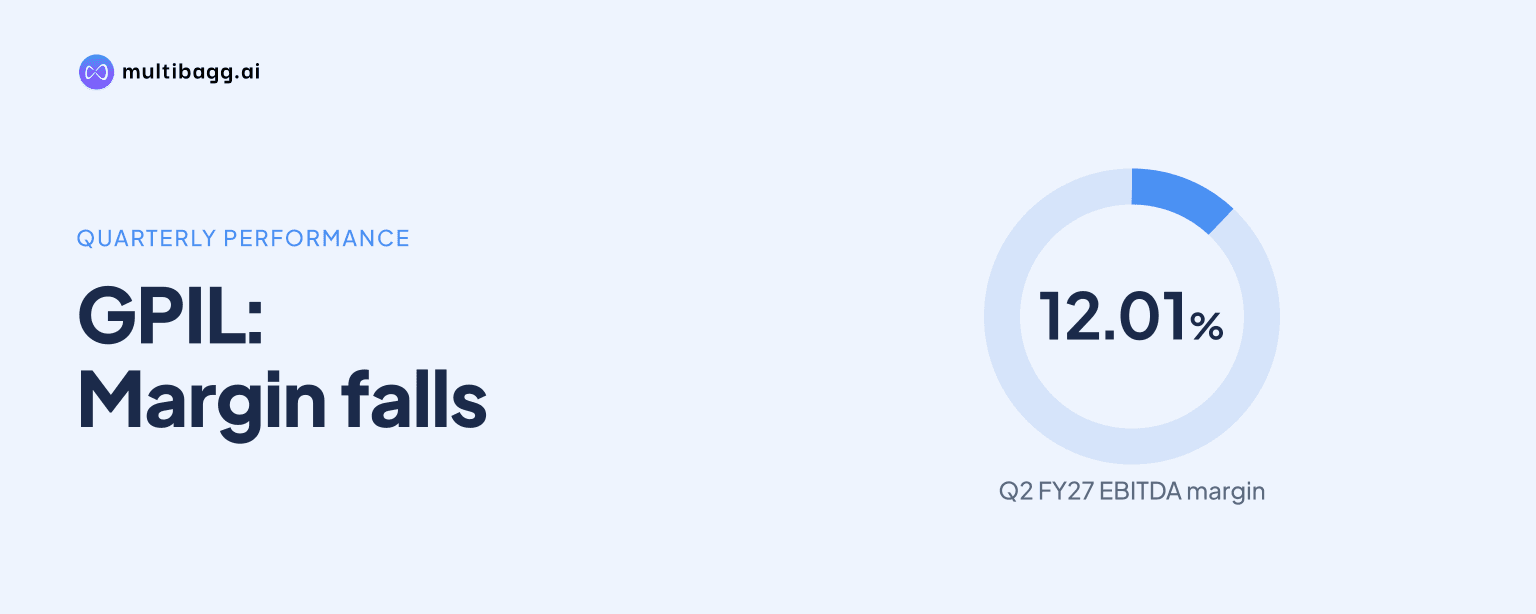
In Q2FY27, Godawari Power and Ispat Limited reported consolidated earnings before interest, tax, depreciation and amortisation (EBITDA) of Rs 196 crore, down 25% year on year, despite 25% revenue growth to Rs 1,632 crore; its EBITDA margin fell to 12.01% as iron ore and coal costs increased and pellet realisation declined sequentially.
Know Godawari Power & Ispat inside out
Results, valuation, peers and who's buying, in one view.
Why did GPIL’s EBITDA fall despite higher revenue?
GPIL’s EBITDA fell because total expenses rose faster than net sales in Q2FY27. Consolidated total expenses increased 37% year on year to Rs 1,436 crore, compared with 25% growth in net sales to Rs 1,632 crore. EBITDA consequently declined from Rs 260 crore in Q2FY26 to Rs 196 crore in Q2FY27.
Management attributed the cost increase to higher market sourcing of iron ore and elevated coal prices amid the West Asia crisis. Iron ore mining production declined 31% year on year to 4,47,820 tonnes in Q2FY27 because of space constraints for overburden dumping while tree-cutting permission for additional allotted land was delayed. Lower captive ore availability required more external procurement for pellet production.
How far did GPIL’s Q2FY27 margins decline?
GPIL’s consolidated EBITDA margin declined to 12.01% in Q2FY27 from 19.89% in Q2FY26 and 19.07% in Q1FY27. This was a year-on-year decline of 788 basis points and a sequential decline of 705 basis points, where 100 basis points equal one percentage point. The profit after tax margin fell to 5.21%, from 12.36% a year earlier.
The sequential movement reflected lower sales and earnings in Q2FY27 than in Q1FY27. Net sales were 7% below Rs 1,750 crore in Q1FY27, while EBITDA was 41% below Rs 334 crore. Management identified lower pellet realisation and higher input costs as the two reasons for this quarter-on-quarter pressure.
Iron ore pellet realisation declined 10% sequentially to Rs 9,354 per tonne in Q2FY27 from Rs 10,340 per tonne in Q1FY27. It was nearly unchanged from Rs 9,364 per tonne in Q2FY26. Pellet sales volume was broadly flat sequentially at 6,30,922 tonnes, while it increased 42% year on year from 4,42,758 tonnes.
Which operating trends affected GPIL’s costs?
GPIL’s lower iron ore mining output was the principal operational factor linked to higher input costs. Q2FY27 mining production of 4,47,820 tonnes was 17% below Q1FY27 output of 5,37,832 tonnes and 31% below Q2FY26 output of 6,48,614 tonnes. Management said the overburden-dumping constraint raised dependence on market ore for pellet production.
Other production lines recorded year-on-year growth in Q2FY27. Pellet production increased 20% to 7,99,050 tonnes, steel billet production rose 10% to 1,39,170 tonnes, and M.S. rounds production increased 11% to 65,912 tonnes. Pellet production was nevertheless affected by the temporary closure of the 2 million-tonne pellet plant because operations were uneconomical.
Sales data showed differing demand and captive-consumption patterns. Pellet sales rose 42% year on year to 6,30,922 tonnes, rolled structural product sales increased 62% to 8,612 tonnes, and steel billet sales rose 9% to 42,118 tonnes. Sponge iron sales fell 64% to 15,105 tonnes because GPIL used more sponge iron captively in its steel melting shop.
Got a follow-up? Ask IRIS
What does GPIL’s H1FY27 performance and guidance show?
GPIL’s first-half FY27 results also showed revenue growth being outweighed by cost growth. Consolidated revenue rose 29% year on year to Rs 3,382 crore in H1FY27, while EBITDA declined 9% to Rs 530 crore and profit after tax from ordinary activities fell 19% to Rs 307 crore. EBITDA margin reduced to 15.66% from 22.21% in H1FY26.
Total expenses increased 39% to Rs 2,852 crore in H1FY27, exceeding the 29% increase in net sales. Finance costs rose 70% to Rs 45 crore and depreciation increased 20% to Rs 102 crore. The second-quarter EBITDA of Rs 196 crore followed Rs 334 crore in Q1FY27, accounting for the lower half-year margin.
GPIL reduced FY27 iron ore mining guidance to 2.50 million tonnes from 3.40 million tonnes and pellet-production guidance to 3.50 million tonnes from 4 million tonnes. By H1FY27, mining output was 0.99 million tonnes, or 40% of the revised target, while pellet production was 1.70 million tonnes, or 49% of the revised target.
What could change GPIL’s margins from Q4FY27?
Management expects margin recovery from Q4FY27 if tree-cutting permission is received for overburden-dumping land and the beneficiation plant is commissioned. It said these developments would support greater use of captive iron ore in pellet production and improve cost efficiency. The 5.4 million-tonne beneficiation plant was stated to be on track for commissioning in Q3FY27.
GPIL is also progressing projects outside the immediate pellet-cost issue. It approved Rs 100 crore for a container manufacturing line for battery energy storage system (BESS) and marine containers, and Rs 135 crore for a 3 gigawatt-hour BESS project for commercial and industrial applications. Its 20 gigawatt-hour BESS project is slated for commissioning in Q1FY28, according to management.
For its proposed 0.7 million-tonne cold rolling mill complex, Maharashtra Industrial Township Limited issued an offer letter for 31.45 acres at AURIC Bidkin in Maharashtra. GPIL also disclosed credit-facility sanctions of Rs 2,795 crore for the BESS project, comprising Rs 700 crore of term debt and Rs 2,095 crore of working-capital facilities. These facilities and projects had not contributed to Q2FY27 operating earnings.
Conclusion
GPIL’s Q2FY27 results show that higher sales volume and revenue did not offset rising input costs and weaker sequential pellet pricing. Revenue reached Rs 1,632 crore, but EBITDA declined to Rs 196 crore and the EBITDA margin reached 12.01%, as ore procurement costs, coal prices and a 10% sequential fall in pellet realisation affected profitability.
The next disclosed milestones are tree-cutting permission for the overburden-dumping land and Q3FY27 commissioning of the 5.4 million-tonne beneficiation plant, from which management expects full margin benefits from Q4FY27. Progress against revised FY27 targets of 2.50 million tonnes of mining output and 3.50 million tonnes of pellet output, plus the planned Q1FY28 BESS commissioning, will also be material.