










Godawari pellet output rises 27% despite 2-million-tonne closure
Key highlights
- Godawari produced 1,702,950 metric tonnes of iron ore pellets in H1FY27, 27% more than in H1FY26.
- Godawari's Q2FY27 pellet output of 799,050 metric tonnes was 12% below Q1FY27 after the temporary plant closure.
- Godawari's H1FY27 pellet sales increased 39% year on year to 1,264,025 metric tonnes.
- Godawari's Q2FY27 pellet realisation declined 10% sequentially to Rs 9,354 per tonne.
powered by IRIS
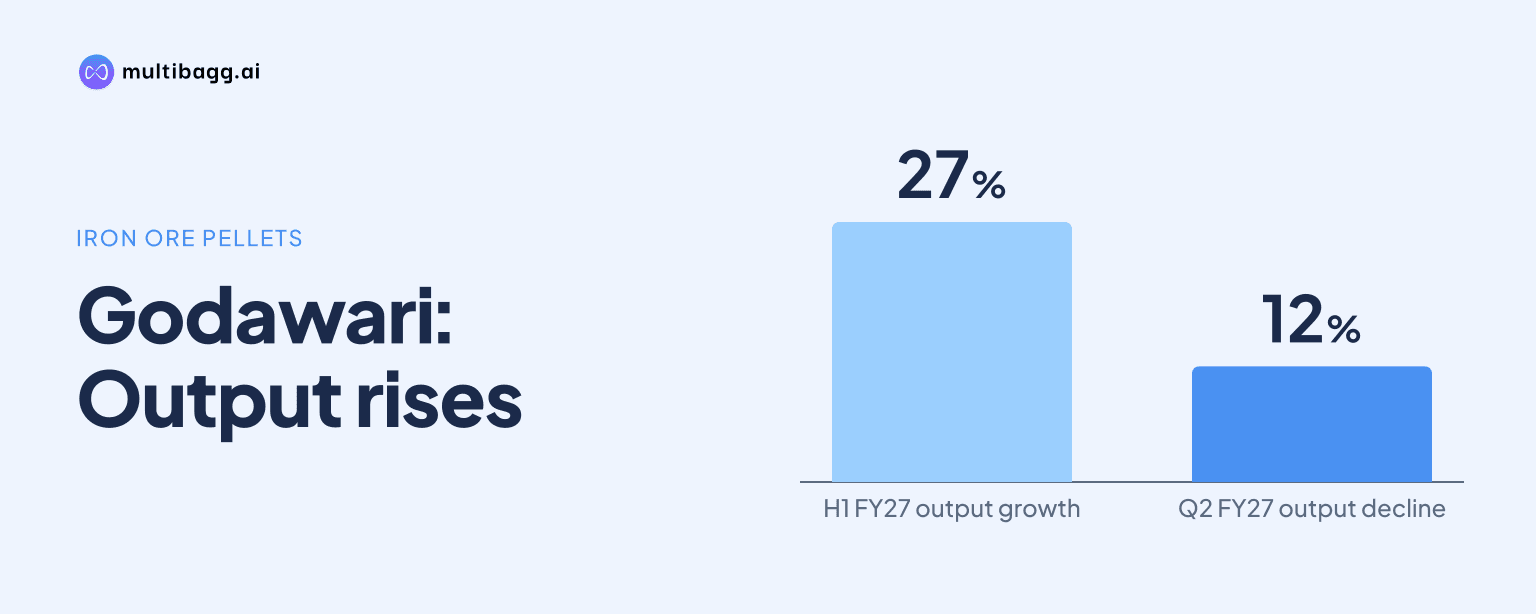
Godawari produced 1,702,950 metric tonnes of iron ore pellets in H1FY27, a 27% increase from H1FY26, despite temporarily closing its 2-million-tonne pellet plant because operations were uneconomical. Q2FY27 production fell 12% sequentially to 799,050 metric tonnes, while lower pellet realisation and higher iron ore sourcing costs weighed on profitability.
Know Godawari Power & Ispat inside out
Results, valuation, peers and who's buying, in one view.
Why did Godawari's pellet output rise in H1FY27?
Godawari's H1FY27 pellet output rose because production reached 1,702,950 metric tonnes, compared with 1,340,950 metric tonnes in H1FY26, adding 362,000 metric tonnes. The 27% year-on-year increase exceeded growth in other disclosed major production lines, including sponge iron at 12%, steel billets at 10% and M.S. rounds at 5%.
The half-year increase did not continue into the second quarter. Godawari produced 799,050 metric tonnes of pellets in Q2FY27, down 12% from 903,900 metric tonnes in Q1FY27, although it was 20% above Q2FY26 output of 667,200 metric tonnes. The presentation says pellet production was affected by the temporary closure of the 2-million-tonne plant for uneconomical operations.
Godawari's pellet sales increased faster than production in the reported half year. H1FY27 sales rose 39% year on year to 1,264,025 metric tonnes from 909,333 metric tonnes, while Q2FY27 sales of 630,922 metric tonnes were 42% above Q2FY26 but broadly flat against Q1FY27 sales of 633,103 metric tonnes. The presentation does not explain the difference between sales and production growth.
What does Godawari disclose about the closed pellet plant?
Godawari says its 2-million-tonne pellet plant was temporarily closed because operations were uneconomical. The presentation does not disclose the closure date, a restart date, the operating capacity of other pellet facilities, or the price and cost conditions that would make the plant economical to run again.
Godawari does not disclose a 4.7-million-tonne pellet capacity figure or a target to reach 75% utilisation in the supplied presentation. It also does not provide a pellet-plant utilisation rate. The defined operational disclosure is that the temporary 2-million-tonne plant closure affected pellet production in Q2FY27 and H1FY27.
The closure coincided with lower iron ore mining output. Godawari's iron ore mining production declined 31% year on year to 447,820 metric tonnes in Q2FY27 and fell 24% to 985,653 metric tonnes in H1FY27, as space constraints for overburden dumping followed delays in tree-cutting permission for additional allotted land.
Godawari says the mining constraint required higher market procurement of iron ore for pellet production, contributing to elevated input costs. This separates two disclosed pressures: the closed pellet plant was uneconomical to operate, while lower captive mining availability increased the need to source ore from the market. The company does not quantify purchased-ore volumes or the separate earnings impact of either factor.
Got a follow-up? Ask IRIS
How did Godawari's pellet prices affect earnings?
Godawari's Q2FY27 pellet realisation fell 10% sequentially to Rs 9,354 per tonne from Rs 10,340 per tonne in Q1FY27. That figure was nearly unchanged from Rs 9,364 per tonne in Q2FY26, and the company says lower pellet realisation contributed to the quarter-on-quarter decline in profitability.
Godawari's H1FY27 pellet realisation was Rs 9,828 per tonne, 2% above Rs 9,602 per tonne in H1FY26. The half-year comparison was positive even as the quarterly price declined, while H1FY27 sales volume grew 39% year on year. The presentation does not state whether inventory movements or sales timing contributed to the gap between production and sales growth.
Godawari reported consolidated net sales of Rs 3,382 crore in H1FY27, up 29% from Rs 2,631 crore in H1FY26, but total expenses rose 39% to Rs 2,852 crore. The company attributes the pressure primarily to higher iron ore sourcing costs and increased coal prices amid the West Asia crisis.
Consolidated earnings before interest, tax, depreciation and amortisation, or EBITDA, declined 9% to Rs 530 crore in H1FY27 from Rs 584 crore a year earlier, while profit after tax declined 19% to Rs 307 crore from Rs 378 crore. EBITDA margin fell to 15.66% from 22.21%, and profit-after-tax margin decreased to 9.09% from 14.37%.
What could change for Godawari's pellet economics next?
Godawari management expects margins to recover from Q4FY27 if it receives tree-cutting approval for overburden dumping land and commissions its beneficiation plant. According to the presentation, these measures would enable greater use of captive iron ore in pellet production and reduce the higher market procurement caused by the mining constraint.
The stated margin outlook is conditional rather than a reported result. Godawari's consolidated Q2FY27 EBITDA was Rs 196 crore, down 41% from Rs 334 crore in Q1FY27, while Q2FY27 profit after tax was Rs 85 crore against Rs 222 crore in the preceding quarter. Q2FY27 EBITDA margin was 12.01% and profit-after-tax margin was 5.21%.
Godawari's consolidated property, plant and equipment stood at Rs 4,154 crore on September 30, 2026, compared with Rs 3,754 crore on March 31, 2026. Over the same period, long-term borrowings rose to Rs 329 crore from Rs 238 crore and short-term borrowings increased to Rs 392 crore from Rs 189 crore. The presentation does not allocate these changes to the pellet business.
Conclusion
Godawari delivered higher H1FY27 pellet production and sales despite shutting a 2-million-tonne plant temporarily, but its Q2FY27 production and realisation both declined from Q1FY27. The wider effect of constrained captive iron ore supply was visible in higher input costs, with consolidated revenue rising 29% while EBITDA and profit after tax fell 9% and 19%, respectively.
The next disclosed factors to watch are the anticipated tree-cutting approval for additional overburden dumping space and commissioning of the beneficiation plant. Management expects those steps to permit more captive ore use and support margin recovery from Q4FY27, while the presentation leaves unresolved the closed plant's restart timing and any pellet-capacity utilisation target.