










Government of India Sets Rs 12 Lakh Zero-Tax Limit in Budget
Key highlights
- No income tax would be payable up to Rs 12 lakh under the proposed new tax regime, excluding special-rate income.
- The no-tax-payable threshold for salaried taxpayers would reach Rs 12.75 lakh after a Rs 75,000 standard deduction.
- Pre-Budget reports discussed possible tax cuts for incomes up to Rs 15 lakh, but said the scale was undecided.
- The government described Rs 12 lakh as average income of Rs 1 lakh a month, other than special-rate income.
powered by IRIS
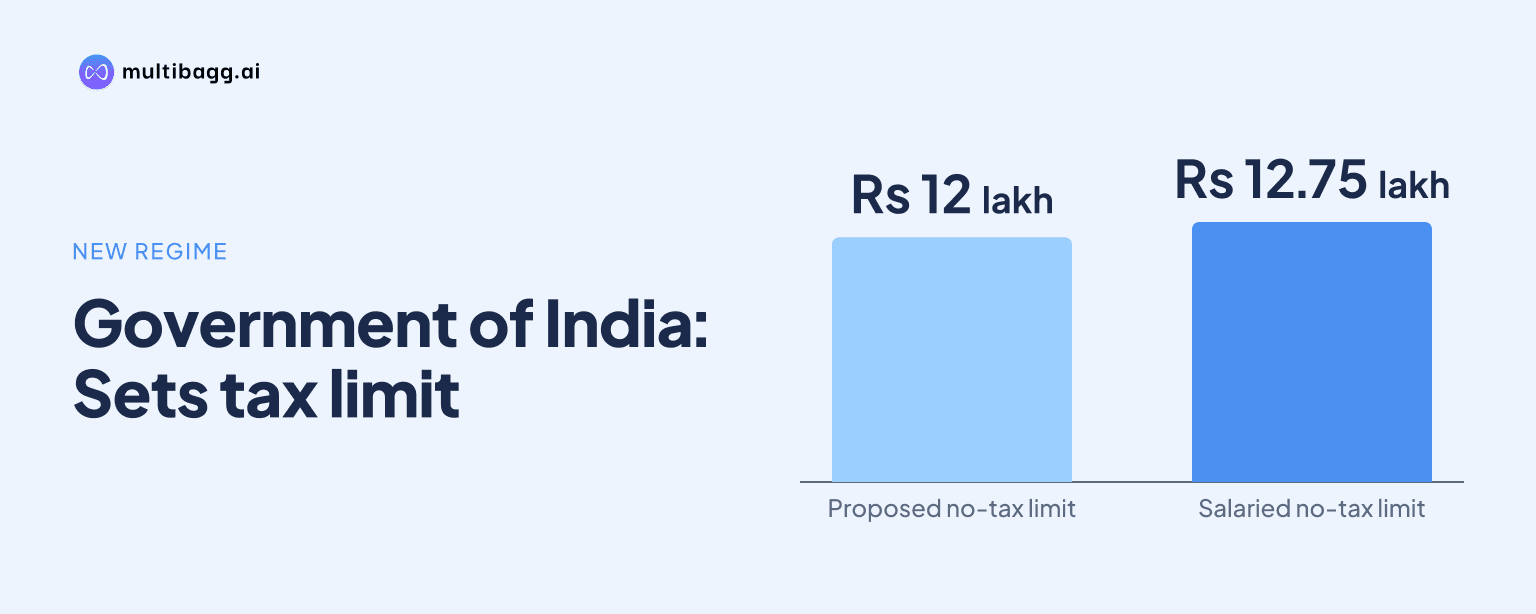
Government of India proposed in Budget 2025-26 that no income tax would be payable under the new tax regime on total income up to Rs 12 lakh, while the Rs 75,000 standard deduction would take the salaried threshold to Rs 12.75 lakh, excluding special-rate income such as capital gains.
What did the government propose in Budget 2025-26?
The government proposed a tax rebate alongside lower slab rates so that taxpayers with total income of up to Rs 12 lakh would have no income tax payable under the new tax regime. Finance Minister Nirmala Sitharaman said the structure was designed to provide relief to taxpayers, with a particular focus on the middle class.
The Rs 12 lakh figure applies to total income other than income taxed at special rates. Capital gains are specifically identified as special-rate income in the Budget context, meaning taxpayers should not treat the stated threshold as applying to every form of income without distinction. The proposal is framed under the new tax regime rather than as a universal change across both tax systems.
Who can use the Rs 12.75 lakh salaried threshold?
Salaried taxpayers using the new tax regime can reach a Rs 12.75 lakh threshold because of the Rs 75,000 standard deduction. The government described Rs 12 lakh as equivalent to an average income of Rs 1 lakh a month, other than special-rate income such as capital gains.
The distinction matters because the Rs 12.75 lakh figure is not a separate base income limit for all individuals. It reflects the Rs 12 lakh total-income threshold together with the standard deduction available to salaried taxpayers. Taxpayers will need to assess their income type and the regime they use when considering the stated relief.
How does the Budget proposal differ from reports of a Rs 15 lakh cut?
The Budget proposal differs from pre-Budget reports because it specifies a Rs 12 lakh no-tax-payable threshold and a Rs 12.75 lakh salaried threshold, while earlier reports only described possible cuts for people earning up to Rs 15 lakh. Those reports cited anonymous government sources and said the magnitude of any reduction had not been decided.
Reuters reporting before the Budget said discussions focused on individuals earning up to Rs 15 lakh annually, with a decision expected closer to the February 1 announcement. It also said the possible changes would be under the new regime introduced in 2020. Social-media discussion has often placed the reported Rs 15 lakh figure next to the announced thresholds, but they refer to different stages of the policy process.
Got a follow-up? Ask IRIS
Why were personal tax cuts under discussion?
The government was reported to be considering personal tax relief to support consumption and provide relief to middle-class households facing high living costs. The reports said city dwellers could be among those affected and that the changes could encourage more taxpayers to use the newer tax system.
Before the Budget, reports described the scale of the potential cut as unresolved. One report said the government was considering consumption-boosting measures worth more than Rs 500 billion, with almost half of that amount expected to come from tax cuts, but the details remained under discussion. Another report said any revenue loss could be partly offset by increased consumption, though no specific revenue impact was stated in the Budget context provided.
How do the new and old tax regimes differ?
The new tax regime is the framework identified for the proposed relief, while the older system allows exemptions on items such as housing rentals and insurance. Earlier reporting characterised the newer system as offering lower rates while not allowing major exemptions, giving taxpayers a choice between two different approaches.
Reports also said taxpayers could choose between the old and new systems, although they could not alter their choice once the new regime was opted for. The pre-Budget discussion noted that income from Rs 300,000 to Rs 1.5 million was taxed at rates ranging from 5% to 20% under the newer system, while higher income was taxed at 30%. The Budget context, however, provides the confirmed thresholds rather than a complete fresh slab table.
Conclusion
The government’s Budget 2025-26 proposal established a clear no-tax-payable threshold of Rs 12 lakh under the new tax regime, rising to Rs 12.75 lakh for salaried taxpayers because of the Rs 75,000 standard deduction. It replaced the uncertainty of pre-Budget reporting about potential relief for incomes up to Rs 15 lakh with stated thresholds and conditions.
Taxpayers should next watch for the detailed operation of the revised slab structure and rebate, especially the treatment of income taxed at special rates. The unresolved practical issue is how individual income profiles, deductions and the choice between the old and new regimes affect the final tax outcome.