










Sagility India Limited: Analysts See Targets Up to ₹65
Key highlights
- S&P Global's 12-analyst poll showed a Strong Buy consensus and a ₹58.75 average target for Sagility.
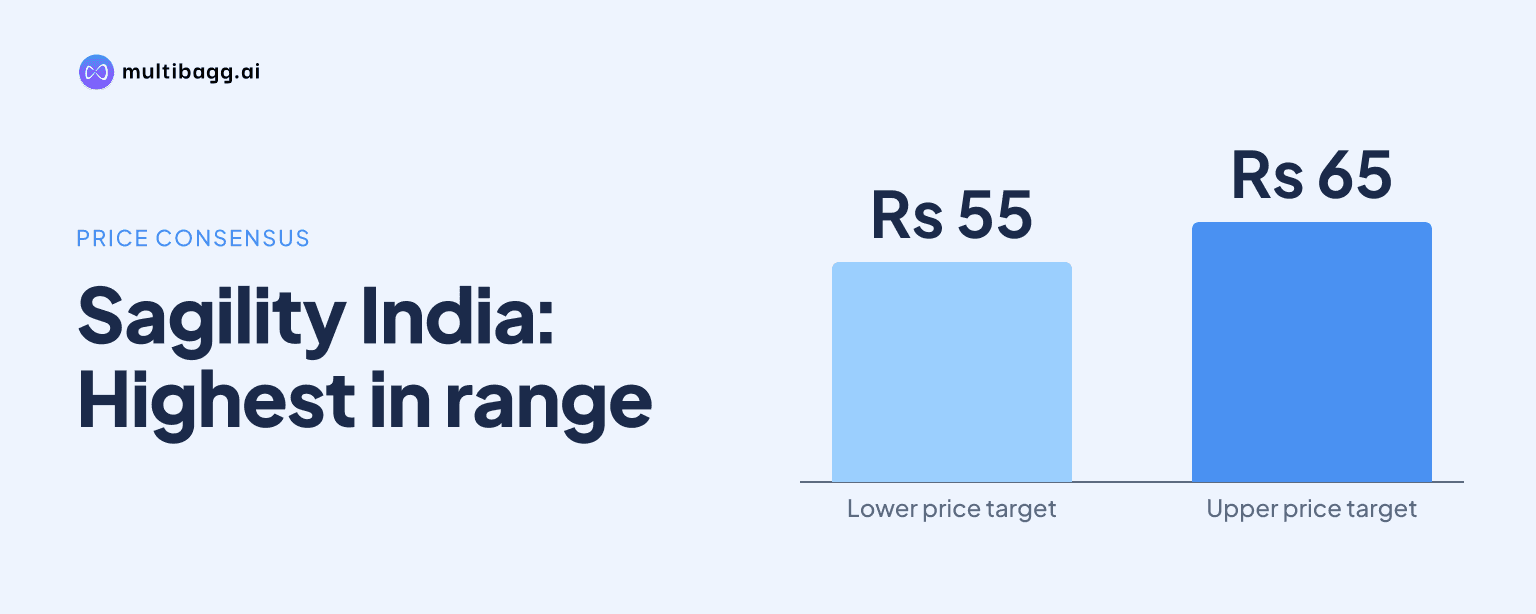
- Reported Sagility price targets range from ₹55 to ₹65, with ₹65 the highest target in the cited consensus.
- Sagility's steady-state deal annual contract value reached US$40.2 million, up 18% year-on-year.
- MarketsMOJO assigned a Hold rating and a 58.0 Mojo Score, while citing a one-year return of minus 13.33%.
powered by IRIS
Sagility India Limited has a reported 12-analyst Strong Buy consensus, with price targets ranging from ₹55 to ₹65, but its holding outlook remains mixed because MarketsMOJO maintained a Hold rating and cited a one-year return of minus 13.33% and 100% promoter-share pledging.
What are analysts expecting from Sagility?
Analyst expectations for Sagility are positive overall, though target prices differ across the research updates cited. S&P Global's poll of 12 analysts showed a Strong Buy consensus and an average target of ₹58.75, with the lowest target at ₹55 and the highest at ₹65. The average forecast was stated to be 32.05% above the then-current share price.
The context also says all 12 analysts in that consensus recommended buying, with none recommending a hold or sell. Separately, following second-quarter results, a group of 13 analysts forecast 2027 revenue of ₹87.2 billion and retained a consensus target of ₹58.08. That report said the unchanged target suggested that improved earnings estimates had not materially altered the longer-term view of shareholder value creation.
Why is the holding outlook not uniformly bullish?
The holding outlook is not uniformly bullish because MarketsMOJO rates Sagility as Hold, despite the more favourable broker recommendations. Its Hold stance indicates that existing investors may maintain positions rather than buy or sell aggressively, while watching company updates, earnings and market conditions.
The cautious assessment reflects weak recent relative performance and ownership-related risk. Sagility's one-year return was reported at minus 13.33%, below the benchmark, while 100% of promoter shares were described as pledged. The context notes that pledged shares can add pressure during market downturns. MarketsMOJO's Mojo Score of 58.0 was downgraded from Buy to Hold on November 2, and the technical view pointed to tentative recovery potential but continuing uncertainty.
What supports Sagility's growth plan?
Sagility's retained guidance for low double-digit organic growth in FY27 is supported by record contract value, acquisitions and operating-margin progress. Steady-state deal annual contract value reached US$40.2 million, up 18% year-on-year, including a large payment-integrity win with a top-10 health plan.
Management retained its low double-digit constant-currency organic revenue growth guidance even after lowering its FY27 seasonal revenue expectation by about 100 basis points to roughly 5% of revenue. The company also raised adjusted EBITDA margin guidance to 25-26% from 24-25%, following a 290-basis-point sequential expansion in the second quarter. Operating efficiencies, cost management and foreign-exchange tailwinds were cited as contributors.
The Chirok Health acquisition is intended to address a mid-revenue-cycle gap and broaden the provider portfolio. The context also says Chirok and CareSeed are expected to add incrementally to growth. Earlier growth has been strong, with USD revenue CAGR of about 16% and rupee revenue CAGR of about 20% during FY23-FY26, helped in FY26 by BroadPath consolidation, seasonal performance and expansion within mature accounts.
Got a follow-up? Ask IRIS
Which risks should Sagility investors monitor?
Sagility investors should monitor healthcare-spending trends, client behaviour, pricing pressure and the pace at which acquisitions deliver benefits. The cited research flags possible delays in acquisition synergies, frequent policy changes that could reduce discretionary spending and outsourcing, and a muted Q3FY27 open-enrolment outlook that is expected to be broadly flat year-on-year.
Other disclosed risks include client insourcing, regulatory changes affecting Medicare and Medicaid, client concentration and AI-driven deflation in labour-intensive workflows. Management's medium-term low-to-mid-teens organic growth objective already incorporates annual revenue deflation of about 1.5-2.0% from pricing, productivity, offshoring, conventional automation and AI. A potential sponsor stake-sale overhang is another factor identified in the research context.
For financial projections, Emkay estimates FY27 revenue of ₹87,034 million, EBITDA of ₹21,167 million and adjusted profit after tax of ₹11,403 million. It expects USD revenue CAGR of about 12% and rupee revenue CAGR of about 15% over FY26-FY29E. Those are analyst estimates rather than company guidance, and their delivery depends on growth, margins and acquisition integration.
Conclusion
Sagility's outlook combines a favourable sell-side consensus with meaningful reasons for investor caution. Targets between ₹55 and ₹65 and a Strong Buy consensus point to expectations of growth supported by new contract value, acquisitions and higher margin guidance. However, the Hold rating, share-price underperformance and full promoter-share pledging make the case less straightforward for investors assessing whether to add to an existing position.
The next areas to watch are FY27 organic-growth delivery, the expected contribution from Chirok and CareSeed, and progress toward the 25-26% adjusted EBITDA margin guidance. Investors will also need to assess whether muted open-enrolment activity, pricing-related deflation and the identified regulatory or client risks affect the path implied by analyst forecasts.