










Indian Stock Market Rally Gains FPI Support Amid AI Sell-Off
Key highlights
- Foreign portfolio investors bought a net ₹38,519 crore of Indian shares through stock exchanges between November 2 and November 6.
- The Nifty rose 7.58% in a week, with analysts linking the move to FPI buying and a short squeeze.
- The Sensex gained 2,008.61 points, or 2.60%, on Thursday in its biggest single-day advance in seven months.
- FIIs were provisional net buyers of ₹14,974.68 crore of Indian equities on Thursday.
powered by IRIS
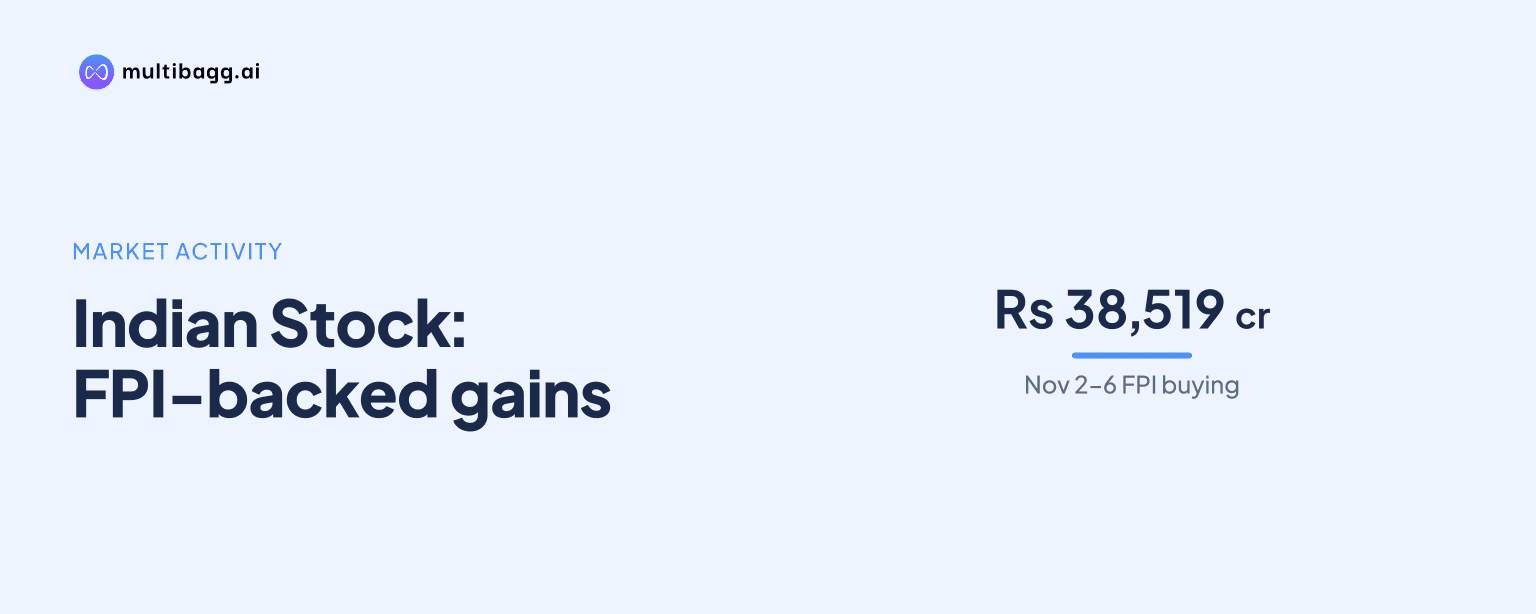
Indian stock market rallied while Wall Street's AI-led sell-off spread across global markets, supported by ₹38,519 crore of net foreign portfolio investor buying between November 2 and 6 and a 7.58% weekly rise in the Nifty. The Indian market also drew support from improving corporate earnings, lower crude prices and large-cap buying.
Why did the Indian market rise during Wall Street's technology sell-off?
The Indian market rose because foreign buying, a rotation away from AI-linked trades and domestic large-cap support outweighed the immediate impact of weak global sentiment. Wall Street's decline was led by concerns over spending on AI infrastructure, data centres and the returns that companies may generate from those investments. Several Asian markets also weakened as technology and semiconductor shares came under pressure.
India was viewed as relatively less exposed to semiconductor manufacturing and the global AI hardware supply chain. That limited exposure gave domestic benchmarks some protection from the technology-led shock. Analysts also pointed to a possible "reverse AI" trade, in which capital moves away from AI-heavy markets towards markets such as India that have a different sector mix.
The rally was not solely a response to global technology weakness. Commentators cited better-than-expected corporate earnings, fair valuations, easing crude oil prices and lower US bond yields as factors that improved the case for Indian equities. Buying in heavyweight stocks helped the Sensex and Nifty retain positive momentum even while global markets remained volatile.
How strong were foreign investor flows into Indian equities?
Foreign portfolio investor buying was the most visible support for the Indian market, with NSDL data showing net purchases of ₹38,519 crore in Indian shares through stock exchanges from November 2 to November 6. Provisional exchange data also showed FIIs as net buyers of ₹14,974.68 crore of Indian equities on Thursday.
The return of foreign flows was described as the strongest weekly inflow in more than a year. One market view was that aggressive FPI buying, combined with a short squeeze, helped lift the Nifty by 7.58% over a week. This buying occurred despite selling and profit-booking by domestic institutional investors.
Foreign flows can provide rapid support to benchmark stocks, particularly when global investors raise allocations to emerging markets. However, analysts cautioned that this support is conditional. India has not decoupled from global markets, and the same flows that lifted equities can reverse if global risk appetite weakens.
Got a follow-up? Ask IRIS
Which market moves showed India's relative resilience?
The Indian market's resilience was reflected in benchmark gains despite sharp losses in US technology shares and weakness across Asia. On Thursday, the Sensex gained 2,008.61 points, or 2.60%, to close at 79,310.01, while the Nifty climbed nearly 600 points. The move extended the Sensex's advance to a sixth consecutive session.
On Friday, the Sensex opened 103.65 points higher at 79,413.66 and later rose to 79,760.10 by mid-morning. The Nifty opened at 24,538.20 and was quoted at 24,612.85 by mid-morning. Separate market updates also reported the Sensex reclaiming 80,000 and the Nifty crossing 24,700, while another account described the Nifty rising 2% to close above 25,000 and the Sensex gaining 1,718 points.
These reported moves underline the speed of the rebound after earlier pressure from oil prices, the rupee and foreign selling. The Indian market had already absorbed some of those pressures before the latest global technology rout. As a result, the local recovery was helped by a combination of returning foreign demand and a more favourable comparison with AI-heavy markets.
What could interrupt the Indian market's rally?
Rising crude prices, global volatility and a reversal in foreign investor flows could interrupt the Indian market's rally. Analysts stressed that India's outperformance depends on broader global conditions and the continuation of foreign buying. A sustained global deleveraging cycle could eventually lead to foreign selling in domestic sectors even where there is no immediate earnings impact.
Globally sensitive stocks, including IT shares, may face more direct pressure if concerns about AI investment and overseas technology spending persist. At the same time, IT stocks were among the gainers in the reported domestic session, showing that the local response was not uniformly negative. The immediate market direction will therefore depend on whether investors treat the AI weakness as a sector-specific event or as a wider reduction in risk appetite.
Corporate earnings remain another important support point. The reported improvement in Q2 earnings helped investors look beyond the global sell-off, but earnings will need to remain supportive if valuation and foreign-flow arguments are to hold. Domestic institutional selling and profit-booking also remain relevant counterweights to FPI demand.
Conclusion
The Indian market's advance during Wall Street's AI-led sell-off reflected a favourable combination of foreign buying, relative insulation from the AI hardware trade, lower crude prices and improving corporate earnings. The ₹38,519 crore of net FPI purchases between November 2 and 6 and the Nifty's reported 7.58% weekly advance illustrate how strongly flows influenced the move.
The next signals to watch are whether foreign investors continue buying, whether crude prices and US bond yields remain supportive, and whether global technology selling broadens beyond AI-linked shares. Upcoming corporate earnings trends will also test whether the domestic market's fundamental support can continue through global volatility.