










GPT Healthcare H1 PAT rises 54% as EBITDA margin reaches 21%
Key highlights
- GPT Healthcare’s H1FY27 PAT rose 53.9% year on year to Rs 28.1 crore.
- GPT Healthcare’s H1FY27 EBITDA margin increased to 21.0% from 18.8% a year earlier.
- GPT Healthcare’s H1FY27 occupancy improved to 47.9% from 44.7% with 719 beds unchanged.
- GPT Healthcare has targeted end-FY27 commissioning for a 155-bed Jamshedpur hospital with Rs 75 crore of investment.
powered by IRIS
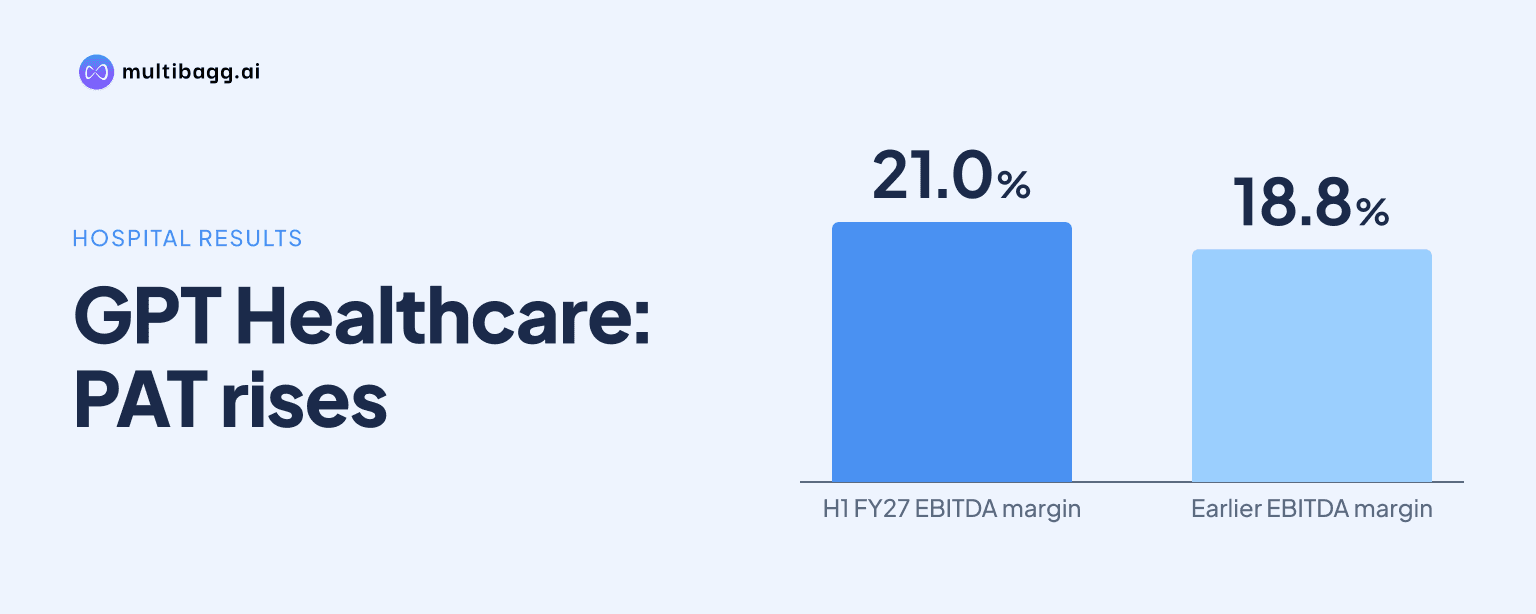
In H1FY27, GPT Healthcare’s profit after tax rose 53.9% year on year to Rs 28.1 crore and its EBITDA margin reached 21.0%, up from 18.8%. Revenue from operations increased 15.8% to Rs 261.8 crore, while occupancy, patient volumes and average revenue per occupied bed also increased from H1FY26.
Know GPT Healthcare inside out
Results, valuation, peers and who's buying, in one view.
How did GPT Healthcare perform in H1FY27?
GPT Healthcare reported total revenue of Rs 266.8 crore in the first half of the financial year labelled FY27, or H1FY27, a 16.5% increase from Rs 228.9 crore in H1FY26. Revenue from operations rose to Rs 261.8 crore from Rs 226.0 crore, while other operating income increased to Rs 5.0 crore from Rs 2.9 crore.
Earnings before interest, tax, depreciation and amortisation, or EBITDA, increased 30.3% to Rs 56.0 crore from Rs 43.0 crore. Profit before tax grew 44.5% to Rs 37.8 crore from Rs 26.2 crore, and profit after tax, or PAT, rose to Rs 28.1 crore from Rs 18.3 crore. Basic earnings per share increased to Rs 3.4 from Rs 2.2.
What changed in GPT Healthcare’s profitability margins?
GPT Healthcare’s EBITDA margin improved by 2.2 percentage points to 21.0% in H1FY27, while PAT margin increased by 2.5 percentage points to 10.5%. EBITDA grew faster than total revenue, at 30.3% compared with 16.5%, and earnings before interest and tax, or EBIT, rose 40.4% to Rs 42.1 crore from Rs 30.0 crore.
The second quarter, Q2 FY27, also recorded higher profit than both comparison periods shown in the presentation. Q2 FY27 EBITDA was Rs 29.8 crore, up 23.9% from Rs 24.1 crore in Q2 FY26 and 13.8% from Rs 26.2 crore in Q1 FY27. Its EBITDA margin was 21.5%, compared with 20.0% in Q2 FY26 and 20.4% in Q1 FY27.
GPT Healthcare’s H1FY27 EBITDA margin remained below the 23.0% reported in FY24 but was above the 18.8% recorded in FY26. PAT margin followed the same direction, moving from 11.8% in FY24 to 8.8% in FY26 before reaching 10.5% in H1FY27. The presentation states that the H1FY27 figures are not annualised.
Did GPT Healthcare’s hospital operating metrics improve?
GPT Healthcare increased occupancy to 47.9% in H1FY27 from 44.7% in H1FY26 while keeping its bed count unchanged at 719. Inpatient volume rose 11.2% to 18,715 from 16,829, and outpatient volume increased 14.0% to 102,377 from 89,802. Occupancy was nevertheless below the 58.9% reported for FY26.
Average revenue per occupied bed, or ARPOB, increased 8.1% to Rs 41,490 from Rs 38,376. Average length of stay declined to 3.37 days from 3.49 days. Inpatient hospital revenue rose to Rs 220 crore from Rs 189 crore, while outpatient revenue increased to Rs 42 crore from Rs 37 crore.
The half-year growth followed the addition of beds between FY25 and FY26. GPT Healthcare had 561 beds in FY25 and 719 in FY26, while occupancy was 58.9% in each of those full financial years. H1FY27 therefore showed improved utilisation from H1FY26, but not a return to the FY26 occupancy level.
Got a follow-up? Ask IRIS
How has GPT Healthcare’s service mix changed?
GPT Healthcare’s H1FY27 revenue mix had a lower share from nephrology with renal transplants and larger shares from cardiac sciences and orthopaedics than in FY25. Nephrology represented 14% of care-service revenue in H1FY27, down from 20% in FY25, while cardiac sciences rose to 10% from 5% and orthopaedics and joint replacement increased to 9% from 7%.
Internal medicine and diabetology was the largest named care-service category at 17% in H1FY27, down from 19% in FY25. Oncology accounted for 2% of H1FY27 revenue distribution but was not separately listed in FY25 or FY26. The “others” category rose to 14% from 12% in FY25.
GPT Healthcare launched comprehensive cancer care at Agartala, comprising a positron emission tomography scan and a linear accelerator, and describes it as Tripura’s only integrated oncology unit. The presentation also states an objective to create a doctor-agnostic, broad-specialty platform with a diversified case mix and services added according to demand.
What does GPT Healthcare plan to do next?
GPT Healthcare plans to scale to 1,000 beds within two years from the 719 beds reported in H1FY27. Management has also set a target of at least 70% bed occupancy across mature hospitals, using capacity utilisation, equipment optimisation and phased expansion.
A memorandum of understanding has been signed for a 155-bed Jamshedpur hospital, with Rs 75 crore of investment and commissioning targeted by the end of FY27. Management said developers would fund the land and building, while GPT Healthcare would operate the facility under fixed-rental arrangements. The company also outlined entries into Tier II cities in Uttar Pradesh, Assam and Odisha, plus select Tier I locations in Eastern India.
Management targets occupancy of 70% to 75% at Agartala and Howrah, compared with about 55% cited in its outlook. Howrah has commenced robotic knee replacement surgeries, which management expects to increase ARPOB and reduce average length of stay. Management’s longer-term objective is to maintain return on equity and return on capital employed at about 25%, versus H1FY27 reported levels of 10.2% and 10.6%, respectively.
Conclusion
GPT Healthcare’s half-year results combined higher patient activity and higher revenue per occupied bed with an improvement in profitability margins. Occupancy rose by 3.2 percentage points year on year, inpatient revenue increased by Rs 31 crore and outpatient revenue by Rs 5 crore, while the service mix showed rising shares for cardiac sciences and orthopaedics.
The next disclosures to watch are progress toward at least 70% occupancy at mature hospitals, the 70% to 75% occupancy objective for Agartala and Howrah, and the targeted end-FY27 commissioning of the 155-bed Jamshedpur facility. Management’s stated plan to reach 1,000 beds within two years will determine the pace and structure of capacity expansion.