










GPT Healthcare: Raipur reaches 17% occupancy in H1 FY27
Key highlights
- ILS Raipur reached 17.0% occupancy in H1 FY27, compared with 12.0% in FY26.
- ILS Raipur generated Rs 19.6 crore in revenue in H1 FY27 and Rs 9.0 crore in Q2 FY27.
- ILS Raipur performed its first TAVI procedure and first liver transplant in Q2 FY27.
- ILS Raipur completed 11 renal transplants within a year and has 158 beds.
powered by IRIS
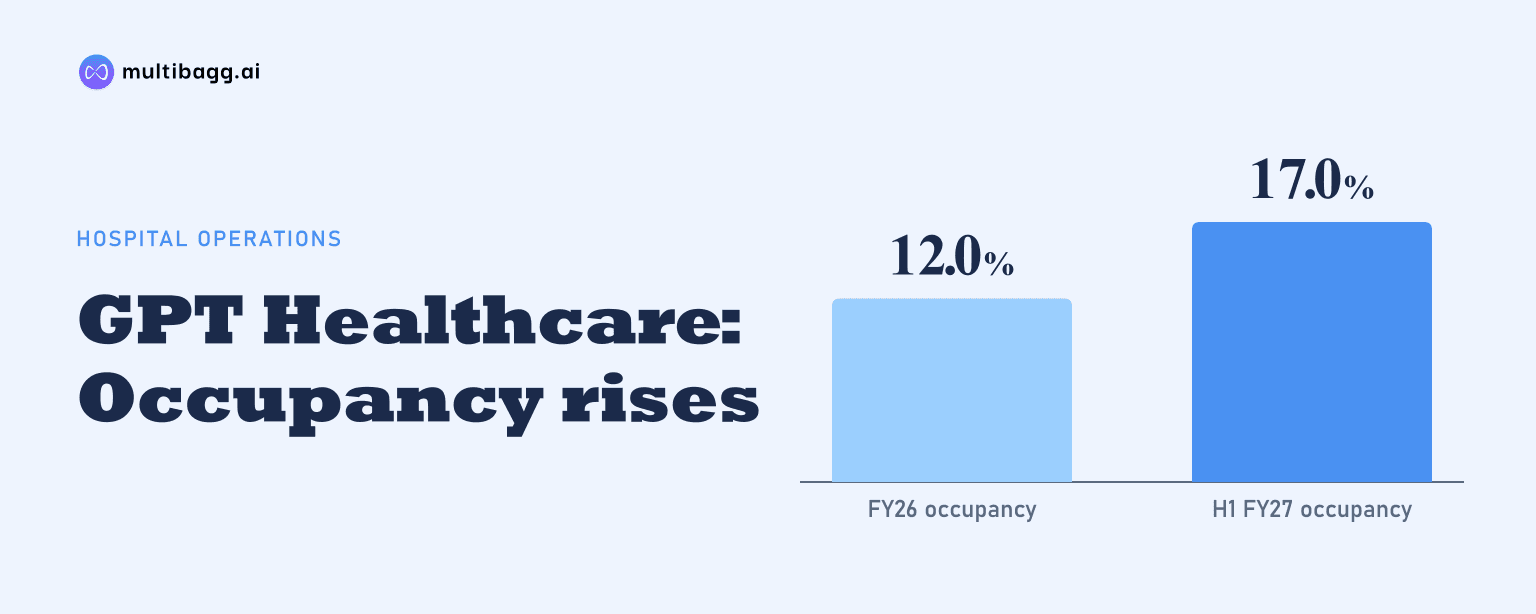
GPT Healthcare Limited’s 158-bed ILS Raipur hospital recorded 17.0% occupancy in H1 FY27, the first half of financial year 2027, up from 12% in FY26, while generating Rs 19.6 crore in revenue and performing its first transcatheter aortic valve implantation (TAVI) procedure and liver transplant in Q2 FY27 after commencing operations in May 2025.
Know GPT Healthcare inside out
Results, valuation, peers and who's buying, in one view.
What was ILS Raipur’s occupancy in H1 FY27?
ILS Raipur’s occupancy was 17.0% in H1 FY27 and 16.5% in Q2 FY27, the second quarter of FY27. The hospital had recorded 12% occupancy in FY26 and Q2 FY26, while H1 FY26 occupancy was 10%, according to GPT Healthcare’s hospital-level performance data. The H1 FY27 reading was therefore 5 percentage points above the FY26 level, although the periods cover different stages of the facility’s ramp-up.
The hospital’s average rate per occupied bed, or ARPOB, was Rs 39,885 per day in H1 FY27 and Rs 37,347 in Q2 FY27. This was below Rs 42,440 in FY26, Rs 40,869 in H1 FY26 and Rs 41,868 in Q2 FY26. The reported data show that higher bed use in the latest half year coincided with a lower ARPOB than in the earlier comparison periods.
ILS Raipur commenced operations in May 2025 at Pachpedi Naka and serves a catchment that includes Raipur, Bilaspur, Durg and Bhilai. Its 158 beds make it GPT Healthcare’s third-largest hospital by capacity, after the 205-bed ILS Agartala and 155-bed ILS Dum Dum. Its 17.0% H1 FY27 occupancy nevertheless remained at an earlier utilisation stage than the older facilities.
How does ILS Raipur compare with GPT Healthcare’s mature hospitals?
ILS Raipur’s 17.0% H1 FY27 occupancy was 39.7 percentage points below the 56.7% reported for GPT Healthcare’s mature hospitals. In Q2 FY27, the gap was 43.3 percentage points, with Raipur at 16.5% and the mature portfolio at 59.8%. This difference explains why network occupancy was 47.9% in H1 FY27 and 50.3% in Q2 FY27 when Raipur was included.
The mature hospitals generated Rs 242.2 crore of GPT Healthcare’s Rs 261.8 crore H1 FY27 revenue from operations, while Raipur generated Rs 19.6 crore. In Q2 FY27, Raipur contributed Rs 9.0 crore of the Rs 135.6 crore group total and mature hospitals generated Rs 126.6 crore. The mature portfolio’s H1 FY27 revenue was stated to have grown 15.8% year on year, while the presentation does not provide a comparable earlier-period revenue figure for Raipur.
Among the older hospitals, ILS Dum Dum posted the highest H1 FY27 occupancy at 69.4%, followed by ILS Salt Lake at 65.4%, ILS Agartala at 49.6% and ILS Howrah at 45.8%. Raipur’s H1 FY27 ARPOB of Rs 39,885 was above ILS Howrah’s Rs 39,556, but below ILS Agartala’s Rs 40,254, ILS Dum Dum’s Rs 43,086 and ILS Salt Lake’s Rs 43,284.
Got a follow-up? Ask IRIS
Which advanced services has ILS Raipur added since opening?
ILS Raipur achieved National Accreditation Board for Hospitals and Healthcare Providers accreditation within its first year, GPT Healthcare said. In Q2 FY27, the hospital performed its first TAVI procedure and its first liver transplant. The presentation also says the hospital completed 11 renal transplants within a year, following the commencement of its renal-transplant programme.
The facility has received a licence for liver-transplant services, while chemotherapy and oncology surgeries are fully operational. GPT Healthcare describes the hospital as a quaternary-care facility with progressive expansion into advanced oncology care. Its infrastructure includes a 3 Tesla magnetic resonance imaging system, a cardiac catheterisation laboratory and a dual-source computed tomography scanner.
The clinical build-out contrasts with utilisation relative to the established network. ILS Raipur had 17.0% occupancy in H1 FY27 across 158 beds, while GPT Healthcare said its network excluding Raipur had 59.8% occupancy in Q2 FY27. The presentation does not disclose the number of TAVI procedures, liver transplants or oncology cases beyond the 11 renal transplants completed within a year.
What does the Raipur ramp-up mean for GPT Healthcare’s reported results?
GPT Healthcare reported H1 FY27 revenue from operations of Rs 261.8 crore, earnings before interest, tax, depreciation and amortisation (EBITDA) of Rs 56.0 crore and profit after tax (PAT) of Rs 28.1 crore. EBITDA represented a 21.0% margin and PAT represented a 10.5% margin. Raipur generated Rs 19.6 crore of the group’s Rs 261.8 crore H1 FY27 revenue.
In Q2 FY27, GPT Healthcare reported revenue of Rs 135.6 crore, EBITDA of Rs 29.8 crore and PAT of Rs 15.4 crore. Revenue rose 14.1% year on year, EBITDA rose 23.9% and PAT rose 45.2%, while the overall EBITDA margin was 21.5%. Network ARPOB increased 7.1% year on year to Rs 40,721 in Q2 FY27, which GPT Healthcare attributed to improved realisations, speciality mix and operational efficiencies.
GPT Healthcare’s five operating hospitals had 719 beds, with ILS Raipur contributing 158 beds. The company has also disclosed a planned 155-bed tertiary-care hospital in Jamshedpur, expected to commence operations in March or April 2027. Management has stated a plan to scale to a 1,000-bed network by FY2027 and a long-term target for return on capital employed and return on equity of about 25%.
Conclusion
ILS Raipur’s H1 FY27 data show a new hospital increasing occupancy from 12% in FY26 to 17.0% while broadening into cardiac, liver and renal services. Its Rs 19.6 crore of H1 FY27 revenue and 158-bed capacity are material to GPT Healthcare’s hospital footprint, but its utilisation remained below the 56.7% mature-hospital occupancy level.
The next disclosed milestone is the planned commencement of the 155-bed Jamshedpur hospital in March or April 2027. GPT Healthcare has also outlined a plan to reach a 1,000-bed network by FY2027, while management has stated long-term return on capital employed and return on equity targets of approximately 25%.