










TLL medical devices nearly match tablet sales in Q2 FY27
Key highlights
- TLL’s medical-devices revenue rose 183% to Rs 17 crore in Q2 FY27 from Rs 6 crore in Q2 FY26.
- Medical devices represented about 36% of TLL’s Rs 47.1 crore consolidated Q2 FY27 revenue, nearly matching tablets at Rs 17.2 crore.
- TLL’s consolidated revenue rose 50% to Rs 47.1 crore and EBITDA rose 65% to Rs 11.3 crore in Q2 FY27.
- TLL reported capacity utilisation of 46% in Q2 FY27, compared with 32% in Q2 FY26.
powered by IRIS
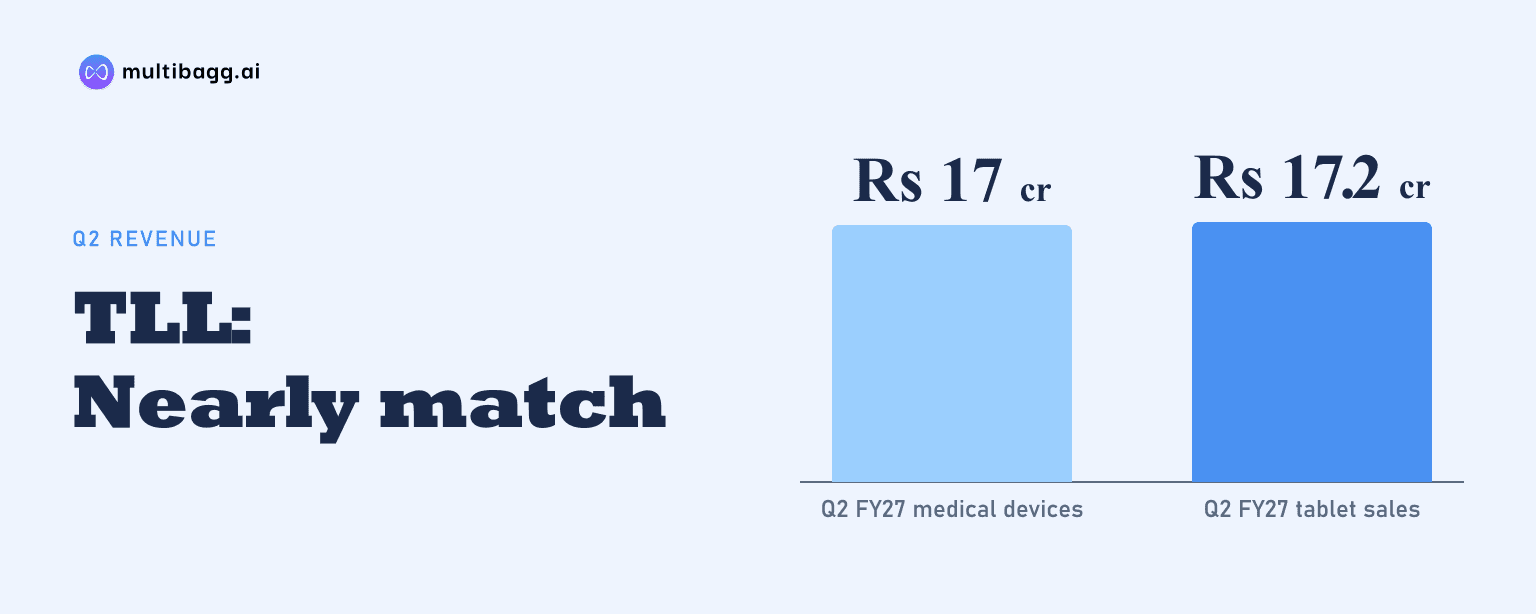
TLL’s medical-devices revenue rose 183% year on year to Rs 17 crore in Q2 FY27, nearly matching tablet revenue of Rs 17.2 crore and representing about 36% of consolidated revenue of Rs 47.1 crore. The Rs 11 crore increase was the largest disclosed change among quarterly operating segments.
Know Trident Lifeline inside out
Results, valuation, peers and who's buying, in one view.
How did TLL’s medical-devices revenue change in Q2 FY27?
TLL’s medical-devices revenue increased to Rs 17 crore in Q2 FY27 from Rs 6 crore in Q2 FY26, a reported 183% year-on-year rise. The segment therefore generated about 2.8 times its revenue of a year earlier and added Rs 11 crore to quarterly sales. TLL identifies medical devices and surgical products as a business vertical alongside pharmaceutical formulations, liquids and injectables.
The increase was materially larger than the movement in the two oral-solid segments disclosed for the quarter. Tablet revenue rose 11% to Rs 17.2 crore from Rs 15.5 crore, adding Rs 1.7 crore, while capsule revenue declined 19% to Rs 5.5 crore from Rs 6.8 crore, reducing revenue by Rs 1.3 crore. Medical devices therefore moved from a segment Rs 9.5 crore below tablets in Q2 FY26 to within Rs 0.2 crore of tablet revenue in Q2 FY27.
The segment comparison is based on consolidated financials, which include subsidiaries, rather than TLL’s standalone accounts. Consolidated revenue from operations was Rs 47.1 crore in Q2 FY27, compared with standalone revenue from operations of Rs 32.7 crore. The Rs 14.4 crore difference shows that the consolidated business base was larger than the standalone business reported for the quarter.
How did TLL’s Q2 FY27 revenue mix change?
TLL’s medical-devices revenue represented about 36% of Q2 FY27 consolidated revenue, almost equal to tablets at about 37%. Those proportions are based on Rs 17 crore of medical-devices revenue and Rs 17.2 crore of tablet revenue against the Rs 47.1 crore consolidated total. In Q2 FY26, medical devices represented about 19% of Rs 31.3 crore in total revenue, while tablets accounted for about 50%.
The comparison shows that medical devices gained roughly 17 percentage points of quarterly revenue share, while tablets lost roughly 13 percentage points despite their Rs 1.7 crore revenue increase. Capsules declined from about 22% of Q2 FY26 revenue to about 12% in Q2 FY27, reflecting both their fall to Rs 5.5 crore and the faster expansion of medical devices.
TLL’s revenue-contribution graphic shows 37% for tablets, 12% for capsules, 36% for one category and 16% for another in Q2 FY27, but repeats the label “Tablets” where the labels appear inconsistent. The disclosed segment values support the calculation that medical devices were about 36% of quarterly consolidated revenue. TLL reports Others revenue of Rs 7.4 crore for H1 FY27 and Rs 3 crore for H1 FY26, so these figures are not a like-for-like Q2 comparison.
Got a follow-up? Ask IRIS
What did the segment shift mean for TLL’s Q2 FY27 performance?
TLL’s consolidated revenue rose 50% to Rs 47.1 crore in Q2 FY27 from Rs 31.3 crore in Q2 FY26, and the Rs 11 crore medical-devices increase accounted for most of the Rs 15.8 crore total rise. Tablets added Rs 1.7 crore, while capsules reduced revenue by Rs 1.3 crore. The disclosed segment data therefore shows that quarterly revenue growth was concentrated in medical devices rather than spread evenly across oral formulations.
Profitability also increased, although TLL does not allocate profit by operating segment in the presentation. Consolidated earnings before interest, taxes, depreciation and amortisation, or EBITDA, rose 65% to Rs 11.3 crore. EBITDA margin increased by 217 basis points to 24.1%, while profit after tax rose 30% to Rs 6.6 crore in Q2 FY27.
Capacity utilisation reached 46% in Q2 FY27, compared with 32% in Q2 FY26, according to the consolidated update. TLL also reported four manufacturing facilities and a product portfolio of 3,710 products, compared with 3,625 in FY26. These measures accompanied the revenue increase, but the presentation does not quantify the share of capacity utilisation attributable specifically to medical devices.
What is TLL planning after the Q2 FY27 sales-mix shift?
TLL says its H2 FY27 priorities are improving capacity utilisation, accelerating execution, expanding product and market presence, strengthening subsidiary performance and maintaining financial discipline. Management also said it was progressing with commissioning its parenterals facility after Diwali, subject to operational readiness. TLL lists injectables as a separate manufacturing capability with consolidated monthly capacity of 10 million units.
Management’s stated ambition is to triple TLL’s consolidated business over the next three years, rather than a formal quarterly revenue forecast. Chairman Hardik Desai said delivery depends on scaling business verticals, disciplined execution and prudent capital allocation. Executive Director and Chief Financial Officer Ashish Bafna said a proposed preferential issue would strengthen financial resources and support strategic priorities, without disclosing an amount or completion date in the presentation.
TLL reported 1,128 global registrations excluding India, 2,582 registrations filed, 64 clients and operations serving 47 countries in Q2 FY27. Research and development and formulation and development investment was Rs 0.7 crore as of H1 FY27, up 89% year on year. The presentation does not assign that investment or the registrations to the medical-devices segment.
Conclusion
TLL’s Q2 FY27 figures show that medical devices became a near-equal revenue contributor to tablets, reaching Rs 17 crore against Rs 17.2 crore for tablets, while consolidated sales rose 50% to Rs 47.1 crore. Tablets continued to grow by 11%, but the 183% increase in medical devices reshaped the quarter’s reported sales composition.
The next disclosures will show whether medical devices sustains a revenue share of about 36%, whether capsule revenue recovers from Rs 5.5 crore and whether capacity utilisation progresses from 46%. TLL has also identified H2 FY27 execution priorities, parenterals commissioning subject to readiness and its three-year ambition to triple consolidated business as matters to watch.