










Trident Lifeline reports 2,582 registrations under approval
Key highlights
- Trident Lifeline reports 2,582 global registrations under approval.
- Trident Lifeline has 1,128 existing global product registrations across 47 countries.
- Africa accounts for 64% of Trident Lifeline’s global registrations and includes 17 countries.
- Trident Lifeline says it adds 300 to 400 new registrations annually.
powered by IRIS
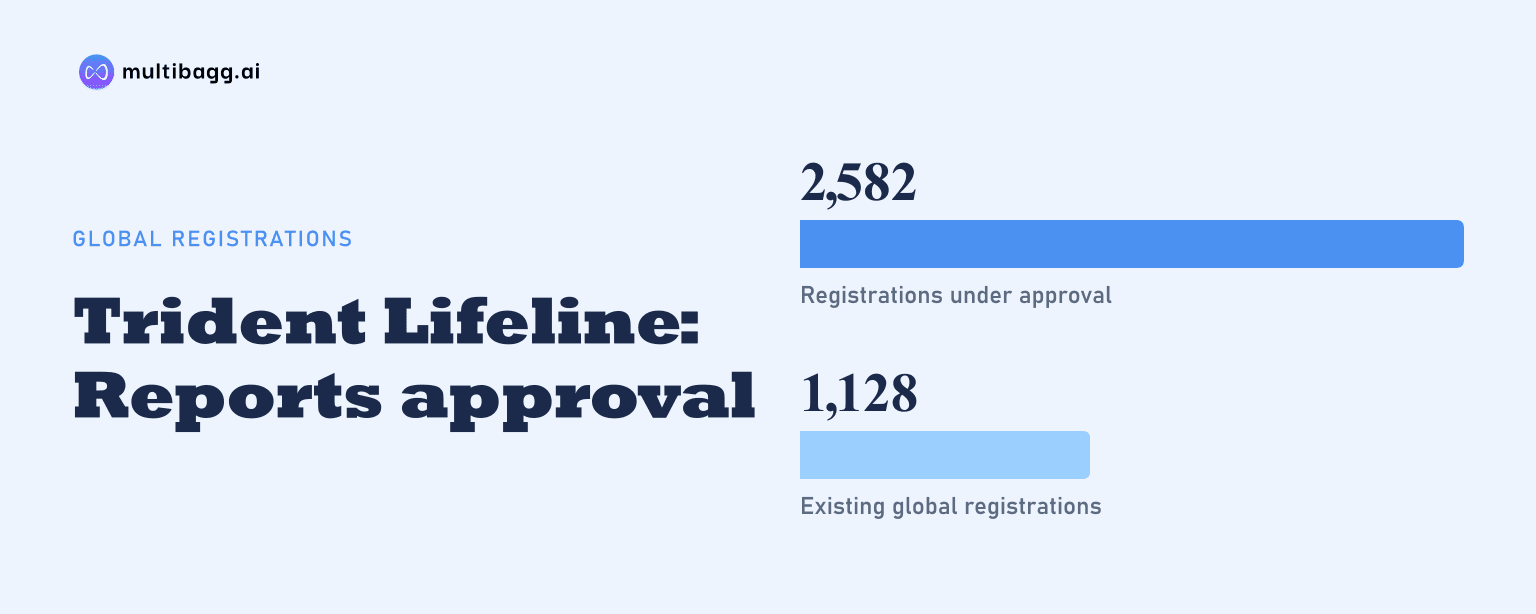
Trident Lifeline reports 2,582 global registrations under approval, creating a future filing pipeline alongside 1,128 existing global product registrations across 47 countries. The company adds 300 to 400 registrations annually and says a typical registration has a gestation period of 1.5 to 3 years before it can support market access and product launches.
Know Trident Lifeline inside out
Results, valuation, peers and who's buying, in one view.
What does Trident Lifeline’s 2,582-registration pipeline represent?
Trident Lifeline’s 2,582 registrations are filings under approval, rather than the same measure as its 1,128 existing global product registrations. This distinction matters because the presentation separates registrations already supporting market access from the larger pipeline awaiting the approval process. Management links the pipeline to future product approvals, launches, revenue growth, manufacturing utilisation, margin expansion and reinvestment.
The company describes registrations as long-term commercial assets that can generate recurring revenue across multiple years and markets. Its stated mechanism is sequential: registrations create market access, market access enables sales and distribution, and the resulting integrated demand supports quality delivery and cash generation. The stated 1.5-to-3-year gestation period means filings may not translate into product launches within a single reporting period.
Trident Lifeline estimates the intrinsic value of its registrations at about Rs 80 crore. That estimate is presented alongside the registration platform, not as reported revenue or a balance-sheet valuation. The company’s investment rationale instead characterises current spending on registrations, market access, sales infrastructure and manufacturing as expected to support multi-year revenue growth, operating leverage and margin expansion.
Where are Trident Lifeline’s registrations and countries concentrated?
Trident Lifeline’s reported presence covers 47 countries, with Africa accounting for 64% of global registrations, Asia 21%, Latin America 14% and the Commonwealth of Independent States, or CIS, 1%. The geographical split is based on registrations, while the country totals describe the company’s presence by region. Europe is listed among the company’s markets but is not assigned a percentage in the registration mix.
Africa is the largest reported registration concentration at 64% and the largest country grouping, with 17 countries. Asia has 13 countries but a 21% registration share, while Latin America has nine countries and a 14% share. The source characterises these regions primarily as emerging, regulated or semi-regulated markets, with Asia identified as an area for expanding registrations.
How quickly is Trident Lifeline adding registrations?
Trident Lifeline says it adds 300 to 400 new registrations annually, while reporting 2,582 registrations under approval. The presentation does not disclose how many filings were approved, rejected or withdrawn in a given year. It therefore provides a measure of additions to the filing base, rather than an annual approval or launch total.
The annual addition range sits beside the company’s 47-country footprint and integrated manufacturing strategy in its growth-driver summary. Management says a larger registration pipeline supports future launches and revenue growth, but it does not give a dated launch schedule, approval target or country-by-country conversion rate. The 300-to-400 figure consequently cannot establish realised sales from the pipeline.
Trident Lifeline invested Rs 0.70 crore in research and development, or R&D, and formulation and development, or F&D, in H1 FY27, after Rs 1 crore in FY26. The R&D and F&D unit handles formulation, process and analytical development and is intended to support new formulations, global products and dosage innovation. That capability is part of the company’s stated process for supplying the registration pipeline with market-ready products.
Got a follow-up? Ask IRIS
How does Trident Lifeline turn registrations into market access?
Trident Lifeline says country-specific regulatory approvals enable market access and product launches, while its distributor-led marketing model and distribution network support availability and market penetration. The company’s demand-led model starts with global registrations, regulatory filings and multi-market approvals, then combines export demand generation and customer engagement with manufacturing expansion. This differs from the traditional model described in the presentation, in which a factory is built before demand exists.
The portfolio behind that process includes more than 3,710 products across six dosage forms, including tablets, capsules, dry powder, syrups, suspensions, injectables, ointments and topicals. It also includes medical devices and surgical products such as intravenous cannulas and infusion sets. Trident Lifeline reports more than 350 products with intellectual property rights, or IPR, but does not state how many of those products are registered or filed in each country.
Manufacturing capacity is reported at 120 million tablets and 120 million capsules per month, plus 10 million injectables per month. Dry-powder bottles, ointments and liquid bottles each have capacity of 3 million units per month, with utilisation based on two-shift operations. These figures show the product formats that can support commercial supply after approvals, but the presentation does not disclose current capacity utilisation or the capacity allocated to the 2,582 filings.
What financial evidence accompanies Trident Lifeline’s registration strategy?
Trident Lifeline reported consolidated revenue from operations of Rs 47.1 crore in Q2 FY27, up 50% from Rs 31.3 crore in Q2 FY26. Consolidated earnings before interest, tax, depreciation and amortisation, or EBITDA, rose 65% to Rs 11.3 crore, and the EBITDA margin increased by 217 basis points to 24.1%. These results are financial outcomes for the quarter, not evidence that a specified number of registrations converted into sales.
Profit after tax rose 30% to Rs 6.6 crore in Q2 FY27 from Rs 5.1 crore a year earlier, while the profit-after-tax margin declined to 14.0% from 16.2%. Finance cost increased 95% to Rs 1.9 crore and depreciation and amortisation increased 71% to Rs 1.6 crore. The presentation supplies no direct reconciliation between registration filings, approvals, country launches and the quarter’s revenue growth.
Conclusion
Trident Lifeline’s disclosed registration base combines 1,128 existing global product registrations with 2,582 filings under approval across a 47-country platform weighted toward Africa, which accounts for 64% of registrations. The company’s strategy connects filings to country approvals, distributor-led demand and integrated manufacturing, while Q2 FY27 consolidated revenue rose 50% to Rs 47.1 crore.
The next issue to watch is conversion because Trident Lifeline adds 300 to 400 registrations annually but does not state approval rates, launch timing or revenue per registration. Management also identifies commercial implementation of the TLL Parenterals Injectable facility in 2026, planning for the TLL Cefa Facility and a planned nutraceutical launch, which could affect products available for future registrations and launches.