










Trident Lifeline Q2 revenue rises 50% while PAT margin falls
Key highlights
- Trident Lifeline’s Q2 FY27 consolidated revenue rose 50% year on year to Rs 47.1 crore.
- Consolidated EBITDA increased 65% to Rs 11.3 crore and EBITDA margin expanded 217 basis points to 24.1%.
- Consolidated PAT rose 30% to Rs 6.6 crore, while PAT margin declined 224 basis points to 14.0%.
- Medical devices revenue grew 183% year on year to Rs 17.0 crore in Q2 FY27.
powered by IRIS
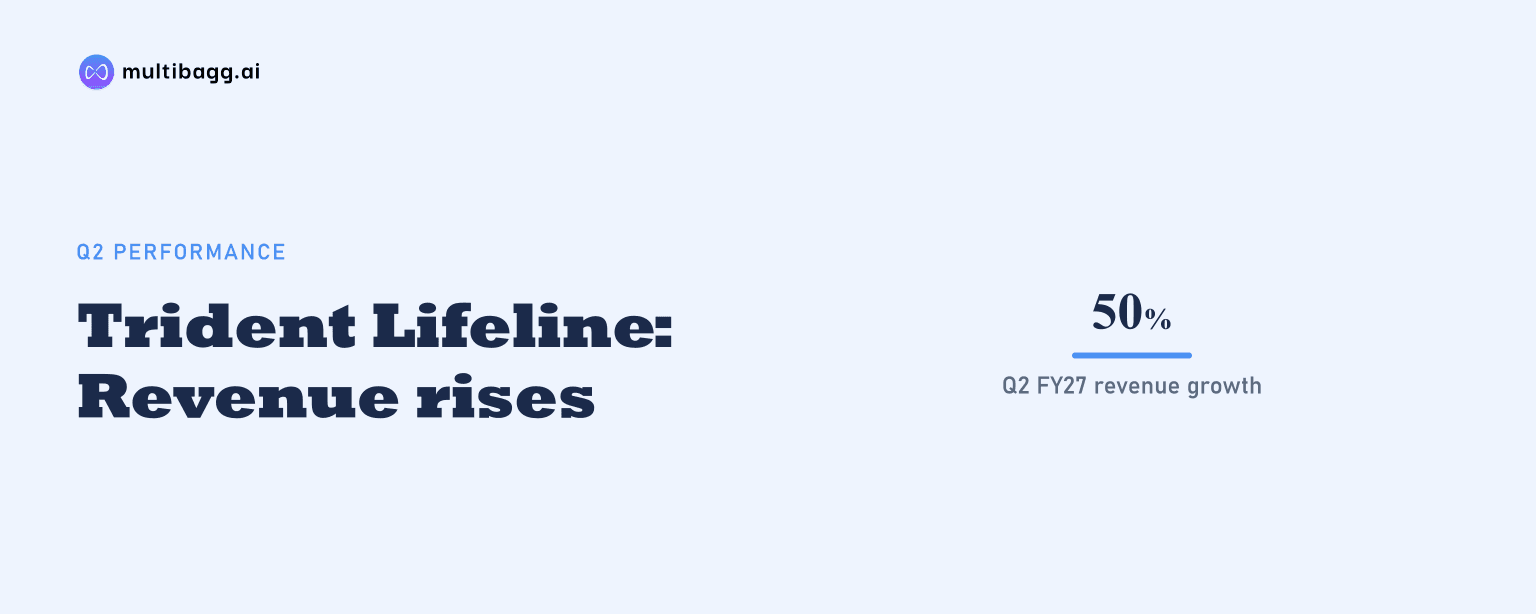
Trident Lifeline Limited, referred to hereafter as Trident Lifeline, reported consolidated revenue of Rs 47.1 crore in Q2 FY27, up 50% year on year, while profit after tax margin fell 224 basis points to 14.0%. EBITDA rose 65% to Rs 11.3 crore, but higher depreciation, finance cost and tax limited profit after tax growth to 30%.
Know Trident Lifeline inside out
Results, valuation, peers and who's buying, in one view.
How did Trident Lifeline perform in Q2 FY27?
Trident Lifeline increased consolidated revenue from operations to Rs 47.1 crore in Q2 FY27 from Rs 31.3 crore in Q2 FY26, while EBITDA increased to Rs 11.3 crore from Rs 6.9 crore. EBITDA, or earnings before interest, taxes, depreciation and amortisation, grew faster than revenue at 65%, lifting EBITDA margin by 217 basis points to 24.1% from 21.9%.
Profit before tax rose 33% to Rs 8.8 crore from Rs 6.6 crore, while profit after tax increased 30% to Rs 6.6 crore from Rs 5.1 crore. The slower growth in post-tax profit than in revenue reduced the consolidated PAT margin to 14.0% from 16.2% in Q2 FY26.
Trident Lifeline also reported sequential revenue growth of 40% from Rs 33.7 crore in Q1 FY27 and EBITDA growth of 33% from Rs 8.5 crore. However, EBITDA margin declined by 120 basis points from 25.3% in Q1 FY27, and PAT margin fell 102 basis points from 15.0%, indicating that the second quarter’s revenue growth did not fully translate into sequential margin expansion.
Which businesses drove Trident Lifeline’s revenue growth?
Trident Lifeline’s medical devices business delivered the largest disclosed Q2 FY27 year-on-year increase, with revenue rising 183% to Rs 17.0 crore from Rs 6.0 crore in Q2 FY26. Tablets remained the largest specifically reported Q2 segment, generating Rs 17.2 crore, up 11% from Rs 15.5 crore.
Capsule revenue declined 19% to Rs 5.5 crore in Q2 FY27 from Rs 6.8 crore a year earlier. The presentation separately reported revenue from others, including syrups, suspensions, dry powder bottles and ointments, at Rs 7.4 crore in H1 FY27, up 147% from Rs 3.0 crore in H1 FY26; this is a half-year comparison rather than a Q2-only measure.
Capacity utilisation rose to 46% in Q2 FY27 from 32% in Q2 FY26. Management attributed the period’s progress to product registrations, new-market expansion, portfolio additions, subsidiary contributions and improved manufacturing-capacity use, while identifying further utilisation gains and subsidiary performance as H2 FY27 priorities.
Trident Lifeline reported 64 clients, representing stated year-on-year growth of 31%, and a product portfolio of 3,710 compared with 3,625 in FY26. Its platform covered 47 countries, with 1,128 global product registrations excluding India and 2,582 registrations filed; Africa accounted for 64% of registrations, followed by Asia at 21%, Latin America at 14% and the Commonwealth of Independent States at 1%.
Got a follow-up? Ask IRIS
Why did Trident Lifeline’s PAT margin decline despite EBITDA growth?
Trident Lifeline’s PAT margin declined because expenses and income items below EBITDA moved less favourably than the 65% EBITDA increase. Depreciation and amortisation rose 71% to Rs 1.6 crore, finance cost increased 95% to Rs 1.9 crore and tax expense rose 44% to Rs 2.2 crore, while other income fell 42% to Rs 1.0 crore.
These movements meant that the Rs 4.4 crore increase in EBITDA produced a Rs 2.2 crore increase in profit before tax and a Rs 1.5 crore increase in PAT. PAT of Rs 6.6 crore was therefore 30% above Q2 FY26, compared with the 50% revenue increase, resulting in the 224-basis-point decline in PAT margin.
Other expenses rose 79% to Rs 5.3 crore from Rs 3.0 crore, exceeding the rate of revenue growth, while material costs increased 51% to Rs 27.4 crore. Employee benefits expense declined 9% to Rs 3.1 crore from Rs 3.4 crore, partly offsetting the increase in other costs.
The sequential comparison shows a similar pattern: finance cost increased from Rs 0.9 crore in Q1 FY27 to Rs 1.9 crore in Q2 FY27, and other expenses rose from Rs 3.2 crore to Rs 5.3 crore. PAT increased from Rs 5.1 crore to Rs 6.6 crore over that period, but PAT margin decreased to 14.0% from 15.0%.
What do Trident Lifeline’s cash flows, debt and plans show?
Trident Lifeline reported consolidated net cash from operating activities of Rs 11.5 crore in H1 FY27, compared with Rs 4.7 crore for the full FY26. Investing activities used Rs 16.7 crore in H1 FY27 and financing activities generated Rs 5.2 crore, leaving net cash flow at Rs 0.0 crore, versus a Rs 1.8 crore increase for FY26.
At H1 FY27, non-current borrowings stood at Rs 54.5 crore, compared with Rs 40.0 crore in FY26, while short-term borrowings rose to Rs 35.5 crore from Rs 33.0 crore. The reported net debt-to-equity ratio was unchanged at 0.7 times, and the current ratio improved to 1.8 times from 1.6 times in FY26; trade receivables declined to Rs 61.2 crore from Rs 73.7 crore, while inventories increased to Rs 44.3 crore from Rs 36.4 crore.
Management said the parenterals facility was expected to be commissioned after Diwali, subject to operational readiness. It also said a proposed preferential issue would support strategic priorities, although the presentation did not disclose an amount or timetable, and reported research and development and formulation development investment of Rs 0.7 crore in H1 FY27, up 89% year on year.
Management’s stated ambition is to triple Trident Lifeline’s consolidated business over the next three years. It linked that plan to execution across business verticals, capacity utilisation, registrations, product and market expansion, subsidiary performance and capital allocation, while its growth framework indicates 300 to 400 new registrations added annually.
Conclusion
Trident Lifeline delivered higher consolidated revenue and operating profit in Q2 FY27, led by medical devices, tablet sales and increased capacity utilisation. Yet EBITDA growth of 65% did not translate proportionately into PAT growth because depreciation, finance cost and tax increased, while other income declined, reducing PAT margin to 14.0%.
The next disclosed markers are H2 FY27 progress on capacity utilisation, subsidiary performance and market expansion, as well as the expected post-Diwali commissioning of the parenterals facility, subject to readiness. Management’s three-year objective to triple the consolidated business and its proposed preferential issue place execution, funding and registrations growth among the disclosed matters to watch next.