










GPT Healthcare Plans Rs 75 Crore Jamshedpur Hospital by FY27
Key highlights
- GPT group plans a 155-bed Jamshedpur hospital with Rs 75 crore of investment, targeted for commissioning by end-FY27.
- Developers will fund the Jamshedpur land and building, while GPT group will operate the facility on fixed rental arrangements.
- GPT group reported 719 beds in H1FY27 and aims to scale to 1,000 beds within two years.
- H1FY27 revenue from operations rose 16% year on year to Rs 262 crore, while EBITDA increased 30% to Rs 56 crore.
powered by IRIS
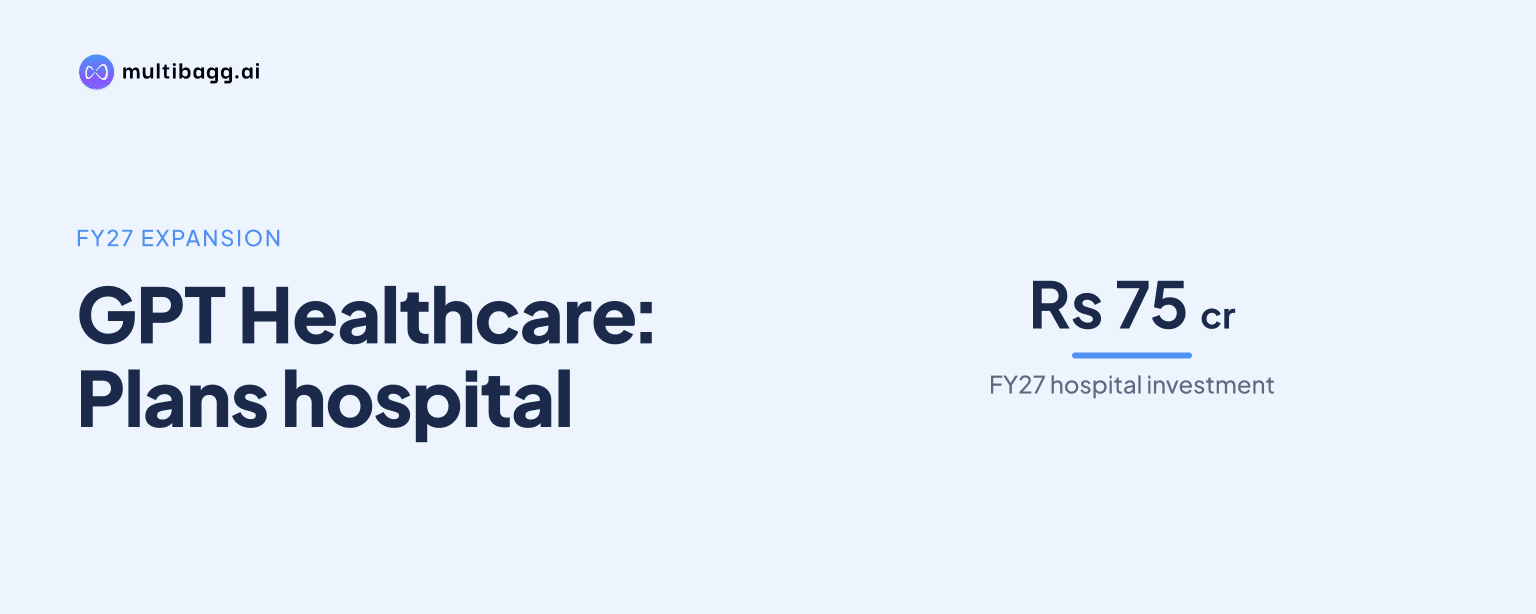
GPT Healthcare plans to commission a 155-bed Jamshedpur hospital by the end of financial year 2027 (FY27) with Rs 75 crore of investment, while developers fund its land and building and GPT group operates it on fixed rentals. The presentation positions this asset-light structure as a route to capacity growth with lower capital intensity and faster return on capital employed.
Know GPT Healthcare inside out
Results, valuation, peers and who's buying, in one view.
What is GPT group planning in Jamshedpur?
GPT group has signed a memorandum of understanding (MoU) for a 155-bed Jamshedpur hospital, with commissioning targeted by the end of FY27. The presentation lists Rs 75 crore of investment for the facility, but does not disclose a construction schedule, specialty mix, developer name or allocation of the investment between equipment and hospital fit-outs.
The Jamshedpur project forms part of GPT group’s short-term expansion outlook, alongside planned entry into Tier II cities in Uttar Pradesh, Assam and Odisha and select Tier I locations in Eastern India. Its stated expansion proposition centres on locations in dense residential areas near transport hubs, intended to improve patient access.
The proposed 155 beds compare with the 719 beds reported in H1FY27. GPT group aims to reach 1,000 beds within two years in Tier I and Tier II Eastern India markets, implying a planned addition of 281 beds from the H1FY27 base, so Jamshedpur would account for only part of the stated capacity increase.
How does GPT group’s developer-funded model work?
GPT group says developers will fund the Jamshedpur land and building, while hospital operations will run under fixed rental arrangements. The structure separates funding of the physical property from the operating hospital, although the presentation does not disclose the rent, lease term, escalation clauses or developer identity.
Management describes this as an asset-light model designed for rapid scale-up with low capital intensity, disciplined risk and minimal balance-sheet strain. The stated mechanism is that developer funding of land and buildings lets GPT group deploy capital toward operating a 155-bed hospital rather than fully funding the real-estate asset.
The presentation links the model to faster return on capital employed (ROCE), but gives no Jamshedpur-specific ROCE forecast or break-even estimate. At the network level, GPT group cites break-even in 8 to 10 months and capital expenditure per bed of Rs 70 lakh to Rs 80 lakh as part of its capital-efficient execution proposition, rather than as guidance for this project.
How does Jamshedpur fit GPT group’s occupancy and return targets?
GPT group targets bed occupancy of at least 70% across mature hospitals through capacity use, equipment optimisation and phased expansion. That target exceeds the 47.9% occupancy reported in H1FY27 and the 58.9% reported in both FY25 and FY26, making patient-volume ramp-up relevant alongside the addition of new beds.
Management also aims to maintain long-term return on equity (ROE) and ROCE of about 25%. Reported FY26 ROE was 15.7% and ROCE was 16.5%, down from 20.1% and 23.5%, respectively, in FY25; the presentation does not state a date by which the approximately 25% targets are expected.
GPT group reported net debt to equity of 0.05 times in H1FY27, compared with 0.38 times in H1FY26. The presentation does not say whether Jamshedpur fixed-rental commitments will affect this ratio or quantify the rental cost attached to the developer-funded arrangement.
Got a follow-up? Ask IRIS
What operating trends accompany GPT group’s expansion plan?
GPT group reported revenue from operations of Rs 262 crore in H1FY27, up 16% from Rs 226 crore in H1FY26. Earnings before interest, tax, depreciation and amortisation (EBITDA) rose 30% to Rs 56 crore, while the EBITDA margin increased to 21.0% from 18.8% in the same half-year comparison.
Profit after tax increased 54% to Rs 28 crore in H1FY27 from Rs 18 crore in H1FY26, and the margin rose to 10.5% from 8.0%. In the full-year comparison, FY26 revenue rose to Rs 478 crore from Rs 407 crore in FY25, while EBITDA declined to Rs 90 crore from Rs 92 crore and margin fell to 18.8% from 22.1%.
Inpatient volume increased to 18,715 in H1FY27 from 16,829 in H1FY26, while outpatient volume rose to 102,377 from 89,802. Average revenue per occupied bed increased to Rs 41,490 from Rs 38,376, average length of stay declined to 3.37 days from 3.49 days, and occupancy rose by 3.2 percentage points to 47.9%.
What other initiatives does GPT group disclose for the near term?
GPT group has launched Comprehensive Cancer Care at Agartala, including a positron emission tomography scan and a linear accelerator, which the presentation identifies as Tripura’s only integrated oncology unit. Management targets occupancy at Agartala and Howrah to increase from about 55% to 70% to 75%.
At Howrah, GPT group has commenced robotic knee replacement surgeries. Management expects the service to increase average revenue per occupied bed and reduce average length of stay, but the presentation gives no procedure-volume forecast, revenue target or date for reaching the 70% to 75% occupancy range.
GPT group also describes a doctor-agnostic, broad-specialty platform with diversified case mix and the ability to add services according to demand. It aims to secure more than 90% of revenue from cash and insured patients, which management says limits reliance on government schemes and corporates.
Conclusion
GPT group’s Jamshedpur proposal combines 155 additional beds and Rs 75 crore of investment with a developer-funded land-and-building structure operated on fixed rentals. The plan supports management’s stated objective of reaching 1,000 beds within two years while pursuing at least 70% occupancy in mature hospitals and long-term ROE and ROCE of about 25%.
The next disclosed milestone is Jamshedpur commissioning by the end of FY27. The presentation also identifies occupancy ramp-up at Agartala and Howrah from about 55% toward 70% to 75% as a near-term operational target, while rental terms and the other sites contributing to the 1,000-bed plan remain undisclosed.