










GPT Healthcare Delays Raipur Break-Even Target to Q1 FY28
Key highlights
- GPT Healthcare expects Raipur to reach monthly break-even in Q1 FY28 after clinical-talent attrition delayed the prior target.
- Raipur recorded Rs 6.5 crore of losses in H1 FY27, which management said were in line with expectations.
- GPT Healthcare expects Raipur average occupancy of 25% to 30% by the end of Q4 FY27.
- Raipur was empanelled with almost 70% of insurance players as of the November 2026 earnings call.
powered by IRIS
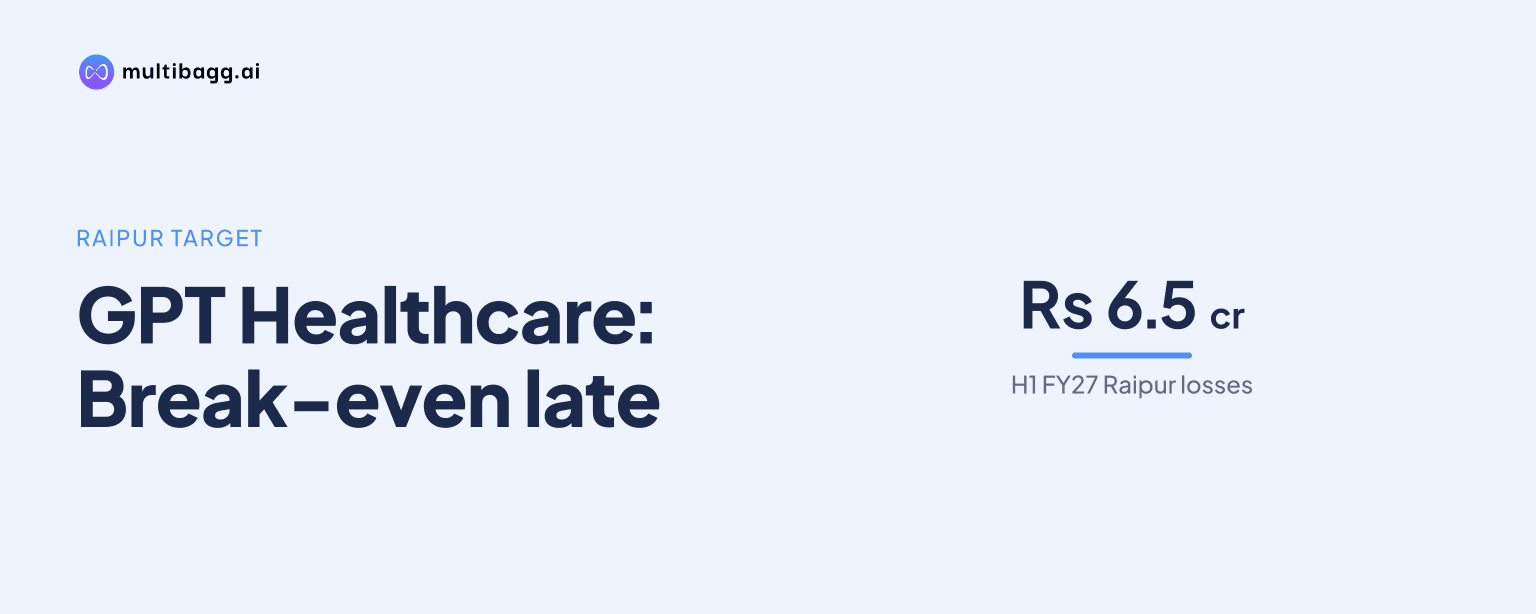
GPT Healthcare Limited delayed Raipur hospital’s monthly break-even target to Q1 FY28 after clinical-talent attrition tied by management to new market entrants, while the facility recorded Rs 6.5 crore of H1 FY27 losses. Management said it had restored the consultant roster and expects average occupancy of 25% to 30% by the end of Q4 FY27.
Know GPT Healthcare inside out
Results, valuation, peers and who's buying, in one view.
Why did GPT Healthcare delay Raipur’s break-even target?
GPT Healthcare delayed Raipur’s monthly break-even target because management said new hospital entrants caused attrition among its clinical talent and affected productivity. On the November 6, 2026 earnings call, Executive Director Anurag Tantia confirmed the revised Q1 FY28 target after an analyst noted that management had previously guided for a Q3 break-even. He said the consultant gap had been bridged and all consultants had been brought back.
The revised target concerns monthly break-even, not a full-year profit forecast. Management said new tertiary-care hospitals generally take nearly three years to reach monthly break-even, placing Raipur’s revised timing within the ramp-up period it described. Management also cited seasonal change in Q2 FY27 as a factor in lower productivity and said it expected Raipur’s average occupancy to reach 25% to 30% by the end of Q4 FY27.
What losses did GPT Healthcare report at Raipur?
GPT Healthcare reported Rs 6.5 crore of losses at Raipur in H1 FY27, which management said were in line with expectations. During the call, management initially referred to around Rs 9 crore before correcting the period and confirming that the H1 FY27 loss was Rs 6.5 crore. The company did not disclose Raipur’s quarterly revenue, current occupancy or monthly loss run rate.
The loss came as Raipur built its clinical offering in its first year. The hospital received National Accreditation Board for Hospitals and Healthcare Providers accreditation within that year, performed its first transcatheter aortic valve implantation procedure and liver transplant in Q2 FY27, and completed 11 renal transplants in just under one year. These additions preceded management’s expectation of better performance in the ensuing quarters.
Raipur’s early-stage losses contrasted with the wider network’s H1 FY27 result. GPT Healthcare reported Rs 261.8 crore of revenue from operations, up 15.8% year on year, while earnings before interest, tax, depreciation and amortisation rose 30.3% to Rs 56 crore. The group’s earnings before interest, tax, depreciation and amortisation margin increased to 21% from 18.8% in H1 FY26, indicating that mature hospitals supported consolidated profitability during Raipur’s ramp-up.
How is GPT Healthcare rebuilding Raipur’s operating base?
GPT Healthcare is rebuilding Raipur’s operating base through its restored consultant roster, insurer empanelment and a broader payer mix. Management said it had refilled clinical gaps created by attrition and brought its consultants back. It did not disclose how many clinicians had left, the specialties affected or the date when the restored roster became fully operational.
Insurance access remains incomplete, with Raipur empanelled with almost 70% of insurance players as of the November 2026 call. Management said it was working with the remaining insurers to reach agreements, without giving a completion date. This is relevant because insurer participation can expand access for insured patients, although the company did not quantify Raipur’s insured-patient volumes or revenue contribution.
Raipur is also taking Ayushman Bharat patients and corporate patients from Steel Authority of India, Coal India and other regional employers. Management said it was managing Ayushman Bharat admissions with cash flow in mind, while corporate cases generally follow Central Government Health Scheme rates that are slightly higher than Ayushman rates. The call did not provide the share of admissions, collections or average revenue by payer category.
Got a follow-up? Ask IRIS
How does Raipur compare with GPT Healthcare’s mature hospitals?
Raipur remains at an earlier utilisation stage than GPT Healthcare’s established hospitals, which recorded 56.7% occupancy in H1 FY27 excluding Raipur. Consolidated network occupancy was 47.9%, up from 44.7% in H1 FY26. The 8.8-percentage-point difference between reported network occupancy and the rate excluding Raipur shows the effect of the new Central India facility on the blended result.
ILS Dum Dum, GPT Healthcare’s largest revenue contributor, reported Rs 84.8 crore of H1 FY27 revenue, 69.4% occupancy and average revenue per occupied bed of Rs 43,086. ILS Salt Lake recorded 65.4% occupancy and the highest average revenue per occupied bed in the network at Rs 43,284. Raipur’s management target of 25% to 30% average occupancy by Q4 FY27 remains below those established-facility levels.
Other hospitals also showed different stages of development. ILS Howrah increased H1 FY27 revenue by 25% year on year and recorded 45.8% occupancy, while ILS Agartala grew 8.1% and reported average revenue per occupied bed of Rs 40,254. Management attributed Agartala and Howrah growth to improved productivity and a shift towards higher-end specialties.
What expansion capacity does GPT Healthcare have beyond Raipur?
GPT Healthcare said Raipur can add another 100 beds by taking additional space from its developer when utilisation supports sustained growth. Management gave no timetable, capital-cost estimate or occupancy threshold for this expansion. ILS Agartala also has capacity for another 100 beds within its existing premises, but management said brownfield additions would be activated when hospital occupancy reached an optimum level.
The next confirmed project is a 155-bed tertiary-care hospital in Jamshedpur, expected to commence operations in March or April 2027. Management said annual lease expense for Jamshedpur would be similar to Raipur’s nearly Rs 4 crore a year. It is also evaluating greenfield and acquisition opportunities, but said any agreement must contribute meaningfully to both revenue and profit rather than be pursued solely for expansion.
Management retained its FY27 expectation of around 15% to 16% growth over the prior year. In Q2 FY27, GPT Healthcare reported Rs 135.6 crore of revenue, up 14.1% year on year, and Rs 29.8 crore of earnings before interest, tax, depreciation and amortisation, up 23.9%. Profit after tax rose 45.2% to Rs 15.4 crore, while the margin expanded to 11.1% from the prior-year quarter’s level.
Conclusion
GPT Healthcare’s Q1 FY28 monthly break-even target for Raipur reflects a delay caused by clinical attrition amid new competition, rather than a disclosed change in the company’s expansion plans. The Rs 6.5 crore H1 FY27 Raipur loss and the gap between 47.9% network occupancy and 56.7% occupancy excluding Raipur show the financial and operating effect of a new hospital ramp-up, even as the group’s H1 revenue rose 15.8%.
The next measures to watch are management’s 25% to 30% Raipur average-occupancy target by the end of Q4 FY27, insurer empanelment beyond almost 70% of players, and retention of the rebuilt consultant base. The planned March or April 2027 opening of the 155-bed Jamshedpur hospital will also add a second newer asset with annual lease expense expected to be near Rs 4 crore.