










Grand Continent Plans Own Brand After Franchise Expiries
Key highlights
- Grand Continent will not renew two Bengaluru franchise agreements that end in 2027 and 2029.
- Grand Continent said franchise fees range from about 3.5% to 5% of revenue across its affiliated hotels.
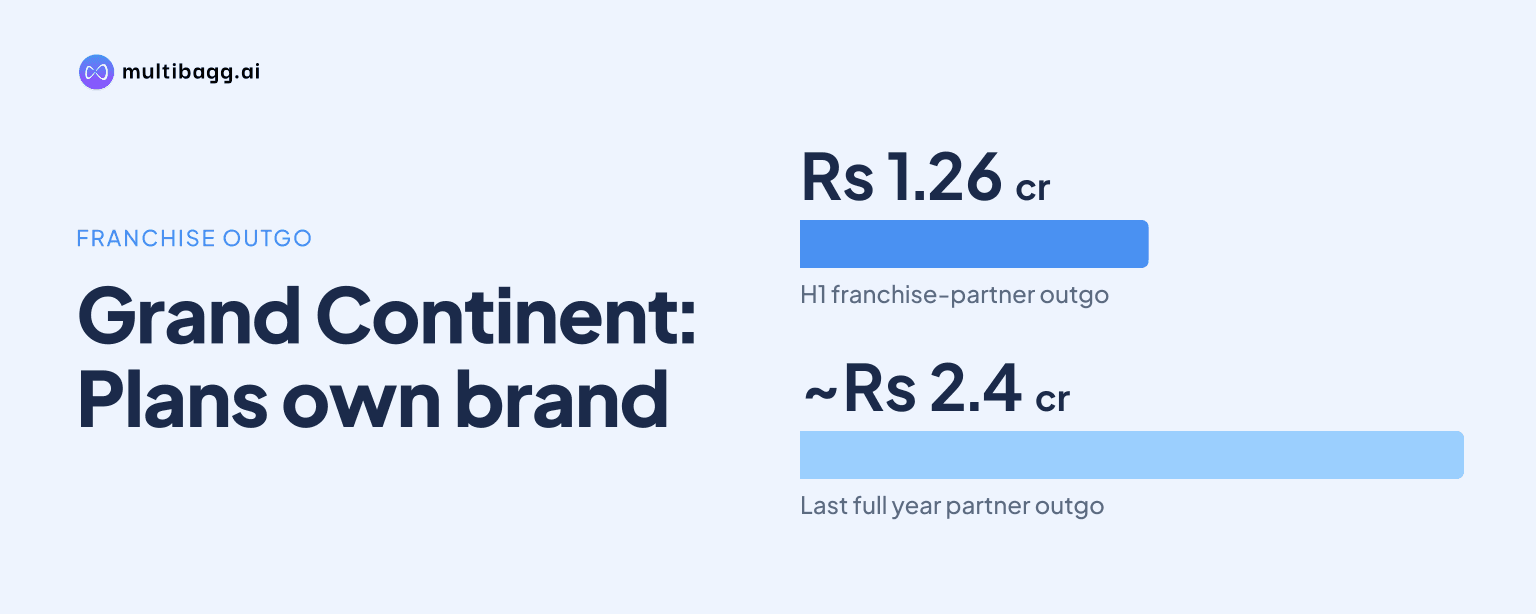
- Grand Continent reported Rs 1.26 crore of franchise-partner outgo in H1, versus about Rs 2.4 crore in the last full year.
- Grand Continent cited ARR of about Rs 4,000 at a Tripathi affiliate and approximately Rs 4,500 at its Manyata and Brookfield hotels.
powered by IRIS
Grand Continent Hotels Limited plans to operate selected hotels under its own brand after franchise contracts expire in 2027 and 2029, as management said affiliations cost roughly 3.5% to 5% of revenue while delivering little average room rate advantage in the examples discussed. Franchise-partner outgo was Rs 1.26 crore in H1.
Know Grand Continent Hotels inside out
Results, valuation, peers and who's buying, in one view.
Why is Grand Continent letting franchise agreements expire?
Grand Continent will allow existing franchise contracts to run to expiry and then operate the affected hotels under its own brand. Management said two Bengaluru hotels, one in Indiranagar and another in Kormagla, have agreements ending in 2027 and 2029, and neither will be renewed with Royal Orchid or another franchise partner.
The company said these arrangements were signed when it was in its initial stage and needed external support. The contracts run for eight to 10 years and have a seven-year lock-in period, which limits an earlier exit. Grand Continent said it has not signed any new franchise agreement and is opening current hotels under its own brand.
Management also said a Sarovar-affiliated Goa property will remain affiliated until its contract ends. The stated approach is therefore a transition at expiry, rather than immediate removal of all franchise affiliations across the 32-hotel portfolio reported on the November 13, 2026 call.
How much does Grand Continent pay in franchise fees?
Grand Continent said Golden Tulip and Tulip Inn charge average franchise fees of 4.5% to 5% of revenue, while Royal Orchid fees are 4% to 5%. Certain Sarovar affiliations were negotiated at 3.25% to 3.5%, and management estimated the overall rate across its affiliated hotels at about 3.5% to 4%.
The company reported Rs 1.26 crore of franchise-partner outgo in H1, compared with about Rs 2.4 crore in the last full year. The figures are not directly comparable as one covers a half year and the other a full year, but they show the disclosed cost base attached to these affiliations.
Management said retaining the roughly 4% paid at affected hotels could add directly to the bottom line after a transition to the own brand. Grand Continent did not disclose revenue, profitability or individual fee payments for the two Bengaluru hotels, so it did not quantify the eventual earnings effect of the 2027 and 2029 expiries.
Do franchise affiliations increase Grand Continent's room rates?
Grand Continent said Golden Tulip, Royal Orchid and Sarovar affiliations did not create much difference in average room rate, or ARR, compared with its own brand in the operating examples management cited. An 88-room Golden Tulip-affiliated property in Tripathi was achieving ARR of about Rs 4,000, while Grand Continent hotels in Manyata and Brookfield, Bengaluru, were each generating approximately Rs 4,500.
That comparison put the ARR at the two Bengaluru own-brand hotels about Rs 500 above the Tripathi affiliate. Management said franchise ties may raise occupancy by around 2% to 4%, but did not expect that benefit to have a major effect on ARR for Royal Orchid and Sarovar arrangements.
The examples are not a like-for-like portfolio study because the properties are in different locations and Grand Continent did not provide occupancy, margins or reporting periods for each. Management separately said a larger luxury brand could provide a better ARR and bottom-line effect, but such a tie-up could require higher operating spending and infrastructure upgrades.
Got a follow-up? Ask IRIS
What did Grand Continent's Goa properties show?
Grand Continent said its two Goa properties showed little commercial difference between the Sarovar affiliation and its own brand. One Goa hotel is affiliated with Sarovar and another operates under the Grand Continent name in Morjim; management said ARR and profitability at the two properties were almost the same.
Management used the Goa comparison to support its decision to await the Sarovar contract expiry rather than renew the arrangement. It said the affiliate had not created a major commercial drive, although it did not provide ARR, occupancy, revenue or profit figures for either Goa property.
The brand decision also comes as Grand Continent works on room tariffs in H2. Management said it did not implement a previously discussed 8% to 10% room-rate increase in H1 because April and May are relatively dull months, and it is instead seeking increases of 2% to 3% at a time while maintaining occupancy to cover fixed costs.
What should readers watch as Grand Continent shifts brands?
The main operating test will be whether hotels transitioning after the 2027 and 2029 expiries maintain ARR and occupancy without the franchise affiliation. Management's evidence so far consists of the Rs 4,000 ARR at the Tripathi affiliate, the approximately Rs 4,500 ARR at Manyata and Brookfield, and the near-equal Goa comparison.
Grand Continent is also expanding its own-brand portfolio. Chief Operating Officer Abhijeet Shrivastava said the company planned a luxury collection in Ayodhya, followed by Vrindavan, and a scheduled 56-room corporate hotel in Gurgaon. Management has set a target of 3,000 keys by 2028, making the pace of openings and the operating performance of newer hotels relevant to the strategy.
The company grew from eight to 10 hotels in 2022-23 to 32 hotels by 2026, according to management. That expansion means the franchise-expiry decision will occur alongside a larger portfolio build-out, rather than as a standalone cost-reduction step.
Conclusion
Grand Continent is moving selected hotels toward its own brand as long-term franchise contracts end, based on management's view that fees of roughly 3.5% to 5% of revenue have not produced a material ARR advantage in the affiliations discussed. The Rs 1.26 crore H1 franchise-partner outgo provides a disclosed measure of the cost involved, while the Bengaluru and Goa examples underpin management's position.
The next disclosed milestones are the franchise expiries in 2027 and 2029 and management's target of 3,000 keys by 2028. Readers should watch whether the 56-room Gurgaon opening and the planned Ayodhya and Vrindavan additions broaden the own-brand portfolio, and whether gradual 2% to 3% tariff increases lift ARR while occupancy is maintained.