










Grand Continent Hotels shifts expansion from leisure stays
Key highlights
- Grand Continent Hotels plans 40 hotels by 2027 while keeping leisure properties at about five.
- Management said corporate hotels can reach about 60% occupancy in 3 to 6 months, versus close to 1 year for leisure hotels.
- Grand Continent Hotels plans hotels in Somnath, Ayodhya, Varanasi and Vrindavan, with Somnath scheduled to open on November 23, 2026.
- Online travel agencies account for about 35% to 45% of Grand Continent Hotels bookings and charge commissions of 17% to 18%, management said.
powered by IRIS
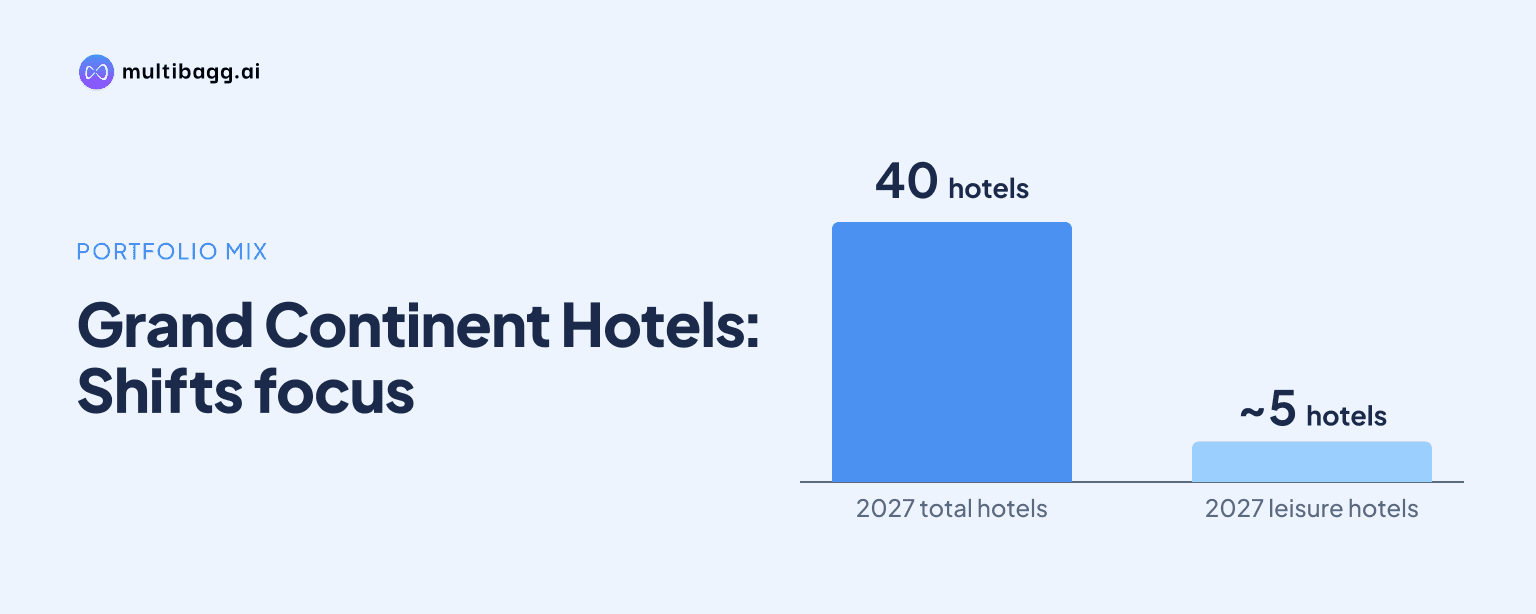
Grand Continent Hotels Limited said on November 13, 2026 that it plans to reach 40 hotels by 2027 while keeping leisure properties at about five, shifting additions toward corporate and spiritual destinations. Management said corporate hotels can reach roughly 60% occupancy in three to six months, compared with close to one year for leisure hotels.
Know Grand Continent Hotels inside out
Results, valuation, peers and who's buying, in one view.
Why is Grand Continent Hotels limiting leisure hotel additions?
Grand Continent Hotels is limiting leisure additions because management said leisure hotels contributed to pressure on Indian hotel profitability and had not materially increased business from the prior year. In the current financial year, the company had opened two hotels, in Gurgaon and Rameshwaram, while leisure properties in Goa, Udaipur and Mahabalipuram performed broadly in line with the prior year.
Management said the group had 32 hotels, including five or six leisure hotels, at the time of the November 13 call. By 2027, Grand Continent Hotels expects 40 hotels while leisure hotels remain at five. The stated strategy is therefore to direct most new additions to corporate and spiritual tourism rather than increase exposure to leisure demand cycles.
Leisure demand has a larger seasonal effect on average room rate, or ARR. Management cited Udaipur, where it said room rates can be Rs 60 lakh to Rs 70 lakh in the peak period on its stated scale, but decline to Rs 40 lakh to Rs 45 lakh in the off-season. It said ARR had returned to Rs 68 lakh to Rs 70 lakh from the start of November as seasonal demand improved.
The Udaipur example also shows the management view of recovery in leisure demand. An analyst cited H1 FY27 occupancy of about 29% to 30% at the hotel, and management said it was targeting close to 60% occupancy year-to-date. Management reported that Udaipur had sold out for the three days before the call and the following three days, with wedding bookings in November and bookings in February.
How will Grand Continent Hotels build its corporate and spiritual portfolio?
Grand Continent Hotels plans spiritual-destination hotels in Somnath, Ayodhya, Varanasi and Vrindavan. Management said Somnath was scheduled to open on November 23, 2026, and that it planned to go live subsequently in Ayodhya, Varanasi and Vrindavan. These four locations form the immediate spiritual-tourism component of the revised property-selection strategy.
Management said the next nine hotels contained no leisure properties except one small hotel that had been signed earlier. The company is not closing its existing leisure hotels in Goa or Udaipur. Instead, it is changing the composition of its future pipeline after the previously committed leisure property is opened.
The reason is the different time required for new hotels to become established. Management divided the portfolio into corporate, pilgrimage and leisure categories and gave the following timelines to reach about 60% occupancy.
Management said the portfolio change should have a better effect in H1 FY28. That is management's expectation, not a reported outcome, and depends on the planned spiritual hotels becoming operational and newer corporate and pilgrimage hotels progressing toward the occupancy levels described on the call.
Got a follow-up? Ask IRIS
How does Grand Continent Hotels plan to improve room rates and channel mix?
Grand Continent Hotels said corporate and spiritual tourism can maintain ARR through the year and allow rate increases during peak periods, unlike leisure hotels that can require material off-season discounting. Management said corporate hotel ARR had increased marginally from the previous year and that peak-period increases of 5% to 8% were possible.
The company is pursuing higher rates through corporate-contract renewals, where management said it was negotiating increases of 8% to 10%. It also cited selected hotel amenities designed not to increase costs. Grand Continent Hotels has regional corporate sales offices in Ahmedabad, Mumbai and Delhi, and had started offices in Hyderabad and Bangalore to seek pan-India agreements with larger companies.
The plan also addresses booking-channel costs. Management said online travel agencies, or OTAs, accounted for about 35% to 45% of bookings and charged commissions of 17% to 18%, which it said directly affected the bottom line. The expanded corporate-sales effort is intended to reduce OTA reliance, raise contracted corporate business and support both ARR and profitability.
Management's expectation for better H2 FY27 results also rests on conditions at its existing estate, not solely on the revised pipeline. It said that after Diwali, leisure properties in Goa and Udaipur were full, while corporate hotels in Bangalore, Chennai and Hyderabad were picking up. Management forecast H2 FY27 would be much better than H1 FY27, without giving a specific earnings before interest, tax, depreciation and amortisation, or EBITDA, margin target.
How is Grand Continent Hotels changing its operating model as it grows?
Grand Continent Hotels is adding some hotels through management contracts rather than using only leases or revenue-sharing structures. Management said two of the nine planned hotels were signed under management contracts, requiring no investment by the company and providing management fees of about 5% to 6%. It is seeking another four or five management-contract hotels in the following year.
A proposed move from leases to revenue sharing remains unresolved because landowners seek a minimum guarantee. Management said a fixed minimum guarantee would attract goods and services tax, or GST, which would reduce the benefit of a pure revenue-share structure. It said it was working with statutory auditors and its legal team on the issue.
The operating-model shift accompanies a plan to add 600 keys and reach about 2,400 keys in four to five months. Management said it had ICICI Bank limits and internal accruals for that phase and did not expect a fundraise, instead using debt. Funding for the later move from 2,400 to 3,000 keys remained to be considered.
Management also linked higher H1 FY27 costs to properties at different stages of opening. Lease rental increased following the Gurgaon and Rameshwaram openings and deposits or preparations for Yelahanka and Vellore, it said. Employee costs rose with four units, minimum-wage effects and the full-period impact of hotels that had not operated for a full prior-year period.
Conclusion
Grand Continent Hotels is reshaping its expansion mix rather than simply adding rooms. Management's stated operating case is that corporate hotels can approach 60% occupancy in three to six months and pilgrimage hotels in four to six months, while leisure hotels can take close to one year and face larger off-season rate reductions. Keeping leisure properties at about five within a 40-hotel portfolio is the practical expression of that plan.
The next disclosed markers are Somnath's planned November 23, 2026 opening, followed by planned launches in Ayodhya, Varanasi and Vrindavan, and the addition of 600 keys toward about 2,400. Management's ability to reduce the 35% to 45% OTA contribution, secure further management contracts and resolve the GST effect of minimum guarantees will determine how the operating model develops.