










Grand Continent debt-equity rises to 0.5 as debt hits Rs 56 crore
Key highlights
- Grand Continent’s debt-equity ratio rose to 0.5 in H1 FY27 from 0.2 in FY26.
- Grand Continent’s total borrowings increased to Rs 56 crore in H1 FY27 from Rs 37 crore in FY26.
- Grand Continent’s total assets rose to Rs 216 crore in H1 FY27 from Rs 184 crore in FY26.
- Grand Continent reported 88 working-capital days in H1 FY27, versus 96 days in FY26.
powered by IRIS
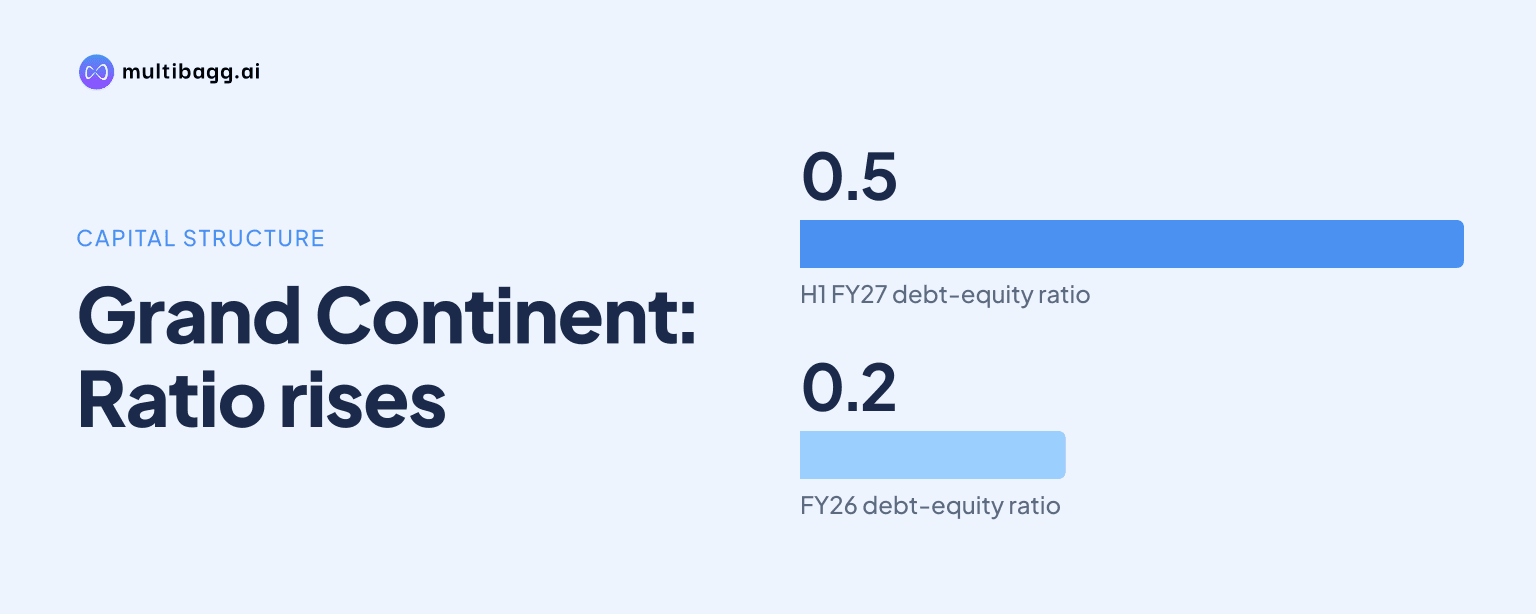
Grand Continent reported a debt-equity ratio of 0.5 in H1 FY27, versus 0.2 in FY26, as long-term and short-term borrowings together reached Rs 56 crore from Rs 37 crore at March 2026. Total assets rose to Rs 216 crore, while shareholder funds increased to Rs 132 crore.
Know Grand Continent Hotels inside out
Results, valuation, peers and who's buying, in one view.
Why did Grand Continent’s debt-equity ratio rise to 0.5?
Grand Continent’s debt-equity ratio rose because borrowings increased faster than shareholder funds. The company reported the ratio at 0.1 in FY25, 0.2 in FY26 and 0.5 in H1 FY27. Over the same sequence, shareholder funds rose from Rs 113 crore to Rs 127 crore and then Rs 132 crore, but total borrowings expanded from Rs 11 crore in FY25 to Rs 37 crore in FY26 and Rs 56 crore in H1 FY27.
The H1 FY27 borrowing total comprises Rs 38 crore of long-term borrowings and Rs 18 crore of short-term borrowings. At March 2026, the corresponding balances were Rs 23 crore and Rs 14 crore, respectively. Long-term borrowings increased by Rs 15 crore and short-term borrowings by Rs 4 crore between March 2026 and H1 FY27, while other equity increased by Rs 6 crore to Rs 107 crore.
How did Grand Continent’s liabilities change in H1 FY27?
Grand Continent’s total liabilities, excluding shareholder funds, reached Rs 84 crore in H1 FY27, compared with Rs 57 crore at March 2026 and Rs 26 crore at March 2025. Non-current liabilities accounted for Rs 43 crore in H1 FY27, up from Rs 27 crore at March 2026, while current liabilities rose to Rs 41 crore from Rs 30 crore.
The increase in current liabilities extended beyond short-term borrowings. Trade payables rose to Rs 11 crore in H1 FY27 from Rs 8 crore in FY26 and Rs 4 crore in FY25. Other current liabilities increased to Rs 10 crore from Rs 7 crore, while short-term provisions rose to Rs 2 crore from Rs 1 crore. These movements coincided with Grand Continent’s reported working-capital cycle falling to 88 days in H1 FY27 from 96 days in FY26, though it remained above 42 days in FY25.
The working-capital measure improved by eight days against FY26 but was 46 days longer than the FY25 level. Current assets were Rs 43 crore in H1 FY27, against Rs 37 crore at March 2026 and Rs 53 crore at March 2025. Within those assets, trade receivables increased to Rs 18 crore from Rs 14 crore in FY26 and Rs 5 crore in FY25, whereas cash and cash equivalents stood at Rs 5 crore, unchanged from FY26 but down from Rs 33 crore in FY25.
Got a follow-up? Ask IRIS
Where did Grand Continent deploy the increase in assets?
Grand Continent’s total assets increased to Rs 216 crore in H1 FY27 from Rs 184 crore at March 2026 and Rs 139 crore at March 2025. The Rs 32 crore increase from March 2026 was driven by non-current assets, which rose by Rs 26 crore to Rs 173 crore, while current assets increased by Rs 6 crore to Rs 43 crore.
Property, plant and equipment rose to Rs 91 crore in H1 FY27 from Rs 84 crore in FY26 and Rs 62 crore in FY25. Capital work-in-progress increased to Rs 15 crore from Rs 5 crore at March 2026, having been nil at March 2025. Other non-current assets rose to Rs 62 crore from Rs 53 crore in FY26 and Rs 20 crore in FY25.
The asset expansion was concentrated in non-current categories rather than cash. Non-current assets represented Rs 173 crore of the Rs 216 crore H1 FY27 asset base, compared with Rs 147 crore of Rs 184 crore in FY26. Grand Continent also reported financial-asset loans of Rs 2.8 crore in H1 FY27, up from Rs 1.5 crore in FY26, and inventories of Rs 1.8 crore, up from Rs 1.5 crore.
What happened to Grand Continent’s returns and earnings in H1 FY27?
Grand Continent reported return on equity, or RoE, of 3% in H1 FY27, compared with 9% in FY26 and 10% in FY25. Return on capital employed was 4% in H1 FY27, compared with 9% in FY26 and 15% in FY25. These measures were disclosed alongside shareholder funds of Rs 132 crore and total assets of Rs 216 crore.
For the first half of FY27, total income was Rs 107.19 crore, up 25% from Rs 85.82 crore in H2 FY26 and 87% from Rs 57.19 crore in H1 FY26. Earnings before interest, tax, depreciation and amortisation, or EBITDA, were Rs 13 crore, compared with Rs 15.60 crore in H2 FY26 and Rs 6.49 crore in H1 FY26. The EBITDA margin was 12.13%, below 18.17% in H2 FY26 but above 11.3% in H1 FY26.
Profit after tax was Rs 6.02 crore in H1 FY27, compared with Rs 10.10 crore in H2 FY26 and Rs 2.31 crore in H1 FY26. Finance cost was Rs 1.79 crore, below Rs 1.90 crore in H2 FY26 and above Rs 1.02 crore in H1 FY26. The presentation does not specify the borrowing instruments, interest rates, maturity schedule or purpose of the Rs 19 crore increase in borrowings from March 2026.
Conclusion
Grand Continent’s H1 FY27 balance sheet shows debt growing faster than equity: borrowings reached Rs 56 crore and the reported debt-equity ratio rose to 0.5, while shareholder funds reached Rs 132 crore. The company also added Rs 32 crore of assets from March 2026, principally through Rs 26 crore of non-current asset growth, including Rs 10 crore more capital work-in-progress.
The next disclosed operating milestone is Grand Continent’s target of 3,000 keys by FY28, alongside planned geographical expansion in North and West India and the USA. Readers can watch whether asset additions, including the Rs 15 crore of capital work-in-progress in H1 FY27, translate into progress toward that portfolio target and how future borrowings, working-capital days and returns develop.