










Grand Continent business hotels post 74.3% H1 occupancy
Key highlights
- Grand Continent business hotels recorded 74.3% H1 FY27 occupancy, versus 43.5% at leisure hotels.
- Grand Continent business hotels accounted for 74% of India revenue mix, while leisure represented 14% and spiritual destinations 12%.
- Grand Continent mature hotels recorded 69.0% occupancy, compared with 41.6% for new hotels.
- Grand Continent’s Andhra Pradesh operations led regional occupancy at 84.6%, while Rajasthan recorded 27.8%.
powered by IRIS
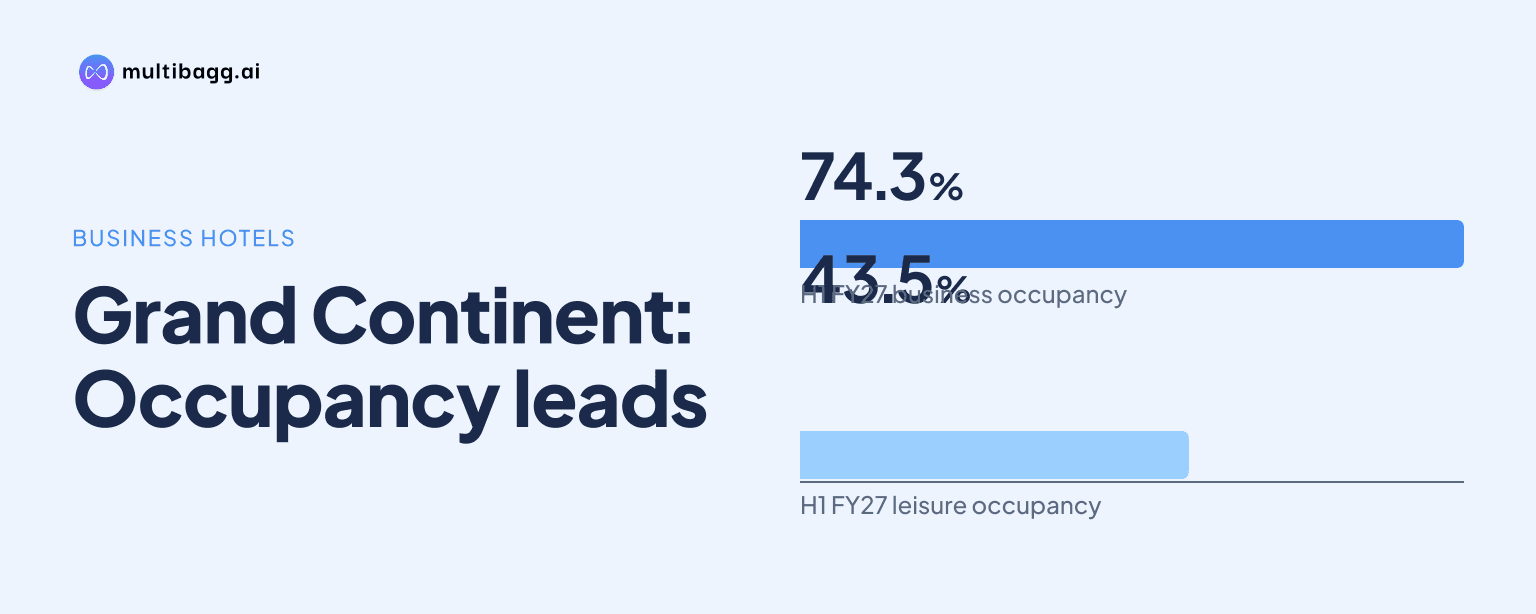
Grand Continent Hotels Limited reported 74.3% occupancy across its 19 business hotels in H1 FY27, exceeding the 43.5% recorded at five leisure properties by 30.8 percentage points. The occupancy difference occurred despite average room rates differing by only Rs 125, at Rs 3,876 for business and Rs 3,751 for leisure hotels.
Know Grand Continent Hotels inside out
Results, valuation, peers and who's buying, in one view.
Why did Grand Continent business hotels lead occupancy?
Grand Continent business hotels led the Indian portfolio with 74.3% occupancy in H1 FY27, compared with 67.5% for spiritual properties and 43.5% for leisure properties. Business was also the largest reported India revenue segment, accounting for 74%, while leisure represented 14% and spiritual destinations represented 12%. The business portfolio comprised 19 units, against five leisure and three spiritual units.
The occupancy gap was substantially wider than the difference in average room rate, or ARR. Business hotels reported ARR of Rs 3,876, only Rs 125 above leisure hotels at Rs 3,751; spiritual properties reported Rs 3,812. This is an analysis of the reported data: the business-leisure difference was associated more with room utilisation than with the published rate level.
Management said mature business and spiritual segments maintained occupancy of approximately 75%, with ARR ranging from Rs 3,700 to Rs 3,800. It said the company was focusing 85% to 90% of its portfolio on these segments. Management described leisure performance as relatively moderate and said it expected improvement in H2 FY27, in line with the trend observed in FY26.
How did mature and new Grand Continent hotels compare?
Grand Continent’s 25 mature hotels recorded 69.0% occupancy in H1 FY27, 27.4 percentage points above the 41.6% reported by its two new hotels. The mature group had 1,280 keys, while the new group had 78 keys. Gurugram, a business hotel, and Rameshwaram, a spiritual hotel, made up the new-hotel group.
Mature hotels also reported ARR of Rs 3,866, compared with Rs 3,482 for new hotels, a difference of Rs 384. The mature portfolio included 18 business properties, five leisure properties and two spiritual properties, so its 69.0% result is not directly a business-only measure. The new group’s lower occupancy therefore reflects a separate maturity classification from the business, leisure and spiritual split.
The segment analysis covered 27 Indian units, consisting of 19 business, five leisure and three spiritual hotels. Management said Grand Continent operated 32 hotels across India and the United States at the time of the H1 FY27 presentation. The India segment pages therefore do not represent consolidated operating metrics for the full 32-hotel platform.
Which Grand Continent regions had the highest occupancy?
Andhra Pradesh had Grand Continent’s highest reported regional occupancy at 84.6%, followed by Bangalore at 76.8% and Telangana at 70.3%. Each was above the 67.7% India-total occupancy shown in the geographical analysis. Their reported ARR figures were Rs 4,013 in Andhra Pradesh, Rs 3,961 in Bangalore and Rs 3,835 in Telangana.
Rajasthan recorded the lowest occupancy at 27.8%, while the National Capital Region, or NCR, reported 38.2%. Rajasthan nevertheless had ARR of Rs 4,266, second only to Chennai at Rs 4,667, while NCR’s ARR was Rs 2,993. The regional data show that the highest room rates did not consistently coincide with the highest occupancy.
Goa recorded 62.0% occupancy and ARR of Rs 2,842, while Mysore reported 60.9% occupancy and ARR of Rs 3,899. Grand Continent’s leisure portfolio includes Anjuna and Morjim in Goa, Mysore, Mahabalipuram and Udaipur. The presentation does not disclose occupancy for each individual hotel, so regional figures cannot be used to assign performance to a particular property.
Got a follow-up? Ask IRIS
How did India-wide metrics change from earlier periods?
Grand Continent reported India ARR of Rs 3,852, revenue per available room, or RevPAR, of Rs 2,597 and occupancy of 67% in H1 FY27. Compared with FY26, ARR declined from Rs 3,968, RevPAR declined from Rs 2,685 and occupancy declined from 68%. The geographical page separately reported India-total occupancy of 67.7%.
Against FY25, H1 FY27 ARR increased by Rs 22 from Rs 3,830, RevPAR increased by Rs 150 from Rs 2,447, and occupancy rose by 6 percentage points from 61%. Compared with FY24, H1 FY27 ARR was Rs 442 higher than Rs 3,410, RevPAR was Rs 99 higher than Rs 2,498, and occupancy was one percentage point above 66%.
India generated Rs 80.84 crore of H1 FY27 revenue and Rs 6.35 crore of profit before interest and tax, or PBIT, equal to 7.85% of segment revenue. The United States generated Rs 26.02 crore of revenue and Rs 3.48 crore of PBIT, equal to 13.37% of revenue. Grand Continent did not disclose revenue or PBIT by Indian hotel type, maturity group or region.
What did H1 FY27 results show about profitability?
Grand Continent reported total income of Rs 107.19 crore in H1 FY27, up 87% from Rs 57.19 crore in H1 FY26, while earnings before interest, tax, depreciation and amortisation, or EBITDA, rose 100% to Rs 13 crore. Profit after tax increased 160% to Rs 6.02 crore from Rs 2.31 crore. The source does not attribute those consolidated changes to any individual Indian hotel segment.
Sequentially, total income was 25% above Rs 85.82 crore in H2 FY26, but EBITDA was 17% below Rs 15.60 crore. EBITDA margin was 12.13% in H1 FY27, versus 18.17% in H2 FY26 and 11.3% in H1 FY26. Management cited about Rs 4.5 crore of ineligible goods and services tax input credit and an approximately 60% increase in Karnataka minimum wages, worth around Rs 30 lakh over four months, as factors affecting the potential for higher margins.
Management said United States operations contributed 24% of revenue and 54% of profit before tax in H1 FY27, supported by higher margins during the peak operating season. It also said Grand Continent exited its Dubai management contract because of the prevailing geopolitical situation, with no major financial impact. These factors mean consolidated earnings included contributions outside the Indian occupancy data.
Conclusion
Grand Continent’s H1 FY27 figures show a marked split within its Indian portfolio. Business hotels led at 74.3% occupancy, spiritual properties reached 67.5%, and leisure hotels recorded 43.5%. The similar ARR levels of Rs 3,876 for business and Rs 3,751 for leisure indicate that the largest reported contrast was utilisation, while mature hotels also exceeded new hotels by 27.4 percentage points.
The next operating test is H2 FY27, when management aims to operationalise nine additional hotels with 600 keys, including four in South India, one in West India and four in North India. The planned mix is four business hotels and five spiritual properties. Management’s expected leisure improvement and the performance of these new additions will clarify whether the occupancy gap changes as the portfolio expands.