










Grand Continent Hotels Limited H1 FY27 Profit Rises 160%
Key highlights
- GCH reported H1 FY27 consolidated total income of ₹107.19 crore, up 87% year on year.
- H1 FY27 EBITDA doubled 100% to ₹13.00 crore.
- Profit after tax rose 160% to ₹6.02 crore in H1 FY27.
- India generated ₹80.84 crore of operating income, while the US reported a higher PBIT margin of 13.37%.
powered by IRIS
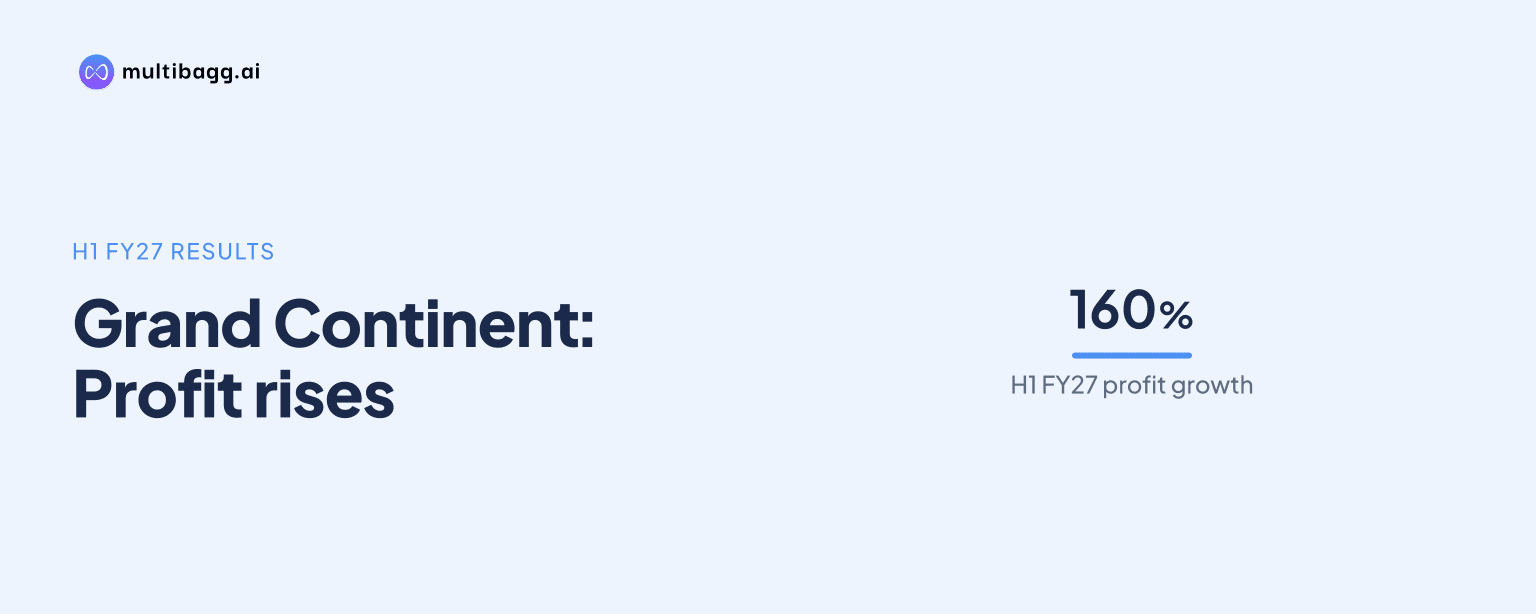
Grand Continent Hotels Limited reported H1 FY27 consolidated profit after tax of ₹6.02 crore, up 160%, alongside total income of ₹107.19 crore, up 87%. The hospitality company attributed its reported scale to operations across India and the United States, with its asset-light, franchise-led network spanning 32 hotels.
Know Grand Continent Hotels inside out
Results, valuation, peers and who's buying, in one view.
What did GCH report for H1 FY27?
GCH reported consolidated total income of ₹107.19 crore for H1 FY27, representing growth of 87% over the comparable previous-year period. Earnings before interest, tax, depreciation and amortisation, or EBITDA, doubled to ₹13.00 crore. Consolidated profit after tax rose 160% to ₹6.02 crore.
Income from operations stood at ₹106.86 crore. India contributed ₹80.84 crore, while the United States accounted for ₹26.02 crore. The figures show that India remained the company’s larger operating market by revenue, while the US business formed a meaningful part of the consolidated income base.
The company’s investor presentation was filed with the National Stock Exchange under the symbol GCHOTELS. The disclosed H1 FY27 figures follow earlier reported information that placed revenue from operations at about ₹106.9 crore and net profit at about ₹6 crore, with year-on-year growth of 91.9% and 160.9%, respectively.
How is GCH expanding its hotel business?
GCH is expanding through an asset-light, franchise-led model across 32 hotels. This approach focuses on operating and building a branded hotel network without relying solely on ownership of the underlying properties. It is relevant because the model can support network growth while limiting the capital required for hotel real estate.
The company is positioned in the mid-scale segment, covering mid-priced and upper mid-priced hotel offerings. Its earlier investor material described the business as serving this segment through properties across several Indian states, including Karnataka, Tamil Nadu, Andhra Pradesh, Telangana and Goa.
The available disclosures show the network has grown from an earlier base. At the end of FY24, GCH operated 12 properties with 531 keys in five cities. Its H1 FY26 presentation later stated that it operated 25 hotels across 12 cities with 1,281 keys. The latest presentation highlights a 32-hotel footprint, although it does not provide a corresponding key count in the information available here.
Why do the India and US margins matter?
The US business reported a PBIT margin of 13.37%, compared with 7.85% for the Indian operations. PBIT, or profit before interest and tax, measures operating profitability before financing costs and income taxes. The higher US margin is notable because the US unit generated less revenue than India but reported a stronger margin on its operating base.
India produced ₹80.84 crore of operating income, more than three times the ₹26.02 crore reported from the US. Therefore, Indian operating conditions remain central to the company’s consolidated performance. The margin difference indicates that the contribution from each geography cannot be assessed solely through revenue share.
The presentation does not provide a detailed breakdown of the factors behind the margin gap. It also does not state whether the higher US PBIT margin is expected to continue. Investors would need subsequent disclosures to assess changes in geographic mix, operating costs and property-level profitability.
Got a follow-up? Ask IRIS
What risks has GCH disclosed to investors?
GCH has identified ineligible GST input credit of about ₹4.5 crore as a risk. It has also cited the Karnataka minimum-wage increase, estimated at about ₹30 lakh, moderate leisure demand and the exit from a Dubai contract among the factors relevant to its operations.
The GST matter is the largest quantified risk item disclosed in the presentation. At ₹4.5 crore, it is material relative to H1 FY27 profit after tax of ₹6.02 crore. The disclosure identifies the issue but the available information does not state the eventual financial resolution or timing of any impact.
The Karnataka wage increase points to higher employee costs in a state where GCH has historically operated hotels. Moderate leisure demand is relevant for occupancy and room demand, although the presentation does not provide occupancy, average room rate or revenue-per-available-room data. The Dubai contract exit also signals that the company’s international activity can involve contract-specific changes.
What does the presentation mean for GCH investors?
The presentation shows sharply higher reported income, EBITDA and profit for H1 FY27, with profit after tax growing faster than total income. The 160% increase in profit after tax and 100% increase in EBITDA are the principal financial developments disclosed by GCH, while the 32-hotel network provides context for its operating expansion.
For investors, the revenue split and PBIT margins provide two important reference points. India is the larger revenue contributor, while the US has the higher disclosed PBIT margin. The company’s asset-light and franchise-led structure may influence how its revenue grows relative to hotel additions, but the presentation does not provide forward financial guidance.
GCH listed on the NSE SME platform on March 27, 2025 after raising ₹74.46 crore through its initial public offering, comprising a fresh issue and offer for sale. The company’s earlier disclosures also show a progression from 12 properties at the end of FY24 to 25 hotels in the H1 FY26 presentation, before the 32-hotel footprint highlighted in the latest material.
Conclusion
GCH’s H1 FY27 presentation reports ₹107.19 crore in consolidated total income, ₹13.00 crore in EBITDA and ₹6.02 crore in profit after tax. The results also show a business with a larger India revenue base, higher reported US PBIT margin and a 32-hotel asset-light, franchise-led operating network.
The next areas to watch are updates on the approximately ₹4.5 crore GST input-credit issue, the cost effect of Karnataka’s minimum-wage increase and any further information on demand conditions or the hotel network. The presentation does not disclose financial guidance, so future exchange filings and results will be important for assessing whether the reported growth and margin profile are sustained.