










Greenply plans 19% SAMET stake to remove quarterly loss drag
Key highlights
- Greenply plans to reduce its SAMET holding from 50% to 19% by January 5.
- Greenply said it stopped funding SAMET losses from Q1, with the partner funding operations through advances.
- SAMET’s partner is planning about Rs 400 crore of additional capital expenditure, according to Greenply management.
- Greenply targets MDF EBITDA above Rs 5,000 per CBM and a 15% to 16% EBITDA margin.
powered by IRIS
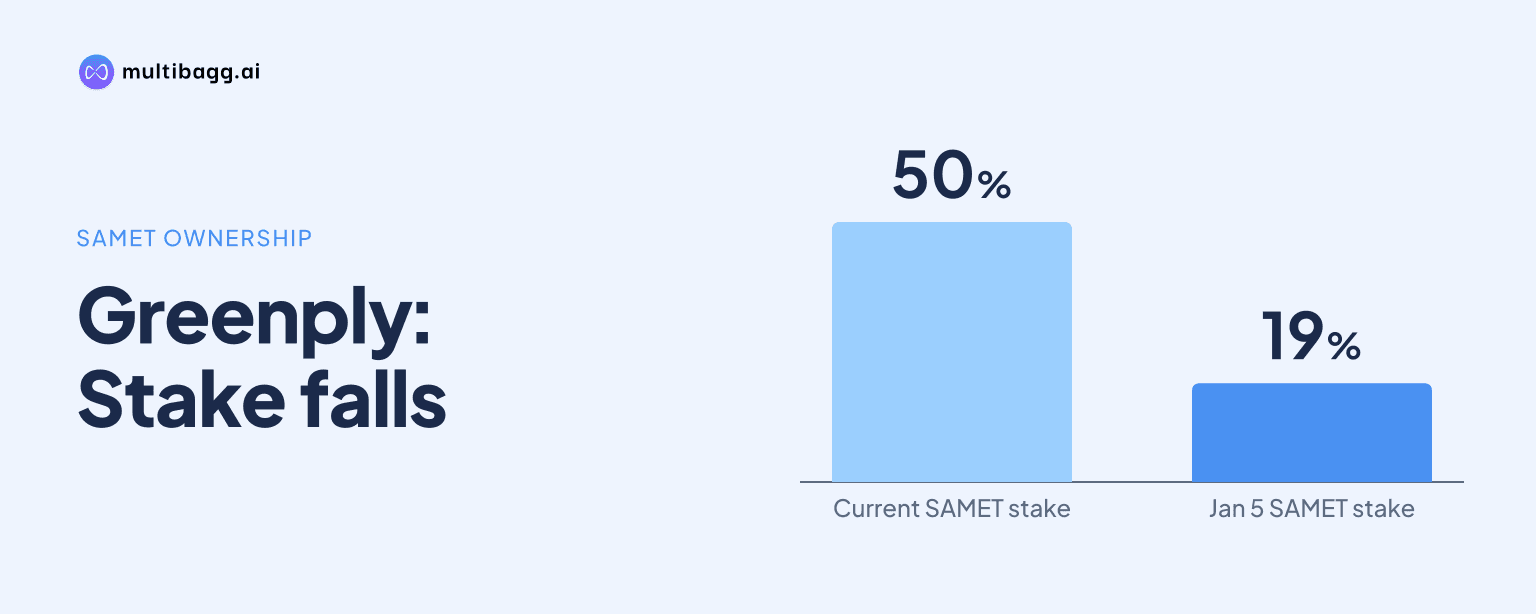
Greenply plans to reduce its 50% holding in the SAMET hardware joint venture to 19% by January 5, which management said will remove the quarterly reported-loss drag after completion. Greenply said it stopped funding the venture’s losses from Q1, while its partner now finances operations through advances.
Know Greenply Industries inside out
Results, valuation, peers and who's buying, in one view.
When will Greenply reduce its SAMET stake?
Greenply expects the dilution of its SAMET stake to be completed by January 5, reducing its holding from 50% to 19%. Management said that date is the end date under the head of terms signed and announced after the previous board meeting. Until the transaction closes, Greenply remains a 50-50 joint-venture partner and continues to report its share of the venture’s profit after tax, or PAT, loss.
The restructuring would change Greenply from an equal partner to a minority investor in the hardware venture. Management said its purpose is to remove the quarterly loss drag from reported results while preserving a 19% to 20% interest in SAMET’s longer-term growth. The call did not disclose the value assigned to the 31-percentage-point dilution, the valuation of the remaining stake or transaction conditions that could affect the January 5 timetable.
Management said the continued accounting impact reflects Greenply’s existing 50% ownership. While it remains an equal joint-venture partner, its consolidated accounts include the PAT loss from SAMET. Once the holding falls to 19%, management said there will be no quarterly drag, although it did not provide a quantified estimate of the loss that would cease to affect reported results.
Why is Greenply reducing its SAMET stake?
Greenply is reducing its stake because management wants to deploy capital in its plywood and medium-density fibreboard, or MDF, businesses rather than fund the hardware venture’s next expansion. Management said both core segments are growing quickly and require significant capital expenditure. It also said the SAMET partner is planning about Rs 400 crore of capital expenditure, which Greenply does not consider suitable for its balance sheet at present.
The funding arrangement has already changed, according to management. Greenply said it stopped funding SAMET’s losses from Q1, while its partner is funding the business through advances and operating the venture. Management described the continuing balance-sheet impact as a line-item entry rather than an actual cash contribution by Greenply.
An analyst on the call referred to Greenply having invested about Rs 105 crore in SAMET. Finance management said no additional provision is required because consolidated accounts have already recognised losses incurred earlier and currently. Greenply did not disclose SAMET’s accumulated losses, the carrying value of its investment or whether the dilution will result in an accounting gain or loss.
What will Greenply retain after becoming a minority investor?
Greenply will retain a 19% to 20% equity interest, participation by its dealer-distributor network in selling SAMET products and access to the joint brand’s reputation. Management also said Greenply would receive an arm’s-length brand charge, which it described as potentially significant other income. The call did not disclose the charge’s rate, duration or expected rupee contribution.
Management said the smaller interest would preserve potential upside while removing the need for Greenply to fund the partner’s proposed Rs 400 crore expansion programme. It said the partner’s majority ownership could lead it to divert global sales to the Indian venture, potentially improving its scale and profitability. These are management’s expectations rather than announced operating outcomes.
Greenply also said the partner’s long-term vision is to list the venture, with Greenply still holding 19% to 20% equity at that point. No listing timetable, valuation target or formal proposal was disclosed. The company also did not specify board rights, veto rights, future capital commitments or protections against further dilution following the planned stake reduction.
Got a follow-up? Ask IRIS
How does the SAMET decision support Greenply’s core expansion?
Greenply said removing the SAMET drag would allow management to focus on MDF and plywood growth, while it has also stated an intention to enter chipboard manufacturing. In MDF, management guided for an earnings before interest, tax, depreciation and amortisation, or EBITDA, margin of 15% to 16%. It also said it was confident of maintaining EBITDA above Rs 5,000 per cubic metre, or CBM.
One MDF line produces about 60,000 CBM per quarter, according to management. However, second-quarter production was about 53,000 CBM and sales exceeded 54,000 CBM, showing that output, rather than demand, constrained volumes in the period. Management attributed the sequential decline to monsoon disruptions and annual maintenance that lasted four days instead of the planned one day, while maintaining its full-year 20% MDF volume-growth guidance despite the first-half shortfall.
Pricing and costs illustrate the operating conditions facing Greenply’s MDF business. Management said a 15.5% price increase taken in Q1 had been almost fully rolled back, while chemical costs remained 7% to 8% higher. It said a larger pre-laminated board mix, lower energy costs and plant efficiencies supported the 15% to 16% EBITDA-margin outlook despite the pricing reversal.
In plywood, management said it would maintain a double-digit EBITDA margin in the second half if sales exceed Rs 600 crore. It also expects annual plywood volume growth above 10%, supported by higher outsourcing in the second half and a greater allocation of capacity to premium products. These are the operating priorities management identified as it reduces exposure to SAMET’s funding needs.
What could affect Greenply’s planned removal of the loss drag?
The reported loss drag will end only if the planned reduction to 19% closes by the January 5 end date specified in the head of terms. Greenply has stated the intended outcome, but the call did not disclose definitive transaction documents, regulatory approvals, closing conditions or an alternative plan if completion is delayed. Until closing, the existing 50-50 structure means Greenply continues to report SAMET’s PAT loss.
MDF execution also remains relevant as Greenply concentrates resources on its core businesses. Management said competition is increasing, citing Action TESA’s southern plant and a new entrant called Elixrr. It said the next 12 months could be difficult for the MDF industry, but maintained that Greenply could continue delivering a 15% to 16% EBITDA margin next year after its new capacity comes on stream.
Conclusion
Greenply’s SAMET restructuring is a capital-allocation move: the company plans to shift from a 50% owner reporting joint-venture losses to a 19% minority investor retaining channel participation, brand-charge income and equity exposure. Management says the plan avoids funding the partner’s proposed Rs 400 crore expansion while allowing Greenply to concentrate on plywood, MDF and prospective chipboard capacity.
The next event to watch is whether the dilution closes on the January 5 date management specified and whether the SAMET loss drag disappears from reported results thereafter. Investors can also monitor management’s disclosed operating targets: 20% full-year MDF volume growth, EBITDA above Rs 5,000 per CBM, and a double-digit plywood EBITDA margin if second-half sales exceed Rs 600 crore.