










Kirloskar Brothers Limited targets 40% services at KBI BV
Key highlights
- Kirloskar Brothers targets services at about 40% of KBI BV business over a three-year cycle.
- Management cited a current services share of about 35% at SPP U.K.
- Management expects SPP's H2 to be noticeably better than H1.
- Management said an analyst-referenced order inflow of about Rs 2,000 crore contained many smaller orders rather than one material order.
powered by IRIS
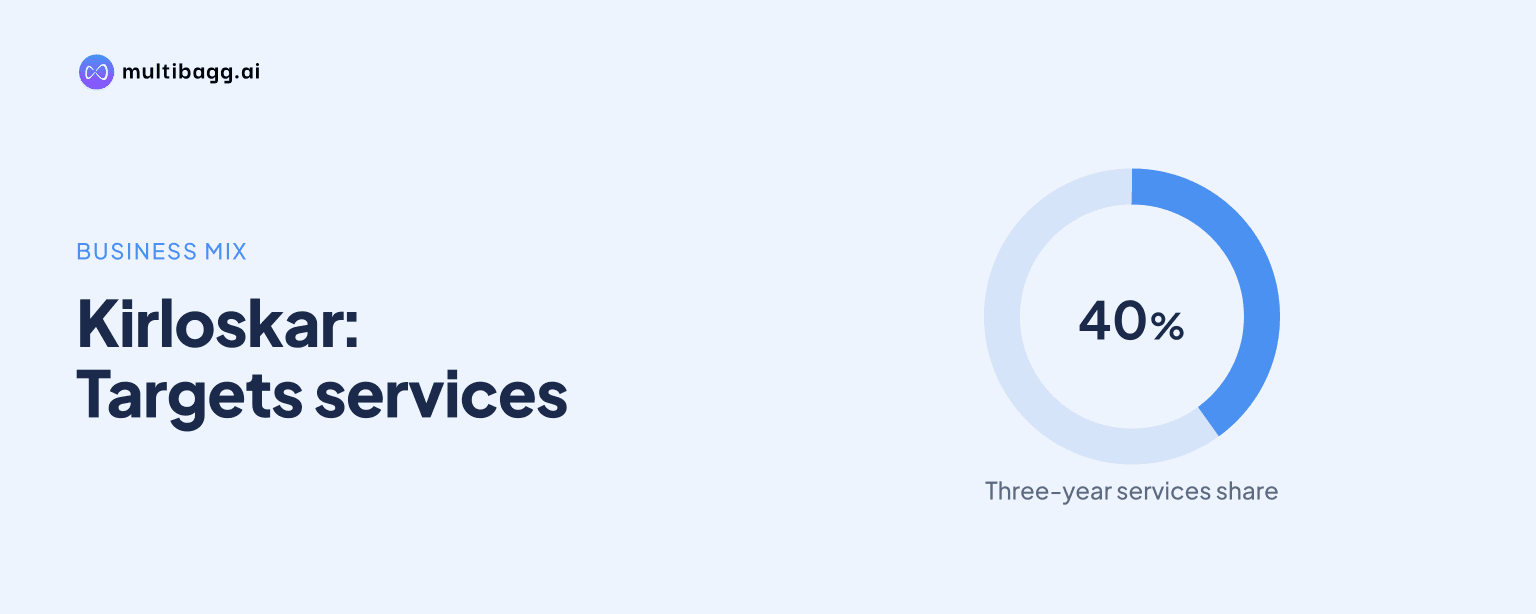
Kirloskar Brothers Limited is targeting services to reach about 40% of total business at the KBI BV level over a three-year cycle, compared with a currently cited service share of about 35% at SPP U.K. Management identified data centres, water supply and service agreements as the main routes to expand that mix.
Know Kirloskar Brothers inside out
Results, valuation, peers and who's buying, in one view.
What is Kirloskar Brothers' services target at KBI BV?
Kirloskar Brothers is targeting services at about 40% of total business at the KBI BV level over a three-year cycle. Alok Kirloskar presented the 40% figure as a management target for the business level called KBI BV, rather than as revenue or profit guidance. The strategy is intended to increase the contribution of servicing activity alongside pump and project work.
Management cited a current service share of about 35% at SPP U.K., while setting the 40% target at KBI BV. The two figures are from different business levels and therefore do not establish a like-for-like change in reported service mix. They nevertheless show that management is seeking a higher services contribution over the stated three-year period.
The plan relies on contract structures as well as equipment supply. Management said it had signed a service agreement with Britain and described service arrangements as a way to build customer relationships in Benelux, comprising Belgium, Luxembourg and the Netherlands. Water projects, framework agreements and installed pumps can create a base for later service and spare-part work.
How will data centres support Kirloskar Brothers' services plan?
Kirloskar Brothers said data centres are gaining traction and represent an area for additional opportunities. Management reported more approvals with data-centre operators and said it was also engaging private-equity groups, including Brookfields. Those approvals could broaden the number of customers able to specify the company's products for data-centre projects.
A proposed framework agreement with a large data-centre operator remains under negotiation. Management said the arrangement would cover many jobs rather than one order, with Kirloskar Brothers becoming the primary supplier for the operator's data centres if the agreement is completed. It did not identify the operator, disclose a value or give a timetable for signing.
Management said it would not provide a deadline because the large operator had imposed stringent conditions and negotiations were continuing. It added that the company wanted to ensure it did not take on anything too risky despite the potential scale of the business. The disclosed milestone is therefore the completion of the framework agreement, not a confirmed order or service-revenue figure.
Kirloskar Brothers also said data centres are only starting in India and that its overseas presence should enable it to offer its best products in that market. This India opportunity is separate from the undisclosed framework under discussion with the large operator. Management did not quantify expected Indian orders, data-centre revenue or the eventual services contribution from either market.
Which water markets could add business for Kirloskar Brothers?
Kirloskar Brothers identified water supply as a second growth area alongside data centres and services. Management cited the Middle East, the U.K. through AMP8, and Benelux as markets where it was seeing traction. It referred to Britain's Water Group and Dunia as large water companies in its discussion of activity in the region.
In the U.K., management said AMP8 would be the main domestic business. AMP8 is distinct from the oil-and-gas work that management said was being exported from the U.K. subsidiary to markets including the United States and Guyana. This places water as a local U.K. demand source while oil and gas is primarily supporting export activity.
Management also identified industrial fire as another U.K. area of strength, linking it to warehouse construction. It said imported materials require warehousing and that warehouses require fire pumps. The mechanism differs from AMP8 water work, but both depend on domestic infrastructure and building activity rather than new U.K. petrochemical investment.
Management contrasted those opportunities with a difficult U.K. industrial backdrop. It said domestic growth in petrochemicals and drilling had finished, citing electricity prices of Rs 30 per unit. Its stated strategy is therefore focused on AMP8, warehouse-related industrial fire, and export projects rather than a recovery in domestic industrial production.
Got a follow-up? Ask IRIS
How do oil-and-gas projects create future services revenue?
Kirloskar Brothers expects large oil-and-gas pump jobs to create later spares and service revenue. Management attributed top-line growth partly to currency and partly to oil-and-gas activity, citing new gas fields in Louisiana, oil-and-gas activity in Guyana, and work in Qatar's North Field. These projects provide equipment installations from which later servicing may arise.
Management said margins on oil-and-gas work had been healthy but were not close to margins on the service side or the water side. The comparison explains the mix target: large project jobs can build equipment population and revenue, while recurring spares and servicing are expected to offer a different margin profile. No segment revenue, margin percentage or service-contract value was disclosed.
The company cited compression platforms COM2, COM4 and COM5 in Qatar's North Field activity, saying it had obtained all of them because COM1 and COM3 were drilling platforms without pumps. Management linked this work to its broader strategy of pursuing service and spare-part revenue after project execution. The call did not state the value of the platform-related pump orders.
Order recognition may also affect the timing of reported inflow. Responding to an analyst's reference to about Rs 2,000 crore of order inflow, management said there was no single material order and that the figure consisted of many smaller orders. Kirloskar Brothers said it recognises orders only after commercial terms and pricing meet its requirements, so customer placement and reported recognition can occur in different quarters.
What did management say about near-term SPP performance?
Kirloskar Brothers expects the second half, or H2, at SPP to be noticeably better than the first half, or H1. Alok Kirloskar made the comment in response to a question on product pull-through and margin normalisation, while declining to quantify what would constitute a material improvement. This is a near-term operating expectation, not a revision to the three-year services-mix target.
Management separately said a rise in commodity prices had reduced standalone gross margin and that this effect should normalise going forward. Sanjay Kirloskar said the change was not caused by execution of legacy contracts and did not reflect a shift between small pumps and other pumps. The call gave no gross-margin percentage or time frame for normalisation.
Data-centre and water opportunities may support the longer-term mix plan, but management did not attach order values or revenue forecasts to either. In contrast, the 40% services objective has a defined three-year time frame, while the framework agreement with the unnamed data-centre operator has no disclosed signing date. The distinction leaves execution milestones more important than numerical forecasts in the near term.
Conclusion
Kirloskar Brothers is seeking to increase the contribution of services at the KBI BV level to about 40% over three years, from the referenced service share of about 35% at SPP U.K. Management’s route combines data-centre approvals and a proposed framework, water activity in the U.K., Middle East and Benelux, and service and spares work that can follow large oil-and-gas pump installations.
The next disclosed item to watch is progress on the data-centre framework agreement, which management said remains subject to negotiations over stringent conditions and has no timetable. Investors can also monitor AMP8-related water activity and whether SPP’s H2 is noticeably better than H1, as management expects, while recognising that neither development had a quantified order or profit contribution on the call.