










GROx AUM reaches Rs 3,661 crore as GNPA falls to 1.4%
Key highlights
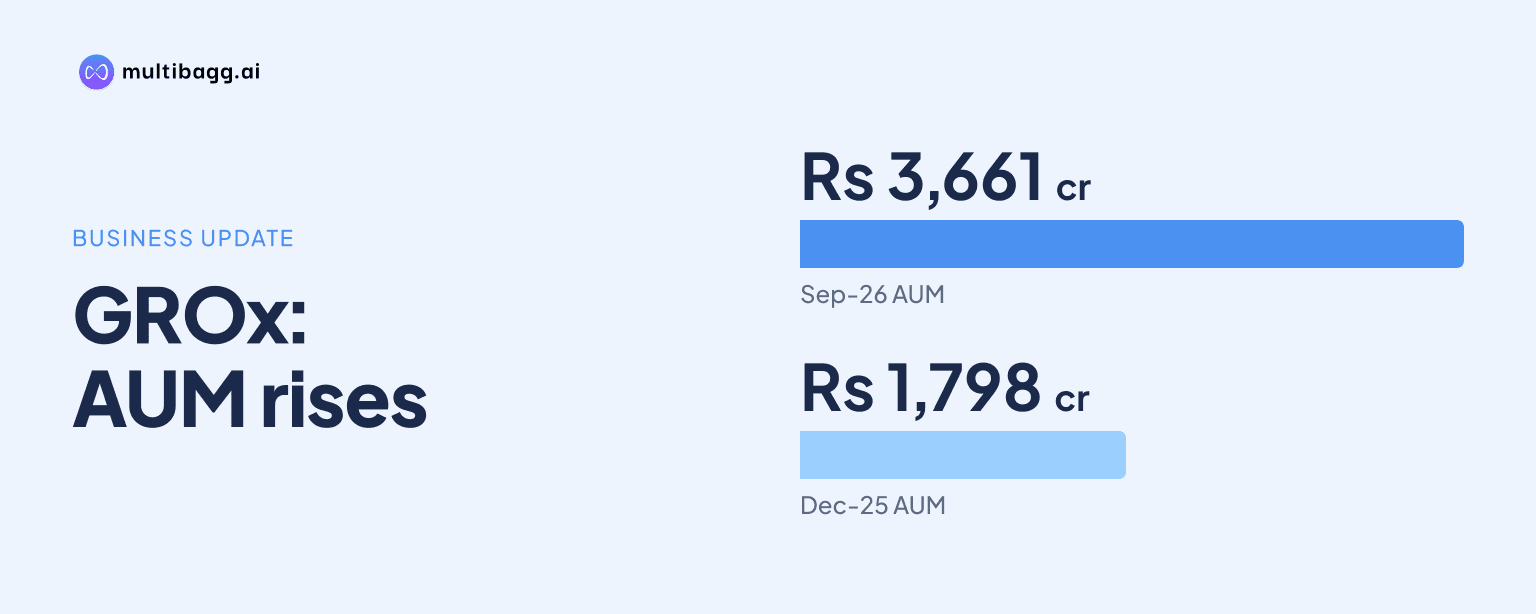
- GROx AUM reached Rs 3,661 crore in Sep-26, compared with Rs 1,798 crore in Dec-25.
- GROx GNPA fell to 1.4% in Sep-26 from 2.1% in Jun-26.
- GROx had about 409,000 active customers in Sep-26, up from 118,000 in Jun-25.
- GROx disbursed Rs 2,253 crore across 248,000 cases in Sep-26.
powered by IRIS
U GRO CAPITAL's GROx embedded merchant-lending platform reported Rs 3,661 crore in assets under management (AUM) in Sep-26, up from Rs 3,003 crore in Jun-26, while gross non-performing assets (GNPA) fell to 1.4% from 2.1%. GROx also served about 409,000 active customers and disbursed Rs 2,253 crore during Sep-26.
Know Ugro Capital inside out
Results, valuation, peers and who's buying, in one view.
How fast did GROx AUM grow?
GROx AUM increased to Rs 3,661 crore in Sep-26 from Rs 1,798 crore in Dec-25 and Rs 1,011 crore in Jun-25. The Rs 658 crore increase from Jun-26 followed a Rs 723 crore rise in the preceding quarter, when AUM grew from Rs 2,280 crore in Mar-26 to Rs 3,003 crore in Jun-26.
GROx exceeded the embedded-finance trajectory shown in its Dec-25 guidance, which recorded Rs 743 crore of AUM in Mar-25 and Rs 1,798 crore in Dec-25, alongside an expectation of more than 25% compound annual growth rate (CAGR) over three years. The presentation reports a 138% CAGR for actual AUM through Sep-26.
On-books principal outstanding (POS) reached Rs 3,126 crore in Sep-26, compared with Rs 1,398 crore in Dec-25 and Rs 2,593 crore in Jun-26. The presentation reports a 165% CAGR for on-books POS, compared with 138% for AUM, although it does not explain the factors behind the differing growth rates.
What drove GROx lending activity?
GROx expanded lending activity through higher disbursements, more cases and a larger active customer base. Disbursements rose to Rs 2,253 crore in Sep-26 from Rs 1,853 crore in Jun-26, while active customers increased to 409,000 from 344,000 over the same period.
The number of cases disbursed increased to 248,000 in Sep-26 from 166,000 in Jun-26 and 55,000 in Jun-25. Management said monthly case-disbursement volumes had increased significantly over the preceding four to five months and expected the run rate to continue at similar levels during the financial year.
GROx added 291,000 active customers between Jun-25 and Sep-26, while disbursements increased by Rs 1,671 crore. U GRO CAPITAL describes GROx as a higher-yield, technology-led book, but the presentation does not disclose average loan size, merchant retention, partner-level disbursements or customer-acquisition cost.
Has GROx maintained asset quality during expansion?
GROx reported GNPA of 1.4% in Sep-26, 70 basis points below the 2.1% reported in Jun-26, while AUM rose by Rs 658 crore during the quarter. One basis point equals one-hundredth of a percentage point.
GNPA did not decline throughout the disclosed series. It increased from 0.2% in Jun-25 to 1.3% in Sep-25, 1.5% in Dec-25, 1.7% in Mar-26 and 2.1% in Jun-26, before declining to 1.4% in Sep-26. The Sep-26 reading was below the Jun-26 peak but remained 1.2 percentage points above the Jun-25 level.
U GRO CAPITAL links the model's credit-cost containment to repayment-at-source and risk-calibrated collections. However, the presentation does not provide GROx credit costs, provisions, write-offs, recovery rates or collection expenses, leaving GNPA as the disclosed asset-quality measure alongside Rs 3,661 crore of AUM.
Got a follow-up? Ask IRIS
How does GROx identify repayment stress?
GROx says 95% of repayments are currently on daily electronic data interchange (EDI) repayment, with application programming interface (API)-driven fund reconciliation handled through in-house technology. This daily settlement process is the platform's disclosed repayment-at-source mechanism.
GROx tracks merchant payments in real time, along with sales volume, quick-response (QR) usage and activity trends, to generate early-warning signals. Its in-house model then triggers structured customer touchpoints before collection activity progresses to tele-calling, field visits or legal action.
The platform uses risk bands and days past due (DPD) to vary collection intensity. Low-risk accounts remain in digital contact through seven DPD before tele-calling or interactive voice response (IVR) begins at eight to 30 DPD, while high-risk accounts move to tele-calling or IVR at two to three DPD and field visits at eight to 30 DPD.
What does GROx's collections model cover?
GROx uses three tiers of intervention: digital nudges, Short Message Service (SMS) and WhatsApp communications, and IVR; tele-calling and field visits; then legal action. For medium-risk accounts, the stated progression is digital contact at one DPD, SMS and WhatsApp at two to three DPD, tele-calling or IVR at four to seven DPD, field action at eight to 60 DPD, and legal action from 61 DPD.
The disclosed model applies different actions to delinquency duration and risk category rather than applying one workflow to every merchant. In Sep-26, GROx had Rs 3,661 crore of AUM, 95% daily EDI repayment coverage and GNPA of 1.4%, but the presentation does not disclose resolution rates at each collection stage.
The available comparison shows that cases disbursed rose from 166,000 in Jun-26 to 248,000 in Sep-26 as GNPA declined from 2.1% to 1.4%. The presentation describes the collection architecture as digitally scalable, but it does not quantify whether greater case volumes directly caused the change in GNPA.
Conclusion
GROx paired rapid expansion with a lower latest-quarter GNPA reading. AUM increased from Rs 1,798 crore in Dec-25 to Rs 3,661 crore in Sep-26, on-books POS reached Rs 3,126 crore, and active customers rose from 190,000 to 409,000 over the same period. The platform also increased Sep-26 disbursements to Rs 2,253 crore across 248,000 cases.
The next disclosed item to watch is whether monthly case-disbursement volumes remain at similar levels through the financial year, as management expects. GNPA will also remain the reported credit measure after falling from 2.1% in Jun-26 to 1.4% in Sep-26, while GROx continues to use 95% daily EDI repayment coverage and DPD-based collection escalation.