










UGRO merger reset cuts pro forma net worth by Rs 575 crore
Key highlights
- UGRO estimates pro forma net worth of Rs 2,454 crore, versus Rs 3,029 crore reported at September 2026.
- UGRO estimates H1 FY27 foreclosure reversals of Rs 58.2 crore pro forma, down from Rs 120.5 crore reported.
- UGRO estimates H1 FY27 pro forma profit after tax of Rs 126.3 crore, Rs 7.7 crore above reported profit.
- UGRO’s National Company Law Tribunal final hearing is scheduled for 20 November 2026.
powered by IRIS
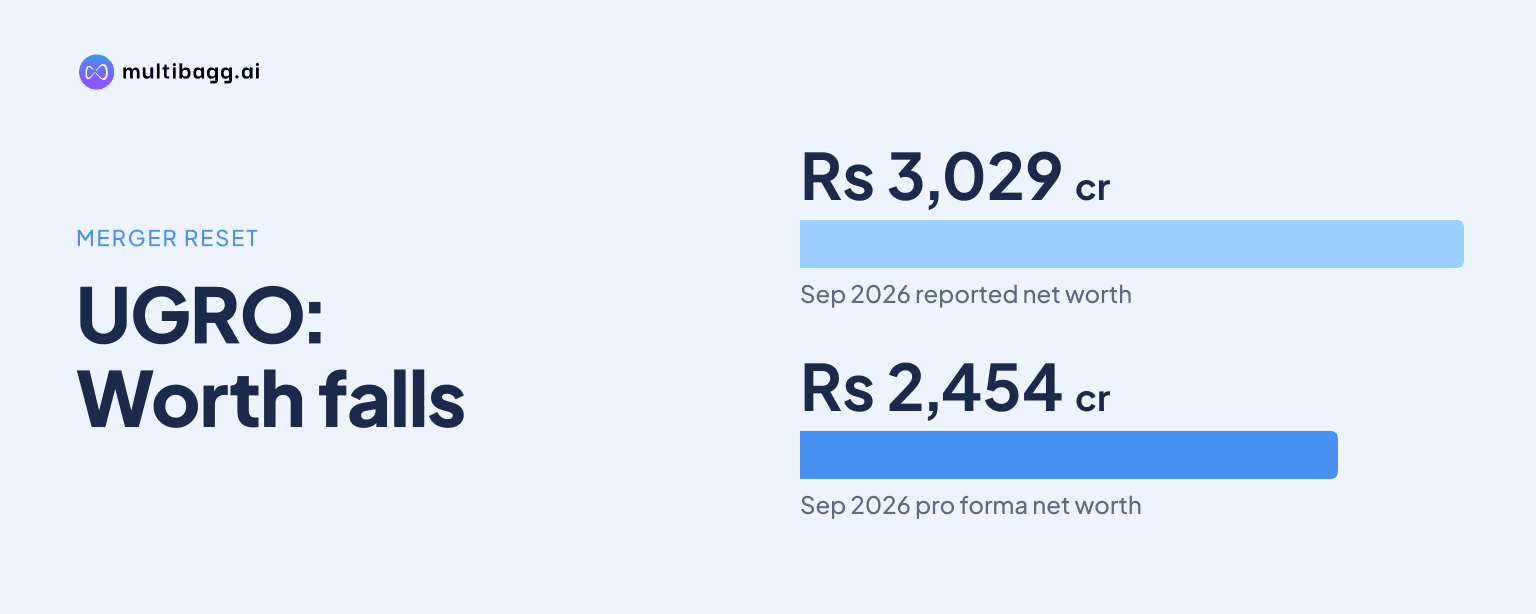
U GRO CAPITAL (UGRO) says its proposed merger accounting reset would lower reported September 2026 net worth by Rs 575 crore to pro forma net worth of Rs 2,454 crore, while reducing estimated first-half FY27 foreclosure reversals to Rs 58.2 crore from Rs 120.5 crore. The Scheme awaits National Company Law Tribunal sanction.
Know Ugro Capital inside out
Results, valuation, peers and who's buying, in one view.
How would the Scheme change UGRO’s net worth?
UGRO’s pro forma net worth would fall to Rs 2,454 crore from Rs 3,029 crore reported at September 2026, a difference of Rs 575 crore. The bridge includes Rs 308 crore for Profectus goodwill and acquisition cost and Rs 266 crore for remeasurement of upfront income against reserves under the Scheme.
The presentation describes the changes as a one-time reset to reserves, while stating that core equity is unchanged. The displayed bridge does not arithmetically reconcile exactly because the individual adjustments total Rs 574 crore against the Rs 575 crore difference between reported and pro forma net worth, with all figures presented in whole crores.
UGRO’s reported book value was about Rs 195 per share at September 2026, compared with pro forma book value of about Rs 158 per share. After Rs 94 crore of intangible assets, pro forma tangible net worth would be Rs 2,360 crore, or about Rs 152 per share; these are accounting values presented under the proposed Scheme.
Why would UGRO’s foreclosure-income reversals decline?
UGRO would recognise upfront income over behavioural tenure based on observed prepayment curves, rather than contractual tenure, so early foreclosures would reverse less income that has already been recorded. The proposed treatment applies both to existing balances being remeasured and to future income recognition, according to management.
For H1 FY27, foreclosure reversals would decline to Rs 58.2 crore on the pro forma basis from Rs 120.5 crore reported, a reduction of Rs 62.3 crore. Gross co-lending income would also be lower, at Rs 221.7 crore rather than Rs 304.5 crore, because more income is deferred over the expected life of the loan.
UGRO reported Rs 318 crore of upfront income reversals on foreclosures from FY22 to FY26, equal to 44% of cumulative profit before tax over those years. Management says that historical reversals occurred because income was originally booked using contractual tenure before sufficient borrower-prepayment history was available.
Got a follow-up? Ask IRIS
What would the reset mean for UGRO’s H1 FY27 profit?
UGRO estimates that H1 FY27 profit after tax would rise by Rs 7.7 crore to Rs 126.3 crore on a pro forma basis from Rs 118.6 crore reported. Total income would increase by Rs 10.2 crore to Rs 1,123.2 crore, reflecting the combined change in interest income, upfront co-lending income and foreclosure reversals.
Pre-provision operating profit would increase to Rs 292.5 crore from Rs 282.3 crore, while profit before tax would rise to Rs 140.0 crore from Rs 129.8 crore. Finance cost of Rs 584.9 crore, operating expenditure of Rs 245.8 crore and credit cost of Rs 152.5 crore are unchanged between the reported and pro forma H1 FY27 estimates.
The increase in profit after tax is smaller than the increase in profit before tax because estimated tax expense rises to Rs 13.8 crore from Rs 11.2 crore. UGRO labels the pro forma figures as unaudited management estimates that remain subject to tribunal sanction and auditor review.
Would the revised accounting remove quarterly profit volatility?
UGRO says the revised accounting would reduce foreclosure-reversal volatility, but quarterly profit would still depend on credit cost and tax effects. Pro forma profit after tax fell to Rs 53.3 crore in Q2 FY27 from Rs 73.0 crore in Q1 FY27, despite pro forma total income rising to Rs 581.7 crore from Rs 541.5 crore.
Credit cost increased to Rs 86.9 crore in Q2 FY27 from Rs 65.6 crore in Q1 FY27, while UGRO also notes that Q1 included a tax credit. Pro forma return on assets, calculated on average on-book position, declined to 2.3% in Q2 from 3.2% in Q1 and stood at 2.7% for H1 FY27.
The portfolio mix is also changing alongside the accounting reset. Emerging Market LAP and GROx accounted for 53% of assets under management at September 2026, up from 32% at December 2025, while the de-focused book declined to Rs 7,090 crore from Rs 10,458 crore over nine months.
What approvals and capital changes remain for UGRO’s merger?
UGRO’s Scheme had shareholder and creditor approval on 23 September 2026, with the National Company Law Tribunal final hearing scheduled for 20 November 2026. The company states that its pro forma financials, including the Rs 2,454 crore net-worth figure, remain subject to sanction and auditor review.
Management says the accounting reset is neutral to the capital adequacy ratio, subject to final review, because the relevant items are already reflected in regulatory capital. Reported capital adequacy ratio was 18.8% at September 2026, while management estimates approximately 22% on the merged pro forma basis.
UGRO also says it does not plan to raise new equity until FY29. Its stated FY29 portfolio objective is for Emerging Market LAP and GROx to approach 85% of assets under management, supported by annual growth guidance of 20% to 30% for Emerging Market LAP and 35% to 40% for GROx.
Conclusion
UGRO’s proposed merger accounting would reduce reported reserves, net worth and book value while moving recognition of upfront income closer to expected borrower behaviour. The September 2026 pro forma net-worth figure is Rs 2,454 crore, and the estimated H1 FY27 reversal reduction of Rs 62.3 crore contributes to a Rs 7.7 crore increase in pro forma profit after tax.
The next disclosed event is the National Company Law Tribunal hearing on 20 November 2026, following approvals on 23 September 2026. After any sanction, management’s disclosed execution markers are growth in Emerging Market LAP and GROx, credit costs as newer loan vintages season, and progress toward its FY29 objective of 3.0% to 3.5% steady-state return on assets.