










UGRO Capital moves 53% of AUM into focused products
Key highlights
- Focused products reached Rs 7,929 crore, or 53% of Rs 15,019 crore AUM, at September 2026.
- The de-focused Prime Intermediated portfolio declined 32% in nine months to Rs 7,090 crore.
- Emerging Market LAP AUM was Rs 4,268 crore and GROx AUM was Rs 3,661 crore at September 2026.
- Quarterly operating expenses fell to Rs 127.2 crore in Q2 FY27 from Rs 205.2 crore in Q4 FY26.
powered by IRIS
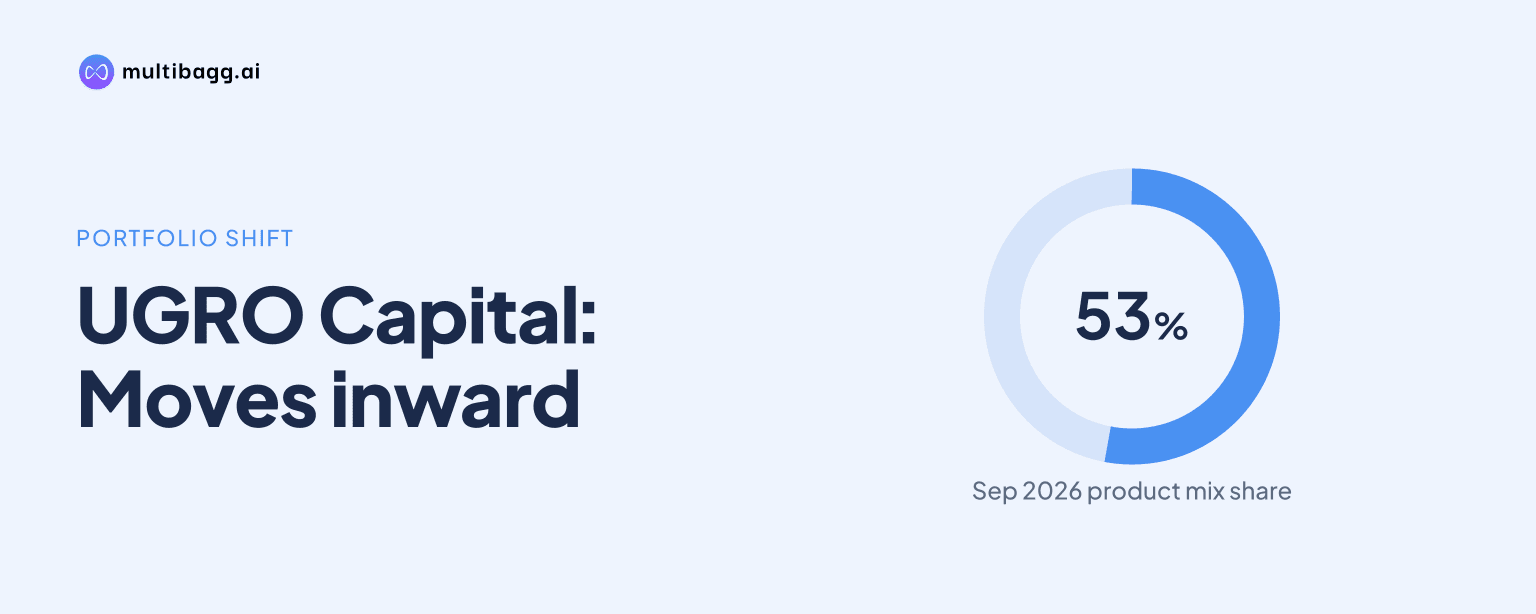
UGRO Capital Limited had moved Rs 7,929 crore, or 53%, of its Rs 15,019 crore assets under management (AUM) into Emerging Market loan against property (LAP) and GROx by September 30, 2026, after ending prime intermediated sourcing in February 2026. The focused share was 32% in December 2025.
Know Ugro Capital inside out
Results, valuation, peers and who's buying, in one view.
Why did UGRO Capital stop prime intermediated sourcing?
UGRO Capital stopped prime intermediated sourcing in February 2026 because its earlier off-balance-sheet model created lower-yield assets and recognised part of the expected income before loans reached maturity. The model used direct selling agent-led sourcing for Prime LAP, business loans and machinery loans, while partner banks and non-banking financial companies funded 80% to 90% of each loan through co-lending, co-origination and direct assignment (DA).
The model expanded AUM from Rs 2,970 crore in March 2022 to Rs 15,334 crore in March 2026, while its off-book share reached 38% at March 2026. At September 2026, off-book AUM stood at Rs 5,326 crore. UGRO Capital recognised the net present value of excess interest spread (EIS) upfront over contractual loan tenure, meaning that early repayment could require an income reversal.
UGRO Capital reversed Rs 318 crore of DA and co-lending income over FY22 to FY26 because of foreclosures, which the presentation identifies as early repayment rather than credit loss. Reversals increased from Rs 5 crore in FY22 to Rs 110 crore in FY25, then declined to Rs 98 crore in FY26. The reversal equalled 22% of gross upfront DA and co-lending income in FY25 and 18% in FY26.
The effect on reported profit was material in the later years of the model’s expansion. Foreclosure reversals represented 54% of profit before tax in FY25 and 40% in FY26, according to the presentation. The February realignment therefore shifts the business toward loans intended to generate recurring income rather than income dependent on contractual-tenure assumptions.
How fast has UGRO Capital changed its portfolio mix?
UGRO Capital increased the focused-products share of AUM to 53% in September 2026 from 32% in December 2025, as both focused businesses expanded and the de-focused portfolio contracted. Total AUM declined to Rs 15,019 crore from Rs 15,454 crore over the same period, reflecting a Rs 3,368 crore reduction in the de-focused book.
Emerging Market LAP reached Rs 4,268 crore in September 2026, and UGRO Capital reported 42% year-on-year growth against earlier guidance of 20% to 25%. GROx reached Rs 3,661 crore, with reported year-on-year growth of 188% against earlier guidance of more than 25%. The source says GROx’s earlier growth came from a low base.
The Prime Intermediated portfolio declined 32% in the nine months to September 2026, reaching Rs 7,090 crore from Rs 10,458 crore in December 2025. It also declined 13% quarter on quarter in Q2 FY27. Management had initially guided for a 15% to 20% annual rundown and now plans annual growth of 20% to 30% for Emerging Market LAP and 35% to 40% for GROx.
Got a follow-up? Ask IRIS
What are the economics of UGRO Capital’s focused businesses?
UGRO Capital’s focused products carry disclosed yields above the approximately 15% yield of the de-focused book, although their loan security, tenure and cost structures differ. Emerging Market LAP had an approximately 18.4% portfolio yield and GROx had an approximately 26% yield, while the company’s overall portfolio yield was 18.7% in Q2 FY27, up 108 basis points year on year.
Emerging Market LAP provides small-ticket, collateral-backed lending to micro, small and medium enterprises in Tier-2 cities and beyond. It had Rs 4,268 crore of AUM, a 2.0% gross non-performing asset (GNPA) ratio and Rs 692 crore of Q2 FY27 disbursements. The business operated 317 branches in 13 states, and UGRO Capital said the branch build-out was complete.
GROx is an automated embedded lending platform for digital merchants and had about 4.1 lakh active customers at September 2026. Its Rs 3,661 crore AUM had a 1.4% GNPA ratio, while Q2 FY27 disbursements were Rs 2,253 crore. GROx loans have a contractual tenure of 13 months and an expected behavioural life of nine to 10 months.
The two products serve separate balance-sheet roles. Emerging Market LAP has typical loan tickets of Rs 17 lakh to Rs 19 lakh, property security and loan-to-value ratios of up to 75%; its expected behavioural life is about five years. GROx has typical tickets of about Rs 90,000, is unsecured with partner first-loss cover, and has stated annual credit costs of 3.5% to 4% of AUM, versus 1.5% to 2% for Emerging Market LAP.
How is UGRO Capital reducing costs and changing income recognition?
UGRO Capital reduced quarterly operating expenses to Rs 127.2 crore in Q2 FY27 from Rs 205.2 crore in Q4 FY26, consistent with its stated Rs 220 crore annualised cost take-out. Management said the reductions involved sales, credit, branches and other costs, and described the Q2 level as in line with FY27 operating-expense guidance of more than Rs 490 crore.
UGRO Capital reported return on assets (ROA) of 2.1% in Q2 FY27, while its H1 FY27 pro forma ROA was 2.7%. Management’s FY29 objective is a 3.0% to 3.5% steady-state ROA and an 85% focused-products AUM share. The company also stated a plan for no new equity through FY29, with reported capital-to-risk weighted assets ratio (CRAR) of 18.8% in September 2026.
The proposed merger is intended to remeasure EIS using observed behavioural loan tenure instead of contractual tenure. Shareholders and creditors approved the scheme on September 23, 2026, and the National Company Law Tribunal final hearing was scheduled for November 20, 2026. Management says this accounting change should reduce the income volatility caused by early foreclosures.
Management’s unaudited pro forma H1 FY27 figures show foreclosure reversals falling to Rs 58.2 crore from reported Rs 120.5 crore, while profit after tax rises to Rs 126.3 crore from Rs 118.6 crore. The same presentation shows reported net worth of Rs 3,029 crore reducing to pro forma net worth of Rs 2,454 crore after Rs 308 crore of goodwill and acquisition-cost adjustments and Rs 266 crore of EIS remeasurement. Management’s position is that CRAR is unaffected, subject to final review.
Conclusion
UGRO Capital’s realignment has changed the composition of its lending book: Emerging Market LAP and GROx together accounted for Rs 7,929 crore, or 53%, of September 2026 AUM, while the de-focused portfolio had fallen to Rs 7,090 crore. The shift replaces a portfolio affected by upfront-income reversals with two products that have stated yields of approximately 18.4% and 26%, but different security, maturity and credit-cost characteristics.
The next matters to watch are delivery against management’s FY29 objectives of 85% focused-product AUM and 3.0% to 3.5% steady-state ROA, alongside the stated 20% to 30% Emerging Market LAP and 35% to 40% GROx growth plans. The scheduled November 20, 2026 tribunal hearing is also relevant because management expects the merger’s behavioural-tenure accounting to reduce foreclosure-related reversal volatility.