










U GRO CAPITAL's Q2 Disbursements Hit Rs 3,159 Crore, AUM Flat
Key highlights
- UGRO CAPITAL reported record Q2 FY27 net disbursements of Rs 3,159 crore, up 77% year on year.
- UGRO CAPITAL's AUM was Rs 15,019 crore in September 2026, unchanged from June 2026.
- UGRO CAPITAL's GROx AUM doubled to Rs 3,661 crore in September 2026 from Rs 1,270 crore a year earlier.
- UGRO CAPITAL's annualised credit cost rose to 3.6% in Q2 FY27 from 2.8% in Q1 FY27.
powered by IRIS
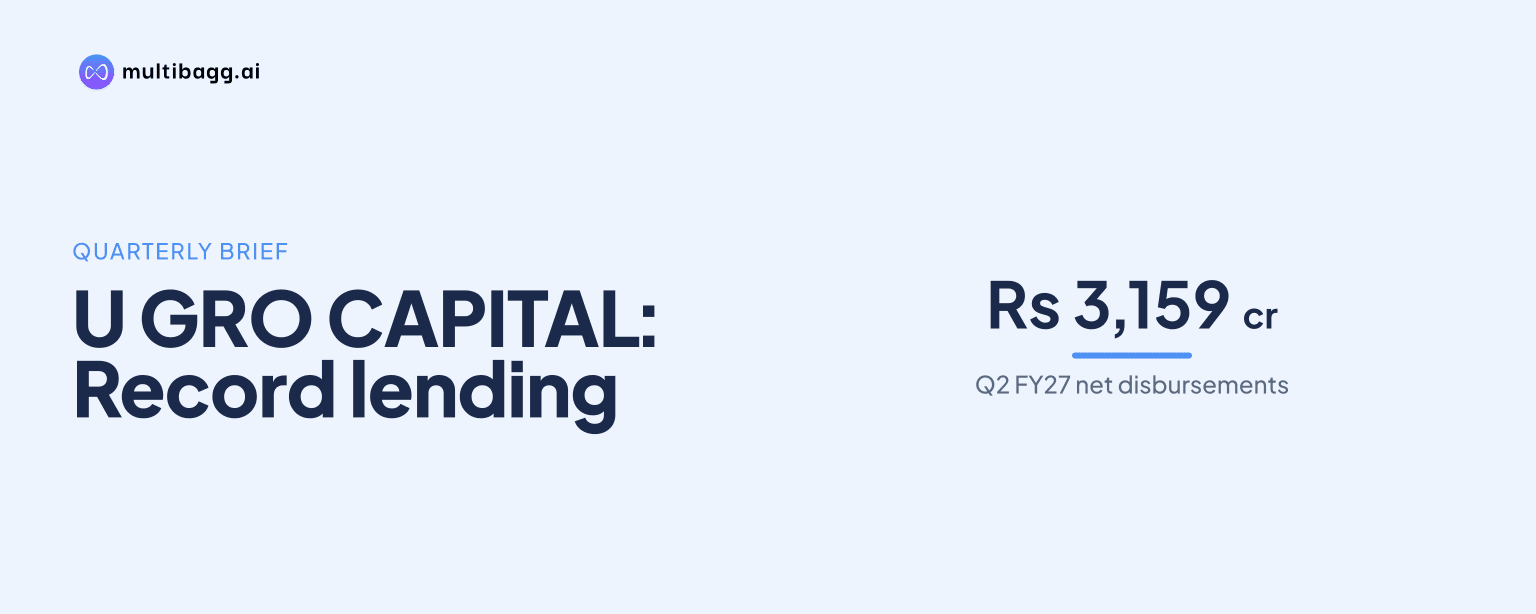
U GRO CAPITAL recorded Q2 FY27 net disbursements of Rs 3,159 crore, up 77% year on year, but assets under management (AUM) remained Rs 15,019 crore at September 2026 as higher-than-expected foreclosures in de-focused verticals offset new lending. Annualised credit cost also rose to 3.6% from 2.8% in Q1 FY27.
Know Ugro Capital inside out
Results, valuation, peers and who's buying, in one view.
Why did UGRO CAPITAL's AUM stay flat despite record disbursements?
UGRO CAPITAL's AUM was Rs 15,019 crore at both June 2026 and September 2026, despite Q2 FY27 net disbursements reaching a record Rs 3,159 crore. The company defined net disbursements as gross disbursements less repayments received in supply-chain financing during the period. Management attributed the flat AUM to higher-than-expected foreclosures in de-focused verticals, while stating that focused-vertical AUM continued to increase.
The recent sequence shows disbursements rising while closing AUM did not. AUM declined from Rs 15,454 crore in December 2025 to Rs 15,334 crore in March 2026 and Rs 15,013 crore in June 2026, before increasing by Rs 6 crore in September 2026. Net disbursements rose from Rs 2,137 crore in Q4 FY26 to Rs 2,551 crore in Q1 FY27 and Rs 3,159 crore in Q2 FY27.
Monthly disbursements exceeded Rs 1,000 crore in each month of Q2 FY27, comprising Rs 1,057 crore in July 2026, Rs 1,010 crore in August and Rs 1,092 crore in September. The presentation also reported more than Rs 1,100 crore of disbursements in October 2026. These monthly volumes supported the quarterly record, but foreclosures and repayments prevented equivalent growth in reported AUM.
Which businesses are changing UGRO CAPITAL's portfolio mix?
UGRO CAPITAL's focused businesses are Emerging Markets (EM) and Embedded Merchant Finance, branded GROx, whose combined AUM share rose to 53% in September 2026 from 32% in December 2025. EM AUM increased from Rs 3,199 crore in December 2025 to Rs 4,268 crore in September 2026. GROx AUM doubled over four quarters, from Rs 1,270 crore in September 2025 to Rs 3,661 crore in September 2026.
EM is secured lending to emerging markets, while GROx is technology-led merchant finance. UGRO CAPITAL linked GROx growth to additional partners and higher volumes from existing partners. Its EM branch network stood at 317 in Q2 FY27, unchanged from March 2026 and above 286 in June 2025, while average branch productivity rose to Rs 0.73 crore in Q2 FY27 from Rs 0.48 crore in FY26.
The portfolio table showed lower gross non-performing assets (GNPA) in the focused products than in other de-focused products. EM had Rs 4,268 crore of AUM and 2.0% GNPA, while GROx had Rs 3,661 crore and 1.4% GNPA. Other de-focused products accounted for Rs 7,090 crore of AUM and carried 3.9% GNPA, compared with 2.7% across total AUM.
Got a follow-up? Ask IRIS
How did UGRO CAPITAL's asset quality and credit cost change?
UGRO CAPITAL's GNPA on AUM rose to 2.7% in September 2026 from 2.6% in June 2026 and 2.4% in September 2025. Annualised credit cost on average on-book portfolio outstanding rose to 3.6% in Q2 FY27 from 2.8% in Q1 FY27. Net non-performing assets were 2.0% of AUM, and the provision coverage ratio remained 45%, unchanged from December 2025.
Expected credit loss staging at September 2026 placed Rs 13,945 crore, or 92.9%, of the Rs 15,019 crore loan exposure in Stage 1. Stage 2 exposure was Rs 662 crore, or 4.4%, while Stage 3 exposure was Rs 412 crore, or 2.7%. The Stage 3 share matched the portfolio-level GNPA ratio reported for the same date.
Collection efficiency, calculated as total collections divided by current-month demand, was 97% in Q2 FY27, compared with 98% in Q1 FY27 and 100% in Q2 FY26. Management described focused-product GNPA as 1.7% in its Q2 reflection, while the product table reported 2.0% for EM and 1.4% for GROx. The presentation identified seasoning of new vintages as the key variable for credit discipline.
What did UGRO CAPITAL report on profitability and funding?
UGRO CAPITAL reported profit before tax (PBT) of Rs 68.3 crore in Q2 FY27, up 11% quarter on quarter and 12% year on year. Total income rose 8% sequentially to Rs 578.4 crore, while net total income increased 15% to Rs 282.4 crore. Pre-provision operating profit increased 22% to Rs 155.1 crore, supported by interest income of Rs 385.5 crore.
Credit cost increased 32% quarter on quarter to Rs 86.9 crore from Rs 65.6 crore, limiting the conversion of higher operating profit into earnings after tax. Profit after tax was Rs 50.7 crore, down 25% from Rs 67.9 crore in Q1 FY27 but up 17% from Rs 43.3 crore in Q2 FY26. Annualised pre-tax return on assets increased to 2.8% from 2.6%, while annualised return on equity fell to 6.8% from 9.2%.
Portfolio yield was 18.7% in Q2 FY27, up 53 basis points quarter on quarter and 108 basis points year on year, which the company linked to the EM and GROx mix shift. Cost of borrowings was 10.19%, versus 10.14% in Q1 FY27 and 10.37% in Q2 FY26. Total debt stood at Rs 10,973 crore, with 53% of borrowings maturing in three to five years and 15% beyond five years.
Conclusion
UGRO CAPITAL's Q2 FY27 results show that record net disbursements did not translate into total AUM growth because foreclosures in de-focused products offset expansion in EM and GROx. The focused businesses increased their AUM share to 53%, while their reported GNPA ratios of 2.0% for EM and 1.4% for GROx were below the 3.9% reported for other de-focused products. Higher credit cost nevertheless reduced quarterly profit after tax and return on equity.
The next disclosed event is the National Company Law Tribunal final hearing for the Profectus merger on 20 November 2026, following shareholder and creditor approvals received on 23 September 2026. Management has stated an FY29 return-on-assets objective of 3.0% to 3.5% and a plan for no new equity for three years, with growth funded through internal accruals. Credit-cost movement, new-vintage seasoning and the pace of the de-focused book rundown remain the disclosed matters to watch.