










GSFC Q2 revenue rose 50% but EBITDA fell 61% on costs
Key highlights
- GSFC’s Q2 2026-27 operating revenue rose 50% year-on-year to Rs 4,711 crore.
- GSFC’s Q2 operating EBITDA fell 61% year-on-year to Rs 131 crore from Rs 333 crore.
- GSFC’s fertilizer EBIT declined to Rs 17 crore from Rs 224 crore as sulphur costs rose 327% and natural-gas costs rose 62%.
- GSFC’s Industrial Products EBIT increased to Rs 66 crore from Rs 54 crore in Q2 2026-27.
powered by IRIS
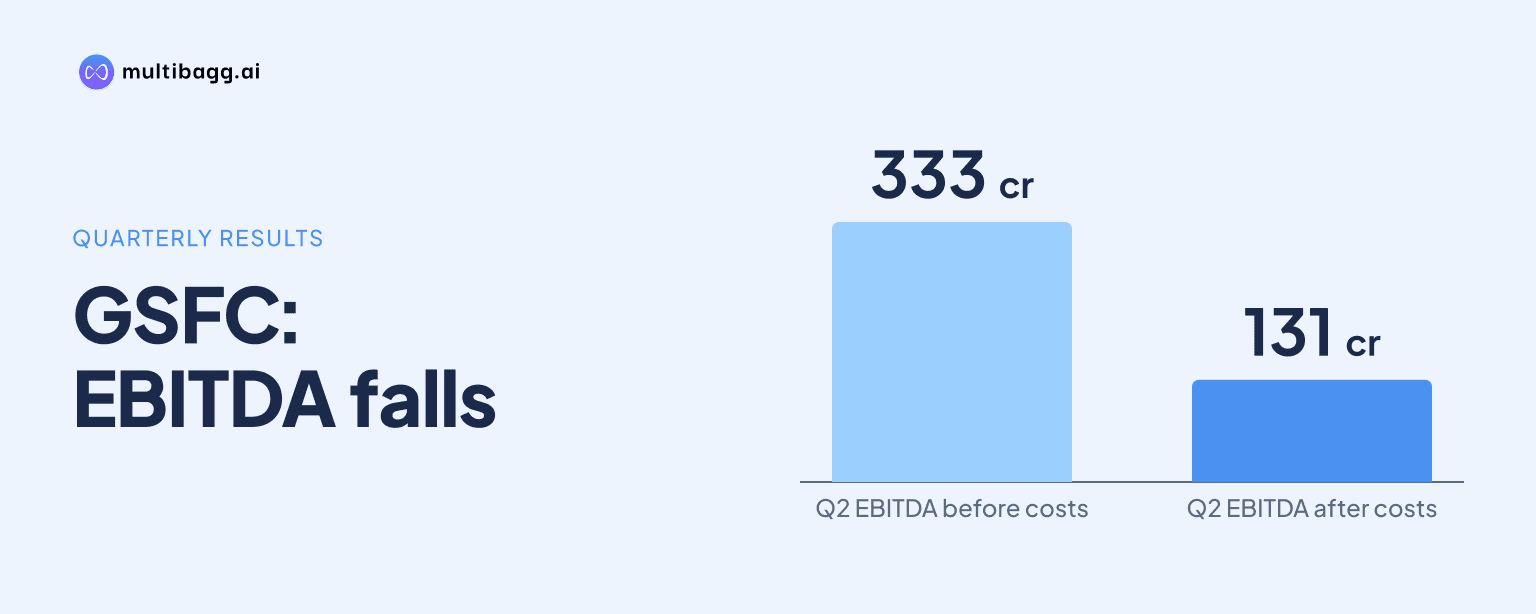
Gujarat State Fertilizers and Chemicals Limited reported record Q2 2026-27 operating revenue of Rs 4,711 crore, up 50% year-on-year, while operating EBITDA fell 61% to Rs 131 crore from Rs 333 crore. GSFC attributed the pressure principally to sharply higher fertilizer inputs, including sulphur costs up 327% and natural-gas costs up 62%.
Know Gujarat State Fertilizers & Chemicals inside out
Results, valuation, peers and who's buying, in one view.
How did GSFC’s Q2 financial performance change?
GSFC increased Q2 2026-27 operating revenue by Rs 1,571 crore year-on-year, but operating EBITDA declined by Rs 202 crore. Operating EBITDA, or earnings before interest, tax, depreciation and amortisation, was Rs 131 crore, compared with Rs 333 crore in Q2 2025-26 and Rs 238 crore in Q1 2026-27. Total revenue rose to Rs 4,881 crore from Rs 3,282 crore a year earlier.
GSFC’s profit after tax was Rs 183 crore in Q2 2026-27, down from Rs 320 crore a year earlier but above Rs 161 crore in Q1 2026-27. Profit before tax followed the same pattern, declining from Rs 424 crore in Q2 2025-26 to Rs 231 crore, while increasing from Rs 207 crore sequentially. Earnings per share, not annualised, were Rs 4.60 against Rs 8.04 a year earlier.
For H1 2026-27, GSFC recorded operating revenue of Rs 8,293 crore, 56% above Rs 5,312 crore in H1 2025-26. Operating EBITDA declined to Rs 369 crore from Rs 534 crore, while profit after tax fell to Rs 344 crore from Rs 460 crore. The half-year comparison indicates that the Q2 margin pressure followed a lower operating EBITDA outcome in Q1.
Why did GSFC’s fertilizer margin decline despite sales growth?
GSFC’s fertilizer segment reported sales-value growth of 55%, or Rs 1,386 crore, in Q2 2026-27, while segment EBIT fell to Rs 17 crore from Rs 224 crore. EBIT means earnings before interest and tax. Total fertilizer sales volume declined 6% to 5.69 lakh metric tonnes from 6.08 lakh metric tonnes, showing that higher sales value did not reflect higher overall volume.
The increase in fertilizer sales value was primarily driven by higher di-ammonium phosphate, or DAP, realisations, according to GSFC. DAP revenue increased by Rs 1,659 crore, with support from the government’s DAP Special Package for international price variations. DAP sales volume rose to 0.91 lakh metric tonnes from 0.09 lakh metric tonnes, while APS sales volume declined to 0.50 lakh metric tonnes from 1.77 lakh metric tonnes.
Input costs rose across the fertilizer business in Q2 2026-27. GSFC reported sulphur costs up 327% and natural-gas costs up 62% year-on-year. Its presentation shows natural-gas prices at Rs 66 per standard cubic metre in September 2026, compared with Rs 41 in September 2025, while imported phosphoric acid input, measured as P2O5, increased to Rs 1.31 lakh per metric tonne from Rs 1.04 lakh per metric tonne.
GSFC said urea subsidy rates remain subject to revision after finalisation of the actual Pool Gas rate by FICC.GAIL, pending since April 2026. Management said forthcoming nutrient-based subsidy, or NBS, rates could partly mitigate elevated raw-material costs and address the stated price distortion between DAP and NPK fertilizers. This remains an outlook item rather than a reported Q2 outcome.
Got a follow-up? Ask IRIS
Which GSFC business supported profit during Q2?
GSFC’s Industrial Products segment partly offset the fertilizer decline, as its sales increased by Rs 185 crore, or 30% year-on-year, and EBIT rose to Rs 66 crore from Rs 54 crore. The Rs 12 crore improvement contrasted with the Rs 207 crore year-on-year reduction in fertilizer EBIT.
Higher realisations supported sales increases of Rs 58 crore for Caprolactam and Rs 60 crore for Nylon, according to GSFC. Anone sales increased by Rs 36 crore on higher volumes, and TGU sales increased by Rs 26 crore. These gains were partly offset by a Rs 5 crore decline in Melamine sales.
The Caprolactam-Benzene spread increased to US$849 per metric tonne in September 2026 from US$512 per metric tonne in September 2025. Caprolactam was priced at US$1,799 per metric tonne and Benzene at US$950 per metric tonne in September 2026. GSFC said the spread is expected to moderate in Q3 2026-27 as regional supply normalises, potentially affecting margins in its Caprolactam-Nylon value chain.
Industrial-product volume data show that higher sales value was not uniform volume growth. Caprolactam sales volume declined to 0.11 lakh metric tonnes from 0.13 lakh metric tonnes, while Nylon sales volume increased to 0.09 lakh metric tonnes from 0.08 lakh metric tonnes. Melamine sales volume fell to 0.07 lakh metric tonnes from 0.09 lakh metric tonnes.
What will GSFC face in Q3 2026-27?
GSFC said fertilizer inventories entering the Rabi season are at their highest level in three years, particularly for urea and NPK grades, which it expects to intensify competition. Management also cited a subdued southwest monsoon and lower reservoir levels, especially in southern India, as factors that could constrain fertilizer demand in Q3 2026-27.
The DAP-NPK price distortion continues to influence farmer preferences and adversely affect NPK offtake, according to GSFC. In Q2 2026-27, traded phosphatic and potassic fertilizer sales rose to 1.87 lakh metric tonnes from 1.07 lakh metric tonnes, while traded urea sales increased to 0.84 lakh metric tonnes from 0.52 lakh metric tonnes. These movements occurred alongside the 6% decline in total fertilizer sales volume.
GSFC commissioned a C-Train modification at its Sikka unit on 23 October 2026, adding 1,200 metric tonnes per day of APS capacity. Its ongoing Sikka phosphoric acid and sulphuric acid project is listed at 198 thousand tonnes per annum of phosphoric acid and 594 thousand tonnes per annum of sulphuric acid. The presentation identifies the project under H2 2026-27 but gives no separate commissioning date for those acid capacities.
Management said its Q3 approach will prioritise operational efficiency, product mix, inventory management, timely market supplies and channel competitiveness. GSFC expects steady demand for Melamine and Technical Grade Urea, possible improvement in HX Crystal exports amid subdued domestic demand, and steady demand for other industrial products. These are management expectations, and the presentation notes that forward-looking outcomes may differ materially.
Conclusion
GSFC’s Q2 2026-27 results show that record operating revenue of Rs 4,711 crore did not protect operating profit when fertilizer inputs rose sharply. DAP-led sales value and subsidy support lifted fertilizer revenue, but total fertilizer volume fell and segment EBIT declined to Rs 17 crore. Industrial Products increased EBIT to Rs 66 crore, but this was insufficient to offset the fertilizer-margin reduction.
The next disclosed markers are forthcoming NBS subsidy rates, finalisation of the Pool Gas rate pending since April 2026, and Rabi-season demand conditions. Management also expects the Caprolactam-Benzene spread to moderate in Q3 2026-27 and must execute the listed Sikka acid project after commissioning the 1,200-metric-tonnes-per-day APS C-Train modification on 23 October 2026.