










GSFC says pending NPK rates will decide H2 fertilizer margins
Key highlights
- GSFC fertilizer EBIT fell to Rs 17 crore in Q2 FY27 from Rs 224 crore in Q2 FY26.
- Fertilizer sales value increased by Rs 1,387 crore despite a 6% volume decline to 5.69 lakh metric tonnes.
- GSFC estimates solar-power savings of Rs 20 crore to Rs 25 crore per quarter.
- Industrial Products EBIT increased to Rs 66 crore from Rs 54 crore in Q2 FY27.
powered by IRIS
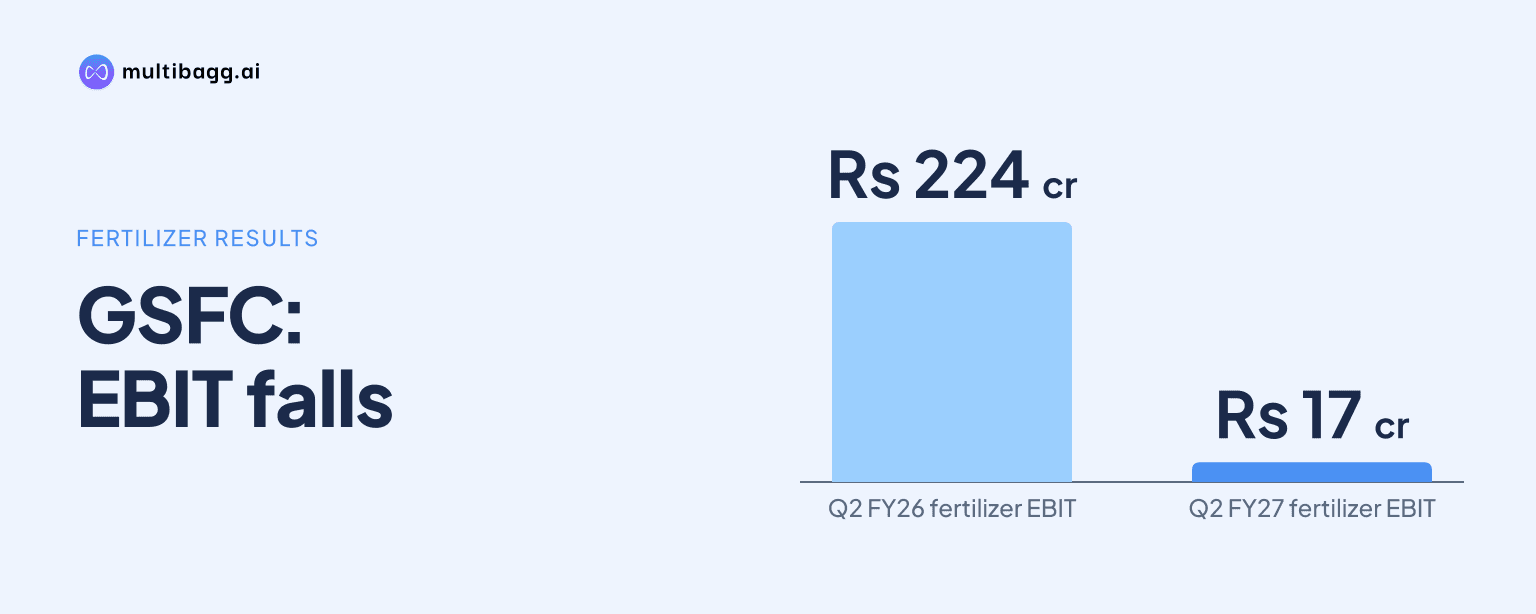
Gujarat State Fertilizers & Chemicals Limited said H2 FY27 fertilizer margins cannot be calculated until the government notifies NPK subsidy rates effective October 1, 2026, after fertilizer EBIT fell to Rs 17 crore in Q2 FY27 from Rs 224 crore a year earlier. Management said a higher approved rate could compensate for the previous quarter’s profit deficit.
Know Gujarat State Fertilizers & Chemicals inside out
Results, valuation, peers and who's buying, in one view.
What will determine GSFC’s H2 FY27 fertilizer margins?
GSFC said the subsidy rate for nitrogen, phosphorus and potassium, or NPK, fertilizer grades will be the principal determinant of H2 FY27 margins because fertilizer profitability depends on subsidies. Management was awaiting the government notification for the six-month period from October 1, 2026 to March 31, 2027, and said it could not estimate an NPK margin percentage before approved rates were known.
GSFC distinguished the economics of its fertilizer products. Management said diammonium phosphate, or DAP, is fully compensated by the Government of India through the applicable advantage-disadvantage mechanism and earns a 4% margin. Urea earns around 3% to 4%, according to management, while NPK-grade profitability can be determined only after the subsidy rates effective from October 1 are received.
Management’s H2 view was conditional rather than a numerical forecast. It said that if the rate increases as it expects based on available information and is approved by the Government of India, the deficit in profits incurred during the previous quarter would be compensated in the next quarter. Management also described H2 as potentially a good six months for GSFC, subject to the subsidy outcome.
Why did GSFC’s fertilizer profit fall in Q2 FY27?
GSFC’s fertilizer segment EBIT declined by Rs 207 crore year on year to Rs 17 crore in Q2 FY27 from Rs 224 crore in Q2 FY26, as raw-material inflation outweighed a 55% increase in fertilizer sales value. Sulfur costs rose 327% and natural-gas costs increased 62%, compressing earnings despite higher realizations and government support for DAP.
Fertilizer sales value increased by Rs 1,387 crore in Q2 FY27 even as sales volume declined 6% to 5.69 lakh metric tonnes from 6.08 lakh metric tonnes. GSFC attributed much of the revenue increase to DAP, where revenue rose by Rs 1,659 crore, supported by the government’s DAP special package intended to compensate for international price variations.
The contrast between revenue and EBIT explains why management focused on subsidy rates rather than sales growth in discussing H2. At the consolidated level, Q2 FY27 sales rose 49% year on year, while profit before tax and profit after tax fell 42% and 38%, respectively. Sequentially, consolidated sales increased 32% to Rs 4,741 crore, while profit before tax rose 22% to Rs 249 crore and profit after tax increased 26% to Rs 200 crore.
Got a follow-up? Ask IRIS
How much can solar power improve GSFC’s H2 costs?
GSFC expects its solar-power arrangement to generate savings of about Rs 20 crore to Rs 25 crore per quarter by replacing costlier electricity-board purchases. Management said the benefit would be distributed across products made at the Sikka unit, including DAP, NPK grades, ammonium phosphate and sulfur products, rather than assigned to one product.
The solar saving is a secondary lever beside subsidy policy. GSFC said it was applying cost-cutting measures at Sikka under a growth strategy suggested by Boston Consulting Group, or BCG, but did not quantify operating efficiencies beyond the estimated quarterly solar benefit. Management specifically described subsidy rates as the major influence on fertilizer margins.
GSFC also commissioned the C-Train modification at Sikka on October 23, 2026. The modification enables production of 1,200 metric tonnes per day of ammonium phosphate sulfate, or APS, instead of DAP according to market requirements. The call did not provide a margin target, expected APS production volume or financial contribution from the modification for H2 FY27.
What other factors could affect GSFC in H2 FY27?
GSFC identified fertilizer inventories, weather and relative product pricing as demand risks for the Rabi season. Management said the country was entering the season with the highest fertilizer inventory in three years, particularly for urea and NPK grades, which could intensify industry competition. It also cited a subdued southwest monsoon and lower reservoir levels, especially in southern India, as factors likely to constrain fertilizer demand.
The price distortion between DAP and NPK fertilizers was influencing farmer purchasing preferences and adversely affecting NPK offtake, according to GSFC. On costs, management said easing geopolitical tensions in the Middle East and Europe could soften international raw-material prices and provide relief to industry margins. These were external possibilities identified by management, not assumptions in disclosed guidance.
The Industrial Products segment reported a different Q2 earnings trend. Its sales increased 30% year on year, or by Rs 185 crore, and EBIT rose to Rs 66 crore from Rs 54 crore. GSFC said higher realizations increased caprolactam sales by Rs 58 crore and nylon sales by Rs 60 crore, while higher volumes lifted Anone sales by Rs 36 crore.
However, GSFC expects the caprolactam-benzene spread to moderate in Q3 FY27 as regional supply normalizes. The spread expanded to USD 849 per metric tonne in Q2 FY27 from USD 512 per metric tonne a year earlier. Management expects steady demand for melamine and technical-grade urea, potential improvement in HX crystal exports amid subdued domestic demand, and stable demand for other industrial products.
Conclusion
GSFC’s Q2 FY27 results show that higher fertilizer revenue did not protect segment profit when sulfur and natural-gas costs rose sharply: fertilizer EBIT fell to Rs 17 crore from Rs 224 crore despite a Rs 1,387 crore increase in sales value. Industrial Products partly offset that pressure, with EBIT increasing by Rs 12 crore to Rs 66 crore, while solar power could reduce Sikka operating costs by Rs 20 crore to Rs 25 crore per quarter.
The immediate item to watch is the Government of India’s notification of NPK subsidy rates for October 1, 2026 through March 31, 2027, which management said is required before it can calculate NPK margins. Investors can also monitor Sikka cost measures, the production mix enabled by the 1,200-metric-tonne-per-day APS modification, and raw-material price movements that management linked to fertilizer profitability.