










Flair targets 15% EBITDA margin amid volatile input costs
Key highlights
- Flair reported a 14.9% EBITDA margin in Q2 FY '27, compared with 16.7% cited for Q1 FY '27.
- Management said Flair aims to maintain EBITDA margin of about 15% at current crude-price levels.
- Flair estimated weather-related disruption caused approximately Rs 25 crore of lost revenue in Q2 FY '27.
- Flair's net working-capital days rose to 145 in H1 FY '27 from 139 in FY '26.
powered by IRIS
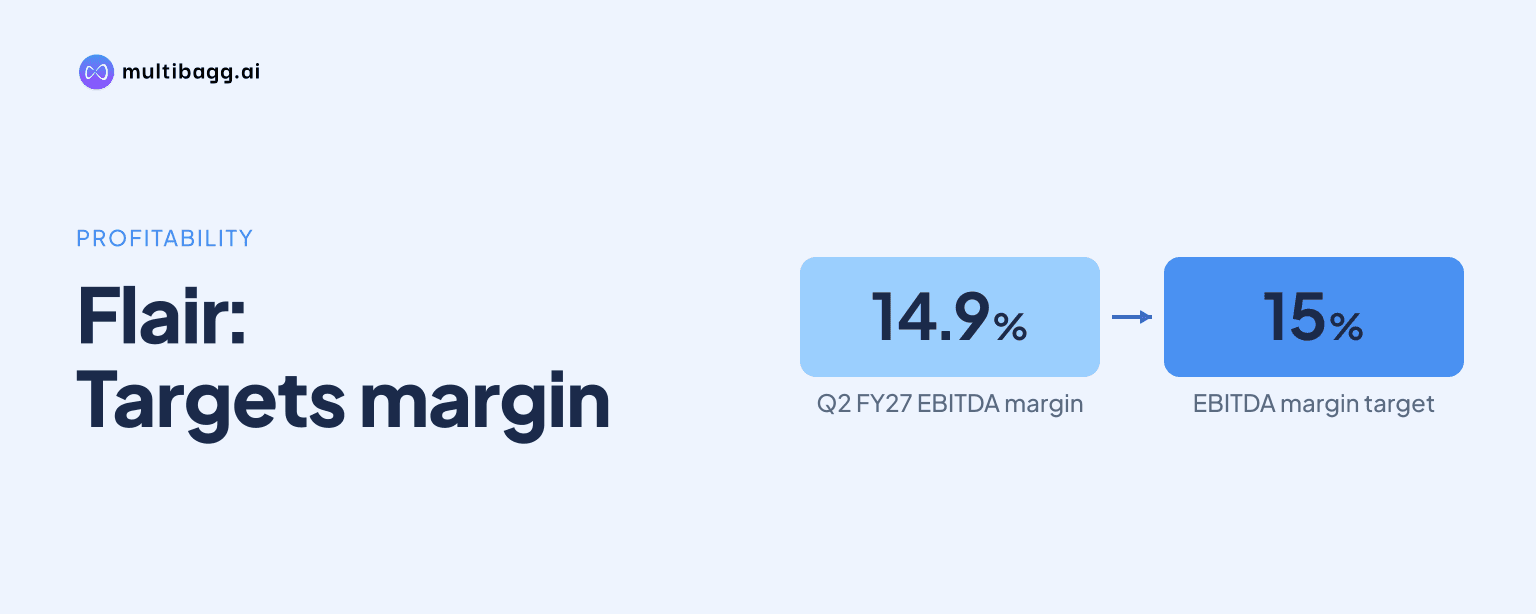
Flair said it aims to maintain an earnings before interest, tax, depreciation and amortisation (EBITDA) margin of about 15% at current crude-price levels after Q2 FY '27 margin fell to 14.9% from 16.7% in Q1; management linked a return to 16%-17% to an improved global cost environment.
Know Flair Writing Industries inside out
Results, valuation, peers and who's buying, in one view.
What EBITDA margin is Flair targeting now?
Flair is targeting an EBITDA margin of roughly 15% while raw-material costs remain volatile and crude stays at the level discussed on the call. Management confirmed that it expects to maintain this level through operational efficiency, financial discipline and diversification across its three business categories.
The target is below the 16.7% margin cited for Q1 FY '27, when an analyst said low-cost inventory had partly shielded Flair from input inflation. In Q2 FY '27, Flair reported EBITDA of Rs 50.6 crore on revenue from operations of Rs 340.1 crore, resulting in a 14.9% margin. Management did not give a date for recovery above 15%.
Why did Flair's Q2 FY '27 margin decline?
Flair said higher raw-material prices and weather-related production disruption reduced Q2 FY '27 profitability. Management explained that normal operating costs were incurred during the disruption but could not be spread over the planned production volume, lowering operating margin beyond the effect of cost inflation.
The Valsad facility, which makes Steel Bottles and Houseware, was unproductive for about 15 days because of flooding-related power, manpower and operational issues. Flair estimated that disruption across its facilities caused approximately Rs 25 crore of lost revenue in the quarter. Without those exceptional events, management said quarterly revenue growth could have been about 7% to 8% higher.
Management said there was no separately identified one-time expense within other expenses. Instead, the cost effect came from lower production during the disruption, which reduced the absorption of operating costs. Manufacturing at both affected facilities had returned to normal by the time of the call.
How will Flair protect its 15% margin?
Flair plans to protect its approximately 15% EBITDA margin through procurement at favourable raw-material prices, selective pricing, lower discounts and schemes, factory-level value engineering and product-mix management. Management said it would monitor material-price volatility and may raise prices for certain products if costs continue to move upward.
The company does not describe its pricing approach as a uniform list-price increase. It said realised pricing can change through promotional discounts and schemes, while new launches are being targeted at price points reflecting current input costs. Flair also sells across mass, mid-premium and premium categories, which management said helps balance quantities and margins.
Inventory is part of the raw-material response but has increased working-capital use. Net working-capital days rose to 145 days in H1 FY '27 from 139 days in FY '26, while inventory days increased to 104 from 94. Management attributed the increase partly to advance stocking when material prices were lower, as well as the higher cost of inventory.
Flair has adopted a new enterprise resource planning (ERP) system for inventory control, but management said it was too early to measure the effect. It expects two to three quarters for the system's effect to appear in the business cycle, while its aim to reduce working-capital days by another 15 to 20 days may take five to six quarters.
Got a follow-up? Ask IRIS
Which businesses could support Flair's margin outlook?
Flair said diversification across Writing Instruments, Creative Products, and Steel Bottles and Houseware supports its margin-management approach. Writing Instruments, its core business, grew 7% in H1 FY '27, while Creative Products grew 24% year on year in the same period, giving the company different sources of volume growth.
Steel Bottles and Houseware was more affected in Q2 because of the Valsad shutdown, following growth of about 54% in Q1. Flair expects its fourth stainless-steel bottle manufacturing line to begin commercial production in Q4 FY '27. Management said the line should increase manufacturing flexibility and help meet demand, but did not quantify its capacity or profit contribution.
Revenue from operations rose 8.2% year on year to Rs 659.4 crore in H1 FY '27, while Q2 revenue of Rs 340.1 crore was 6.5% higher sequentially. Management said H2 has historically been stronger and retained its FY '27 revenue-growth target of 12%, despite geopolitical uncertainty and export-market disruption.
What could move Flair back to a 16%-17% margin?
Flair said an improvement in the global environment could take EBITDA margin back to the 16%-17% range. Management's condition was lower pressure from raw-material costs, rather than a quantified timeframe or a formal margin forecast for a particular quarter.
Management also said margin could move higher if production costs provide a benefit, even while it plans around a 15% level amid volatility. The stated approach combines cost controls with growth in Creative Products and Steel Bottles and Houseware, rather than relying only on passing raw-material inflation to customers.
Conclusion
Flair has set a near-term EBITDA margin floor of about 15% after Q2 FY '27 margin reached 14.9%, compared with 16.7% in Q1. Management attributed the movement to higher raw-material costs and lower operating-cost absorption during disruptions that caused approximately Rs 25 crore of lost quarterly revenue.
The next indicators are whether normalised Valsad operations and the fourth bottle line scheduled for Q4 FY '27 support H2 volumes and the 12% annual revenue-growth target. Management also tied a recovery to 16%-17% EBITDA margin to improved global costs, while the ERP-led inventory-control programme is expected to take two to three quarters to show an effect.