










Flair targets 12% FY27 growth after Rs 25 crore flood loss
Key highlights
- Flair estimates Q2 FY27 flooding at Valsad and Daman cost approximately Rs 25 crore of revenue.
- Flair targets FY27 revenue growth of 12% or more after H1 FY27 revenue rose 8.2% to Rs 659.4 crore.
- Valsad was non-operational for about 15 days and Daman for about seven days during Q2 FY27.
- Creative products grew 24% year on year in H1 FY27, compared with 7% growth in Writing instruments.
powered by IRIS
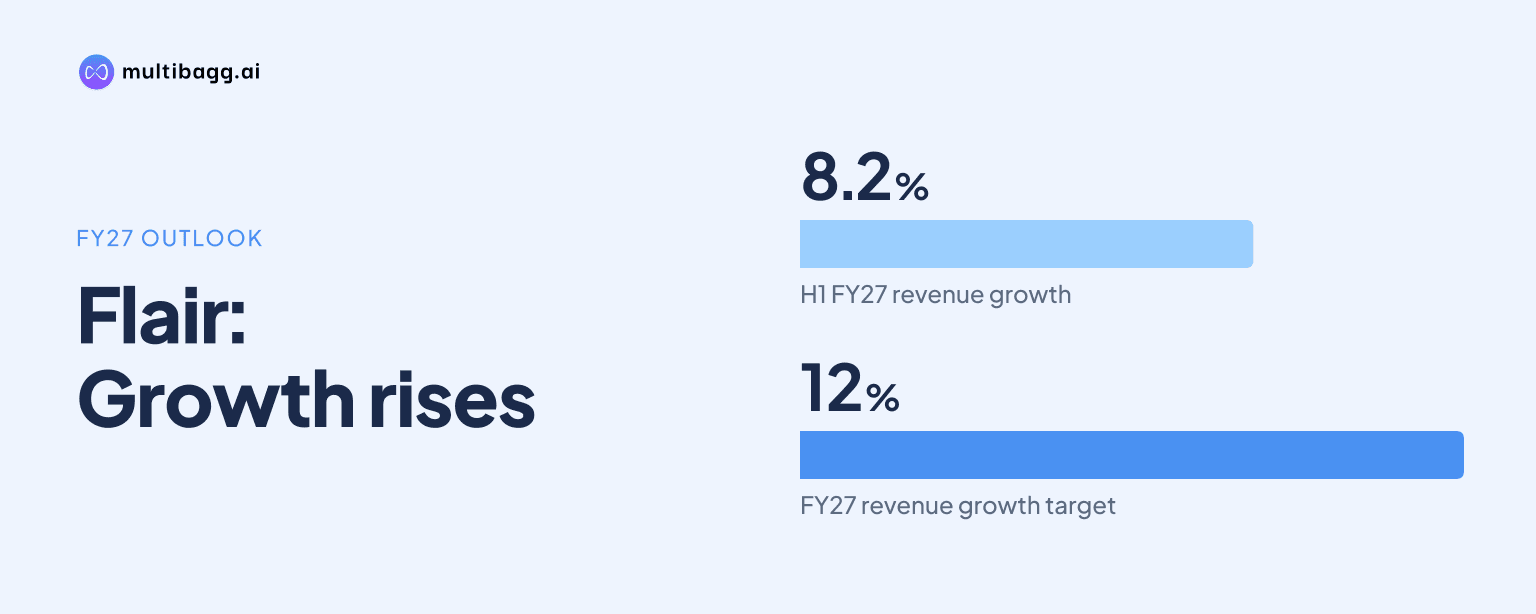
Flair Writing Industries Limited is targeting FY27 revenue growth of 12% or more after flooding at its Valsad and Daman facilities caused an estimated Rs 25 crore revenue loss in Q2 FY27. Management said both plants had returned to normal operations by its November 3, 2026 earnings call and expects a seasonally stronger H2 FY27.
Know Flair Writing Industries inside out
Results, valuation, peers and who's buying, in one view.
What is Flair's FY27 revenue-growth target?
Flair is targeting annual revenue growth of 12% or more in FY27, after reporting revenue from operations of Rs 659.4 crore in H1 FY27, up 8.2% year on year. Management also reiterated its medium-term aspiration of approximately 15% annual revenue growth beyond FY27, supported by writing instruments, Creative products, and Steel bottles and Houseware.
The call transcript does not disclose a prior FY27 revenue-growth target, so it does not establish the size of any change from earlier guidance. Management said its 12% FY27 target depends on normalised manufacturing, a historically stronger second half, wider geographical reach and continued investment in manufacturing and distribution.
The 12% full-year target requires faster growth in H2 FY27 than the 8.2% increase reported in H1 FY27. Q2 FY27 revenue of Rs 340.1 crore was 6.5% higher sequentially, while management estimated that quarterly revenue growth could have been 7% to 8% higher without the flood-related disruption.
How much revenue did floods cost Flair in Q2 FY27?
Flair estimates that flooding caused approximately Rs 25 crore of lost revenue in Q2 FY27. Exceptionally heavy rainfall in western India disrupted manufacturing, employee movement and supply-chain activity at its Valsad and Daman facilities, making the estimate a management assessment rather than a separately reported accounting line item.
Valsad was non-operational for an average of about 15 days during Q2 FY27, compared with about seven days for Daman. Management said some employees took additional time to return after the floods, delaying the restoration of production even after physical operations could resume.
Both sites had returned to normal operations by the November 3 call. Flair said its immediate priorities are improving production efficiency, maintaining supply continuity and recovering momentum through Q3 and H2 FY27, when management expects seasonal demand to be more favourable.
How did the disruption affect Flair's financial performance?
Flair reported Q2 FY27 earnings before interest, tax, depreciation and amortisation, or EBITDA, of Rs 50.6 crore, representing a 14.9% EBITDA margin. It did not quantify the flood-related effect on profit, but said elevated raw-material costs and supply-side price volatility also affected margins during the period.
Profit after tax rose 9.1% sequentially to Rs 31.7 crore in Q2 FY27, and the profit margin improved by 20 basis points to 9.3%. A basis point is one-hundredth of a percentage point. Management attributed the sequential profit improvement to operational efficiencies, cost management and execution discipline.
An analyst on the call cited a 16.7% EBITDA margin for Q1 FY27, compared with 14.9% in Q2 FY27. Management said it had procured materials when prices were lower and would seek to maintain margins through cost efficiencies and financial discipline while monitoring input-price volatility.
Got a follow-up? Ask IRIS
Which businesses could support Flair's second-half growth?
Flair expects its three operating segments, Writing instruments, Creative products, and Steel bottles and Houseware, to contribute to H2 FY27. The company is pursuing a business mix of 60% writing instruments and 40% non-pen categories, making Creative products and Steel bottles and Houseware central to its diversification plan.
Writing instruments grew 7% in H1 FY27, while Creative products grew 24% year on year over the same period. Flair did not disclose segment revenue values on the call, but Creative products expanded faster than the established writing-instruments business, aided by product expansion and consumer traction.
Flair expects its fourth stainless-steel bottle manufacturing line to start commercial production in Q4 FY27. It is also expanding Creative manufacturing in Surat and developing an upcoming Valsad facility, while management said it is looking for a potential acquisition in the Creative segment.
What could affect Flair's FY27 target?
Flair identified raw-material volatility, export logistics and slower export collections as factors that could affect FY27 performance. Management said geopolitical uncertainty in West Asia has influenced trade flows, freight costs, logistics arrangements and some supply chains, including in markets where Flair has a presence.
Net working-capital days increased to 145 in H1 FY27 from 139 in FY26. Inventory days rose to 104 from 94 after advance stocking when raw-material prices were lower, while debtor days increased to 84 from 78 because export-market collections were slower.
Flair has moved to a new enterprise resource planning, or ERP, system to support inventory control. Management said the system would need two to three quarters before its effect becomes visible in the business cycle, leaving working-capital execution relevant to the company’s H2 FY27 plan.
Conclusion
Flair’s FY27 target of revenue growth of 12% or more rests on recovering sales lost during the Q2 disruption and converting normalised factory operations into a stronger H2. H1 revenue grew 8.2% to Rs 659.4 crore, while Creative products grew 24%, ahead of the 7% increase in Writing instruments.
The next disclosed milestones are the expected commercial start of the fourth steel-bottle line in Q4 FY27 and the two-to-three-quarter period management expects before the ERP system affects inventory control. Investors will also be watching whether export collections improve from 84 debtor days and whether the historically stronger second half delivers the acceleration management expects.