










Flair targets 40% non-pen mix as Creative growth accelerates
Key highlights
- Creative products grew 24% year on year in H1 FY27, compared with 7% growth in Writing Instruments.
- Flair is targeting a portfolio mix of 60% writing instruments and 40% non-pen categories.
- Flair expects its fourth stainless-steel bottle line to start commercial production in Q4 FY27.
- Flood disruption at Valsad and Daman caused an estimated Rs 25 crore revenue loss in Q2 FY27.
powered by IRIS
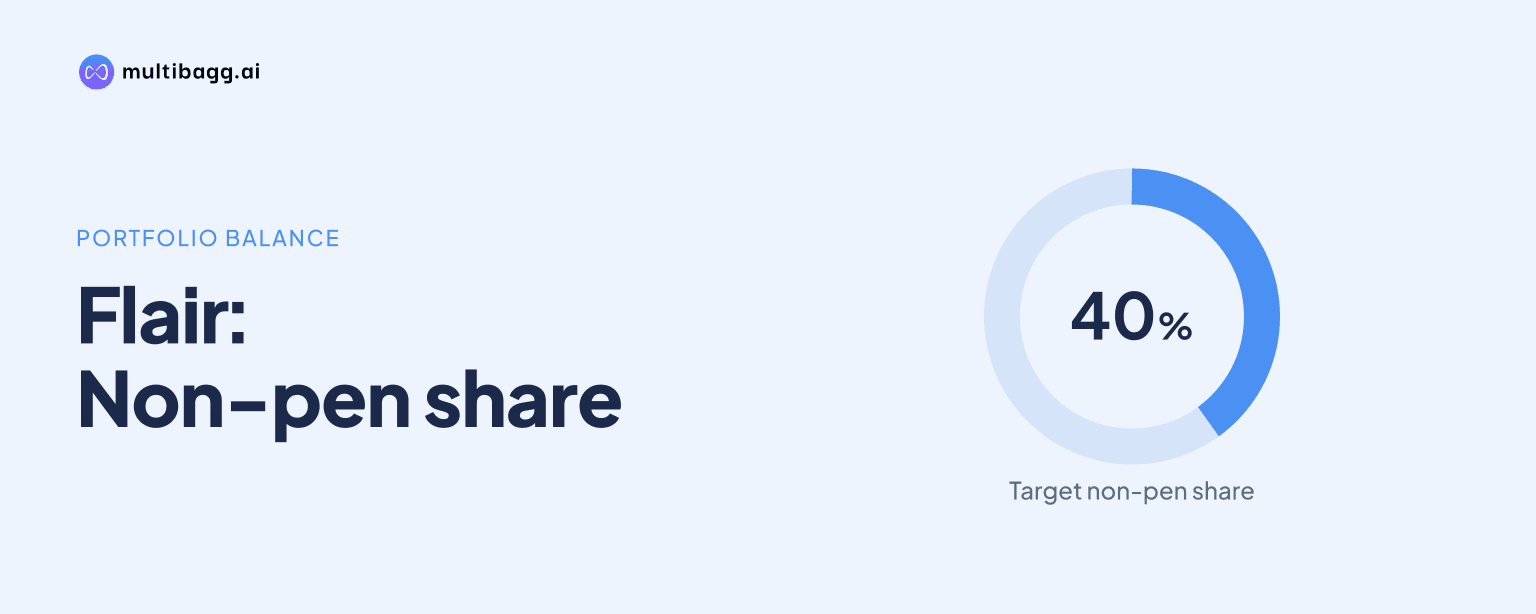
Flair Writing Industries Limited is targeting a portfolio of 60% writing instruments and 40% non-pen categories, supported by 24% year-on-year Creative products growth in H1 FY27 and a fourth steel-bottle line scheduled for commercial production in Q4 FY27. Management did not disclose a 32% non-pen revenue forecast for FY27.
Know Flair Writing Industries inside out
Results, valuation, peers and who's buying, in one view.
What is Flair’s plan to reduce reliance on pens?
Flair plans to reduce its dependence on writing instruments by expanding Creative products and Steel Bottles and Houseware toward a 60:40 mix between pen and non-pen categories. Management described writing instruments as the foundation of operations, while identifying the two non-pen businesses as growth engines for a broader consumer-products portfolio.
The strategy is based on adding products, distribution and manufacturing capacity rather than shrinking the pen business. Writing Instruments grew 7% in H1 FY27, while Creative products grew 24% year on year over the same period, indicating that Creative is currently expanding faster than the established category.
Flair did not disclose segment revenue in rupees for Creative products or Steel Bottles and Houseware, nor did it provide an FY27 revenue share for either category. The 40% non-pen figure is a portfolio target stated by management, rather than a dated FY27 forecast.
How is Flair’s Creative products business growing?
Flair’s Creative products business grew 24% year on year in H1 FY27, compared with 7% growth in Writing Instruments. Management attributed the Creative performance to consumer traction, product innovation and a widening portfolio, and said regular launches of new stock-keeping units, or SKUs, would remain central to further expansion.
Manufacturing investment is part of the plan to maintain that momentum. Flair said it was expanding Creative manufacturing in Surat and developing an upcoming Creative facility in Valsad, where flood-related operational disruption constrained output during Q2 FY27.
Flair is also evaluating a potential acquisition in Creative products. Management said the category is large and that a business with an appropriate manufacturing base could help it expand more quickly, but it disclosed no acquisition target, transaction value, timing or expected revenue contribution.
The company’s Q2 FY27 disruption showed the operational importance of Valsad to newer categories. The Valsad facility was non-operational for about 15 days during flooding, while Daman facilities were shut for about seven days, and management estimated the combined effect reduced quarterly revenue by about Rs 25 crore.
What is changing in Flair’s steel-bottle capacity?
Flair expects its fourth stainless-steel bottle manufacturing line to enter commercial production in Q4 FY27. Management said the line will increase manufacturing capacity, provide greater flexibility for product and portfolio expansion, and support opportunities in Steel Bottles and Houseware.
The bottle business was particularly exposed to the Valsad interruption because steel bottles are manufactured there. Management said Steel Bottles had grown about 54% in Q1 FY27, but the 15-day Valsad closure in Q2 prevented the company from meeting some market demand.
The impact differed from the pen business because Flair had production support elsewhere for writing instruments. Management said pens still grew 5% in Q2 FY27 and 7% in H1 FY27, with facilities in Uttarakhand, the outskirts of Mumbai and Daman helping maintain supplies during the monsoon disruption.
Management said demand in Creative and Houseware remained strong after operations returned to normal and referred to customer additions in the newer categories. Those comments describe management’s demand assessment; Flair did not disclose quarterly segment sales or a numerical FY27 sales target for bottles and houseware.
Got a follow-up? Ask IRIS
What factors could affect Flair’s non-pen expansion?
Flair’s non-pen expansion depends partly on uninterrupted manufacturing after the Q2 FY27 floods. Management estimated that revenue growth could have been about 7% to 8% higher than reported without the Valsad and Daman disruptions, which together caused an estimated Rs 25 crore revenue loss.
Raw-material costs and supply conditions also affected the operating environment. Earnings before interest, tax, depreciation and amortisation, or EBITDA, was Rs 50.6 crore in Q2 FY27, with a 14.9% margin, compared with the 16.7% Q1 FY27 margin cited by an analyst on the call.
Management said it was responding to cost pressure through cost rationalisation, operating efficiencies, promotional schemes and selective price actions. It did not quantify the price changes, explaining that price management can include reduced discounts, promotional adjustments, value engineering and pricing of new product launches.
Working-capital requirements increased during the period as Flair stocked materials amid raw-material price volatility and availability concerns. Net working-capital days rose to 145 in H1 FY27 from 139 days in FY26, with inventory days increasing to 104 from 94 and debtor days to 84 from 78 because of slower export collections.
Can Flair meet its FY27 revenue growth target?
Flair maintained its target of annual revenue growth of 12% or more in FY27, following a revision from its earlier 15% expectation because of market and geopolitical conditions. Revenue from operations reached Rs 659.4 crore in H1 FY27, up 8.2% year on year, while Q2 revenue was Rs 340.1 crore, up 6.5% sequentially.
Management expects the historically stronger second half, normalised manufacturing and the Q4 FY27 bottle-line start to support H2 FY27. It said the new bottle line and the upcoming Valsad Creative facility would help its growth plans, but did not quantify FY27 revenue expected from either project.
Exports are another variable in achieving the annual target. Export revenue rose 13% sequentially to Rs 49 crore in Q2 FY27, although management said geopolitical uncertainty in West Asia continued to affect trade flows, logistics, freight costs and supply chains.
For FY28 onwards, management is targeting about 15% year-on-year revenue growth. It identified market-share gains in writing instruments, faster growth in Creative products and Steel Bottles and Houseware, wider geographical reach, and investment in manufacturing and distribution as the components of that aspiration.
Conclusion
Flair’s disclosed diversification objective is a 40% non-pen portfolio, not a forecast that non-pen businesses will account for 32% of FY27 revenue. H1 FY27 growth supports the strategic direction, with Creative products growing 24% against 7% in Writing Instruments, while the Q2 floods exposed the dependence of bottle output on the Valsad facility.
The next disclosed milestones are commercial production from the fourth steel-bottle line in Q4 FY27, progress at the upcoming Valsad Creative facility and recovery after the estimated Rs 25 crore Q2 revenue loss. Management’s 12% or higher FY27 revenue-growth target and its expectation that the second half will be seasonally stronger remain the near-term measures of execution.